Translation: Allah Subhanahu wa Ta'ala says: Verily! A believing slave is better than a free idolater even though he may be more appealing to you. Allah Subhanahu wa Ta'ala says: Is he who was dead (being without Faith); and We gave him life (by giving him Faith) and set for him a light (of Faith); whereby he can walk amongst men, be compared to him who is in the deep darkness (of disbelief) from which he can never come out? (Meaning
Translation: thereby, can a Muslim be compared to an unbeliever?) Allah Subhanahu wa Ta'ala says: Can he, then, who is a true believer, be compared to him who is an evildoer? Surely they are not alike. As-Sajdah 32: Allah Subhanahu wa Ta'ala says: Then We gave the Book (the Qur'an) as inheritance to those of our servants whom We have chosen. Fatir35
📜حَدِيثٌ شَرِيفٌ
م يَقُوْلُ: قَالَ اللهُ عَزَوَجَلَ
١٩٠- عَنْ مُعَاذِ بْنِ جَبَلٍ رَضِىَ اللهُ عَنْهُ قَالَ: سَمِعْتُ رَسُوْلَ اللهِ ؟
الْمُتَحَابُّونَ فِىْ جَلَالِىْ لَهُمْ مَنَايِرُ مِنْ نُوْرٍ يَغْبِطُهُمُ التَّبِيُّوْنَ وَالشَّهَدَاءُ. رواه الترمدى وقال: هذا حديث
حسن صحيح، باب ما جاء فى الحب فى الله، رقم: ٢٣٩٠
Translation: 1. 'A'ishah Radiyallahu 'anha narrates that Rasulullah ﷺ ordered us to treat people according to their status. (Muqadma Muslim)
Translation: 2. Abdullah Ibne-'Abbas Radiyallahu 'anhuma narrates that Rasulullah ﷺ looked at the Ka'bah and said: La ilaha illallah, how pure you are, and how sweet is your fragrance, and how great is your honour! However the honour of a Mu'min (believer) is greater than yours. Indeed, Allah Subhanahu wa Ta'ala has made you respectable; (likewise) the wealth, the blood, and the honour of a Mu'min has been made respectable; and Allah has forbidden us to suspect him of wrongdoing. (Tabarani, Majma-'uzZawaid)
Translation: 3. Jabir ibne- 'Abdullah Radiyallahu 'anhuma narrates that Rasulullah ﷺ said: The poor among the Muslims will enter Paradise forty years before the rich. (Tirmidhi)
Translation: 4. Abu Hurairah Radiyallahu 'arihu narrates that Rasulullah ﷺ said: The poor Muslims will enter Paradise half-.a-day earlier than the rich. This half-day will be equivalent to five hundred years of this world. (Tirmidhi)
Note: The preceeding hadith states that the poor Muslims will enter Paradise forty years before the rich; this may be in a situation where both the rich and poor have a greed for wealth. Whereas according to this hadith, the poor will enter Paradise five hundred years before the rich; this may be when the poor do not have a greed for wealth.
📜حَدِيثٌ شَرِيفٌ
١٩٥- عَنْ أَبِى ذَرِّ رَضِىَ اللهُ عَنْهُ قَالَ: قَالَ رَسُوْلُ اللهِ : أَفْضَلُ الْأَعْمَالِ الْحُبُّ فِى اللهِ
وَالْبُغْضُ في اللهِ. رواه أبو داود، باب مجانية أهل الأهواء وبغضهم، رقم: ٤٥٩٩
اعه
Translation: 5. 'Abdullah ibne-'Amr Radiyallahu 'anhuma narrates that Nabi ﷺ said; When you will gather on the Day of Resurrection, an announcement will be made: Where are the poor and the destitute of this Ummah? Hearing it, they will rise. Then, it will be said to them: What were the deeds you performed? They will reply: O our Rabb (Sustainer)! You tried and tested us and we endured with patience, whereas You gave wealth and authority to others. Allah will say: You have spoken the truth. Rasulullah ﷺ said: These people will enter Paradise before the rest of mankind. Subsequently, a strict accountability will be left for the wealthy and the rulers. (Ibn Hibban
Translation: 6. 'Abdullah ibne-'Amr Radiyallahu 'anhuma narrates that Rasulullah ﷺ said: Do you know who will be the first to be admitted to Paradise amongst the creations of Allah? The Sahabah said: Allah and His Messenger know better. He said: The first to enter Paradise, amongst the creations of Allah, will be the poor emigrants (the poor who migrated to MadTnah prior to conquest of Makkah). Through them frontiers are guarded and in difficult times they (are put on the front lines to) provide a protection for the security of others. When any of them dies, his needs remain buried in his chest, unfulfilled Allah will say to those angels He desires: Go to them and greet them with Salam. The angels will say: O our Rabb! We are the inhabitants of the Heavens and from the best of Your creations, despite this You command us to go and greet them with Salam? Allah will say: These are those of My slaves who worshipped Me and ascribed no partners to Me. Through them frontiers were defended; in difficulties they were used on the front lines and security was ensured through them. When any of them died, his needs remained within his chest, unfulfilled. Thus the angels will come to them from every door of Paradise, saying: Peace be upon you for your (enduring) patience; indeed, what a supreme end you have achieved. (Ibn Hibban)
Translation: 7. 'Abdullah ibne-'Amr Radiyallahu 'anhuma narrates that Rasulullah ﷺ said: On the Day of Resurrection, some people of my Ummah will have a Nur (light) like that of the sun. We asked: O Rasulullah! Who they will be? He replied: They will be the poor emigrants; in difficult situations, protection was ensured througfi them; when any of them died his needs remained in his chest; they will be brought together from various parts of the world. (Musnad Ahmad)
📜حَدِيثٌ شَرِيفٌ
١٩٨ - عَنْ أَبِى هُرَيْرَةَ رَضِىَ اللهُ عَنْهُ قَالَ: قَالَ رَسُوْلُ اللهِ : الْمُسْتَشَارُ مُؤْتَمَنّ. رواه الترمذى
وقال: هذا حديث حسن، باب ما جاء أن المستشار مؤتمن، رقم: ٢٨٢٢
Translation: 8. Abu Sa'id Radiyallahu 'anhu narrates: I heard Rasulullah ﷺ saying: O Allah! Grant me life as a poor and humble man; let me die a poor and humble man; and resurrect me in the company of the poor and humble man. (Mustadrak Hakim)
📜حَدِيثٌ شَرِيفٌ
١٩٩ - عَنْ جَابِرِ بْنِ عَبْدِ اللهِ رَضِىَ اللّهُ عَنْهُمَا قَالَ: قَالَ رَسُوْلُ اللهِ : إِذَا حَدَّثَ الرَّجُلُ
بِالْحَدِيْثِ ثُمَّ الْتَفَتَ فَهِىَ أَمَانَة. رواه أبو داوُد، باب فى نقل الحديث، رقم: ٤٨٦٨
Translation: 9. Sa'Td ibne-AbT Sa'Td Rahimahullah said: Abu Sa4Td Al-Khudn Radiyallahu 'anhu complained Rasulullah ﷺ about his needs. Rasulullah ﷺ said: Be patient Abu Sa'Td, because from amongst you who loves me, poverty rushes to him, like flood water runs from the top of a valley or from a mountain downwards. (Musnad Ahmad, Majma'uz-Zawa'id)
Translation: 10. Rafi' ibne-KhadTj Radiyallahu 'anhu narrates that Rasulullah ﷺ said: When Allah 'Azza wa Jail loves a slave, He protects him from the traps of the world as anyone of you protects his sick from water. (Tabarani, Majma'uz-Zawa'id)
📜حَدِيثٌ شَرِيفٌ
قَالَ: نَفْسُ الْمُؤْمِنِ مُعَلَّقَةٌ بِدَيْنِهِ حَتّى يُقْضْى
٢٠١ - عَنْ أَبِى هُرَيْرَةَ رَضِىَ اللهُ عَنْهُ عَنِ النّبِيِّ
عنه. رواه الترمذى وقال: هذا حديث حسن، باب ما جاء أن نفس المؤمن ٠٠٠٠، رقم: ١٠٧٩
Translation: 11. Abu Hurairah Radiyallahu 'anhu narrates that Rasulullah ﷺ said: Love the poor and keep your sittings with them. Love Arabs from your heart. And your faults should stop you from criticizing others. (Mustadrak Hakim)
Translation: 12. Anas Radiyallahu 'anhu narrates: 1 heard Rasulullah Sallallahu 'alaihi- wasallam saying: Many a dishevelled one, covered in dust, clothed in old sheets, turned away from peoples doors, (has such a attachment with Allah that) if he swears by Allah, certainly Allah will fulfill his words. (Tabarani, Majma-kuz-Zawaid)
Note: This hadith implies that one must not look down upon a dishevelled and dust laden person, as many-a-such are special slaves of Allah. However, it does not mean such an appearance is to be encouraged. (Ma'ariful Hadtth)
Translation: 13. Sahl ibne-Sa'd As-Sa'idT Radiyallahu 'anhu narrates that once a person passed by Rasulullah ﷺ, (and) he asked someone sitting with him: What do you think of the passer-by? He replied: He is amongst the respected of the society; and by Allah! If he proposes to a woman, he will be married; should he recommend (something), his recommendation will be accepted. Rasulullah ﷺ remained silent Then another person passed by, and Rasulullah ﷺ asked (the same person again): What is your opinion about this man? He answered: O Rasulailah! He is amongst the poor Muslims; if he proposes (for marriage), it will not be accepted; should he recommend (something), his recommendation will be rejected; and if he speaks, nobody will pay heed. Rasulullah ﷺ said: This man (the poor Muslim) is better than a whole world full of the like of the first one. (Bukhari)
📜حَدِيثٌ شَرِيفٌ
٢٠٥- عَنْ أَبِى هُرَيْرَةَ رَضِىَ اللهُ عَنْهُ عَنِ النَبِي ف قالَ: مَنْ أَخَذَ أَمْوالَ النَّاسِ يُرِيد أَدَاءَ هَا
أَدَّى اللهُ عَنْهُ، وَمَنْ أَخَذَ يُرِيْدُ إِثْلَافَهَا أَقْلَفَهُ اللهُ. رواه البخارى، باب من أخذ اموال الناس ٠٠٠٠،
رقم: ٢٣٨٧
Translation: 14. Mus'ab ibne-Sa'd Radiyallahu 'anhu nai'rates that (My father) Sa'd Radiyallahu 'anhu considered himself superior to those who were less than him (in bravery and wealth). So Nabi ﷺ said (with an intention to reform) him: Undoubtedly you are helped and provided sustenance due to the blessings of the weak and destitute amongst you. (Bukhari)
Translation: 15. Abu Darda' Radiyallahu anhu narrates: I heard RasQlullah Sallaliahu 'alaihi wasallam saying: Look for me amongst the weak; for you are provided sustenance and help due to the weak amongst you. (Abu Dawud)
Translation: 16. Harithah ibne-Waheb Radiyallahu 'anhu narrates: I heard Nabi Sallaliahu 'alaihi wasallam saying: Should I not inform you of the people of Paradise? Anyone who is weak, not harsh in dealings and behaviour, but moderate and soft; people (also) consider him unimportant, (but he is so close to Allah that) if he swears by Allah, He will fulfil his words. And the dwellers of Hell are miserly, insolent and arrogant. (Bukhari)
Translation: 17. 'Abdullah ibne-'Amr ibnil Radiyallahu 'anhuma narrates that Rasulullah Sallaliahu 'alaihi wasallam while mentioning the Hell-Fire, said: The people of the Fire are all those who Lire violent, pompous, arrogant, amassing wealth and property excessively (not giving to the needy). And the dwellers of Paradise arc the weak and
📜حَدِيثٌ شَرِيفٌ
٢١١- عَنْ أَسَامَةَ بْنِ زَيْدٍ رَضِىَ اللهُ عَنْهُمَا قَالَ: قَالَ رَسُوْلُ اللهِ ا: مَنْ صُنِعَ إِلَيْهِ مَعْرُوْفٌ
فَقَالَ لِفَاعِلِهِ: جَزَاكَ اللهُ خَيْرًا فَقَدْ أَبْلَغَ فِي الثَّنَاءِ. رواه الترمذى وقال: هذا حديث حسن جيد غريب، باب
ما جاء فى الثناء بالمعروف، رقم: ٢٠٣٥
Translation: 18. Jabir Radiyallahu 'anhu narrates that Rasulullah ﷺ said: Anyone with these three qualities shall be under the shade of Allah's Mercy (on the Day of Resurrection) and will be admitted into Paradise: (1) Courtesy towards the weak (2) Compassion to parents (3) Kindness to slaves (subordinates). (Tirmidhi)
Translation: 19. Abdullah Ibne-'Abbas Radiyallahu 'anhuma narrates that Nabi ﷺ said: The Shaheed (martyr) will be brought on the Day of Resurrection and made to stand for reckoning. Then the giver of Sadaqah (charity) will be brought and made to stand for reckoning. Then those people will be brought who suffered many trials and hardships in the world; for them neither the Scale (of justice) will be established, nor will any Court (of accountability) be established for them. They will be bestowed with such immense rewards from Allah that people who had lived in ease and comfort would wish that their bodies had been cut with scissors for the reward, it would have bestowed upon them. (Tabaranl, Majma-'uzZawaid)
Translation: 20. Mahmud ibne-Labld Radiyallahu 'anhu narrates that Rasulullah ﷺ said: When Allah loves a people, He afflicts them with trials. Anyone who forbears patiently, (the reward) for patience is written down for him. And anyone who becomes impatient, impatience is written down for him (he keeps on grumbling). (Musnad Ahmad, Majma-kuz-Zawaid)
Translation: 21. Abu Hurairah Radiyallahu 'anhu narrates that Rasulullah ﷺ said: (When) Allah grants a higher status to a person, but his deeds do not entitle him to such a status, then Allah continues to afflict him (with trials and hardships) that cause him inconveniences because of which he reaches the higher status. (Abu Ya'Iaa, Majma'uz-Zawa'id)
📜حَدِيثٌ شَرِيفٌ
٢١٦- عَنِ ابْنِ عَبَاسِ رَضِىَ اللهُ عَنْهُمَا قال: قالَ رَسُولُ اللهِ : مَا مِنْ مُسْلِمٍ لَهُ ابْنَتَانِ،
فَيُحْسِنُ إِلَيْهِمَا مَا صَحِبَتَاهُ أَوْ صَحِبَهُمَا، إِلَّا أَدْ خَلَتَاهُ الْجَنَّةَ. رواه ابن حبان، قال المحفق: إسناده ضعيف
وهو حديث حسن بشواهده ٢٠٧٧
Translation: 22. Abu Sa'Td Al-KhudrT and Abu Hurairah Radiyallahu 'anhuma narrates that Nabi ﷺ said: Whenever a Muslim faces fatigue, illness, *vorry, grief, hurt and sorrow, even gets pricked by a thorn, Allah in lieu of his sufferings removes his sins. (Bukhari)
📜حَدِيثٌ شَرِيفٌ
٢١٧- عَنْ أنَسِ رَضِىَ اللهُ عَنْهُ قَالَ: قَالَ رَسُوْلُ اللهِ
مَنْ عَالَ جَارِيَتَيْنِ دَخَلْتُ أَنَا وَهُوَ
الْجَنَّةَ كَهَاتَيْنِ، وَأَشَارَ بِإِصْبَعَيْهِ. رواه الترمذى وقال: هذا حديث حسن غريب، باب ما جاء فى النفقة على
البنات والأخوات، رقم: ١٩١٤
Translation: 23. 'A'ishah Radiyallahu 'anha narrates: I heard Rasulullah ﷺ saying: No Muslim is pierced by a thorn, or is inflicted with something even less, except that he is elevated by one rank (in Paradise) and a sin is erased for him. (Muslim)
📜حَدِيثٌ شَرِيفٌ
٢١٩- عَنْ أَبِى سَعِيْدٍ الْخُدْرِىِّ رَضِىَ اللهُ عَنْهُ قَالَ: قَالَ رَسُوْلُ اللهِ هُ
مَنْ كَانَتْ لَهُ ثَلَاثُ
بَنَاتٍ أَوْ ثَلَاثُ أَخَوَاتِ أَوِ ابْنَتَانِ أَوْ أُخْتَانِ فَأَحْسَنَ صُحْبَتَهُنَّ وَاتَّقَى اللّهَ فِيْهِنَّ فَلَهُ الْجَنَّةُ. رواه
الترمذى، باب ما جاء فى النفقة على البنات والأخوات، رقم: ١٩١٦
Translation: 24. Abu Hurairah Radiyallahu 'anhu narrates that Rasulullah ﷺ said: A believing man or a believing woman continues to remain under trials and afflictions on his own self, on his children, and his wealth, until he meets Allah in such a condition that not a single sin remains on him. (Tirmidhi)
📜حَدِيثٌ شَرِيفٌ
أدب الولد، رقم: ١٩٥٢
Translation: 25. Anas ibne-Malik Radiyallahu 'anhu narrates that Rasulullah ﷺ said: When Allah 'Azza wa Jail afflicts any of His Muslim slaves with a physical ailment, Allah 'Azza wa Jail commands an angel: Keep recording all those good deeds which he used to do (in health). Then if He gives him health, He cleans and purifies him (by washing his sins). And if He recalls his soul, He forgives and blesses him. (Abu YaMa, Musnad Ahmad, Majma- 'uz-Zawaid)
Translation: 26. Shaddad ibne-Aus Radiyallahu 'anhu in a Hadith QudsT narrates: I heard Rasulullah ﷺ saying: Indeed, Allah has said: When I put to test one of My believing slaves (with adversities), and he praises Me (remains thankful to Me), despite these afflictions on him, I command (the angels) to keep on recording the reward for him as you used to record the reward in health. (Musnad Ahmad, Tabarani, Majma- 'uz-Zawaid)
Translation: 27. Abu Hurairah Radiyallahu 'anhu narrates that Rasulullah ﷺ said: A persistent fever or a headache suffered by a Muslim slave, man or woman, will not leave a single sin, even the size of a mustard seed, though being burdened by sins like Mount Uhud. (Abu Ya'la, Maj ma- 'uz-Zawaid)
Translation: 28. Abu Sa'Td Al-KhudrT Radiyallahu 'anhu narrates that Rasulullah ﷺ said: For a Mu'min's headache or a thorn prick or any other thing which causes him distress, Allah, wil] elevate him one degree and wipe out his sins on the Day of Resurrection. (Ibne-Abi DunyaTarghTb)
📜حَدِيثٌ شَرِيفٌ
قَالَ: تَهَادَوا فَإِنّ الْهَدِيَّةَ تُذْهِبُ وَحَرَ
٢٢٥- عَنْ أَبِىْ هُرَيْرَةَ رَضِىَ اللهُ عَنْهُ عَنِ النَّبِيِّ
الصَّدْرِ، وَلَا تَحْقِرَنَّ جَارَةٌ لِجَارَتِهَا وَلَوْ شِقّ فِرْسِنِ شَاةِ. رواه الترمذى وقال: هذا حديث غريب، باب فى
حث النبى على الهدية، رقم: ٢١٣٠
Translation: 29. Abu Umamah Al-BahilT Radiyallahu 'anhu narrates that Nabi ﷺ said: Any slaves of Allah who implores humbly and earnestly in an illness, Allah grants him recovery in such a way that he is cleansed of all his sins. (Tabarani, Majma-'uz-Zawaict)
📜حَدِيثٌ شَرِيفٌ
٢٢٦- عَنْ أَبِىْ ذَرِّ رَضِىَ اللهُ عَنْهُ قَالَ: قَالَ رَسُوْلُ اللهِ : لَا يَحْقِرَنّ أَحَدُكُمْ شَيْئًا مِنَ
الْمَعْرُوْفِ، وَإِنْ لَمْ يَجِدْ فَلْيَلْقَ أَخَاهُ بِوَجْهٍ طَلِيْقِ، وَإِنِ اشْتَرَيْتَ لَحْمًا أَوْ طَبَخْتَ قِدْرًا فَأَكْثِرْ
هَرَقَتَهُ وَاغْرِفْ لِجَارِكَ مِنْهُ. رواه الترمذى وقال: هذا حديث حسن صحيح، باب ما جاء فى إكثار ماء المرقة،
رقم: ١٨٣٣
Translation: 30. Hasan Rahimahullah narrates a saying of Rasulullah ﷺ: Indeed, Allah forgives all the sins of a Mu'min by a night's fever. (Ibne-Abi Dunya* Ithaf)
Translation: 31. Abu Hurairah Radiyallahu 'anhu narrates that RasQlullah ﷺ in a HadTth QudsT said: Allah Subhanahu wa Ta'ala says: When I inflict illness upon My believing slave and he does not complain about Me to people who visit him, I set him free (forgive his sins). Then I change his flesh with flesh better than his and blood better than his blood and he resumes his deeds afresh (as all his sins been wiped out). (Musfadrak Hakim)
📜حَدِيثٌ شَرِيفٌ
فَأَغِتْهُ، وَإِنِ اسْتَقْرَضَكَ فَأَقْرِضْهُ، وَإِنْ دَعَاكَ فَأَجِبْهُ، وَإِنْ مَرِضَ فَعُدْهُ، وَإِنْ مَاتَ فَشَيِّعْهُ، وَإِنْ
أَصَابَتْهُ مُصِيبَةٌ فَعَزَهِ، وَلَا تُؤْذِهِ بِقُتَارِ قِدْرِكَ إِلَّا أَنْ تَغْرِفَ لَهُ مِنْهَا، وَلَا تَرْفَعْ عَلَيْهِ الْبِنَاءَ لِتَسُدَّ عَلَيْهِ
الزَّيْحَ إِلّا بِإِذْنِهِ. رواه الأصبهانى فى كتاب الترغيب ٤٨٠١، وقال فى الحاشية: عزاه المنذرى فى
الترغيب ٣٥٧٣ للمصنف بعد أن رواه من طرق أخرى، ثم قال المنذرى: لا يخفى أن كثرة هذه الطرق تكسبه قوة والله
أعلم
Translation: 32. Abu Hurairah Radiyallahu 'anhu narrates that Nabi ﷺ said: Any (Muslim) who had fever for a single night, and bore it with patience, and remained pleased with Allah the Almighty and Majestic, he gets cleansed of his sins, like the day his mother gave birth tO him. (Ibne-Abid Dunya, TarghTb)
Translation: 33. Abu Hurairah Radiyallahu lanhu reported from Nabi ﷺ in a HadTth QudsT that Allah Ta'ala says: If I take away two of the dearest things (eyes) of a Muslim, and he remains patient, hoping for a reward, then nothing short of rewarding him with Paradise can please Me. (TtrmidhT).
Translation: 34. Abu Musa Radiyallahu 'anhu narrates that Rasulullah ﷺ said: When a (Muslim) slave is ill or on a journey, the same deeds are written for him, as he used to do while at home or in health. (Bukhari)
Translation: 35. Abu Sa'Td Radiyallahu 'anhu narrates that Nabi Sallallahu"alaihi wasallam said: A truthful trustworthy merchant shall be with the Prophets, Siddlqin (the true followers) and martyrs. (Tirmidhi)
Translation: 36. Rifa'ah Radiyallahu 'anhu narrates that Nabi ﷺ said: The merchants will be raised up on the Day of Resurrection sinful, except those who feared Allah, were honest (refrained from fraud and embezzlement) and were truthful. (Tirmidhi)
Translation: 37. Umme 'Ammarah AnsarTah Radiyallahu 'anha, daughter of Ka'b Radiyallahu 'anhu, says that once Nabi ﷺ visited her and she presented him some food. He said: You may eat also. She replied: I am fasting. At this, Rasulullah ﷺ said; Indeed the angels continue to invoke blessing on the person who is fasting and others eat besides him till they finish or they are filled. (Tirmidhi)
Translation: 38. Abu Hurairah Radiyallahu 'anhu narrates that Rasulullah ﷺ said: A tree was causing trouble to Muslims. A man came and cut it and due to this entered Paradise. (Muslim)
Translation: 39. Abu Dharr Radiyallahu 'anhu narrates that Nabi ﷺ said to him: Look! Undoubtedly you are not superior to a fair skinned or a dark skinned person, except that you excel him by Toqwa {the fear of Allah). (Musnad Ahmad)
📜حَدِيثٌ شَرِيفٌ
سَمَعْت رَسُوْل
٢٤١ - عَنْ عَمْرِو بْنِ مَالِكِ الْقُشَيْرِىّ رَضِىَ اللهُ
رواه أحمد
يُغْنِيَهُ اللهُ وَجَبَتْ لَهُ الْجَنَّا
ضَمَّ يَبيْمًا بَيْنَ أَبَوَيْنِ مُسْلِمَيْنِ إِلْى طَعَامِهِ وَشَرَابِهِ
والطبرانى وفيه: على بن زيد وهو حسن الحديث وبقية رجاله رجال الصحيح، مجمع الزوائد ٢٩٤٨
أَنَا وَامْرَأَةٌ
عَنْهُ قال
٢٤٢- عَنْ عَوْفِ بْنِ مَالِكِ الْأَشْجَعِيّ رَضِىَ اللهُ
سَفْعَاءُ الْخَدَّيْنِ كَهَاتَيْنِ يَوْمَ الْقِيَامَةِ، وَأَوْمَاَ يَزِيْدُ بِالْوُسْطى وَالسَّبَّابَةِ، امْرَأَةٌ آمَتْ مِنْ زَوْجِهَا
ذَاتُ مَنْصَبٍ وَجَمَالٍ، حَبَسَتْ نَفْسَهَا عَلْى يَتَامَاهَا حَتّى بَانُوا أَوْ مَاتُوا. رواه أبوداؤُد، باب فى فضل
من عال يتامى، رقم: ٥١٤٩
مَا قعَدَ
٢٤٣ - عَنْ أَبِىْ مُوْسَى الْأَشْعَرِىَّ رَضِىَ اللهُ عَ
تُصْعَتِهِمْ فَيَقْرُبَ قَصْعَتَهُمْ شَيْطَانٌ. رواه الطبرانى فى الأوسط، وفيه: الحسن بن واصل، وهو الحسن بن دينار
وهو ضعيف لسوء حفظه، وهو حديث حسن واللّٰه أعلم، مجمع الزوائد ٢٩٣٨
Translation: 40. Thauban Radiyallahu 'anhu narrates that Rasulullah ﷺ said: In my Ummah there are some people that if one of them comes to you and asks for a dinar, it would not be given to him; if he asks for a dirham, it would not be given to him, (or even) if he asks for a penny, it would not be given to him. However, if he asks Allah for Paradise, He would grant it to him. Clothed into two old sheets which do not completely cover him, yet if he swears by Allah; He would honour his words. (Tabarani, Majma'uz-Zawa'id)
Excellence of Conduct
۞الْقُرْآنُ الْكَرِيمُسُورَةُ المَائـِدَةِ 5:119
﴿عَنْهُ ذَٰلِكَ الْفَوْزُ الْعَظِيمُ﴾
( سُورَةُ المَائـِدَةِ 5:119 )
Translation: Allah Subhanahu wa Ta'ala said to His Prophet ﷺ: And lower the wings of your tenderness over the believers. Allah Subhanahu wa says: And hasten for forgiveness from your Rabb and to a Paradise whose width is as vast as the heavens and the earth, prepared for those who fear Allah. Those who spend freely whether in prosperity or in adversity; who hold and check their anger, and forgive people, and (indeed,) Allah loves the doers of good. Allah Subhanahu wa Ta'ala says: And the true servants of Rahman (the most gracious Allah) are they who walk on the earth with humility. Al-Furqan 25: Allah Subhanahu wa Ta'ala says: (It is permitted that) An ill-deed be
Translation: this is even better than forgiveness) then his great reward is Allah's responsibility. (But whosoever exceeds the limits while taking revenge let him know) that verily He (Allah) does not like the oppressors. 42; The advise which Luqman * Alaihis Salam gave his son has been mentioned by Allah: Subhanahu wa Ta'ala: (O my son!) And turn not your face away from men with pride, nor walk proudly on the earth. Verily, Allah does not like the arrogant (and) boastful And walk with humility and dignity and lower your voice, (for if a loud voice was something of excellence, then the asses' voice would have been good, whereas) verily, the harshest of all voices is the braying of the asses.
Translation: 41. 'A'ishah Radiyallahu 'anha narrates: I heard Rasulullah ﷺ saying: Verily, a Mu'min by his good conduct acquires the rank of one who fasts and stands in Salat during the night. (Abu Dawud)
📜حَدِيثٌ شَرِيفٌ
٢٤٩- عَنْ قَيْسِ بْنِ سَعْدٍ رَضِىَ اللهُ عَنْهُ قَالَ: قَالَ رَسُوْلُ اللهِ : لَوْ كُنْتُ آمِرًا أَحَدًا أَنْ
يَسْجُدَ لِأَحَدٍ لَأَمَرْتُ النّسَاءَ أَنْ يَسْجُدْنَ لِأَزْوَاجِهِنَّ لِمَا جَعَلَ اللّهُ لَهُمْ عَلَيْهِنَّ مِنَ الْحَقِّ .رواه
أبو داؤد، باب فى حق الزوج على المرأة، رقم: ٢١٤٠
Translation: 42. Abu Hurairah Radiyallahu 'anhu narrates that RasOlullah ﷺ said: The most perfect amongst the believers in faith is one who has the best manners; and best of you are those who are best to their wives. (Musnad Ahmad)
📜حَدِيثٌ شَرِيفٌ
٢٥٠- عَنْ أَمَّ سَلَمَةَ رَضِىَ اللهُ عَنْهَا قَالَتْ: قَالَ رَسُوْلُ اللهِ : أَيُمَا امْرَأَةٍ مَاتَتْ وَزَوْجُهَا عَنْهَا
رَاضٍ، دَخَلَتِ الْجَنَّةً. رواه الترمذى وقال: هذا حديث خسن غريب، باب ما جاء فى حق الزوج على المرأة،
ارقم: ١١٦١
Translation: 43. 'A'ishah Radiyallahu"anha narrates that Rasulullah ﷺ said: Indeed, the most perfect believer in faith is one who has the best manners and is the kindest to his family. (TirmidhI)
📜حَدِيثٌ شَرِيفٌ
فَعَلْنَ فَاهْجُرُوهُنَّ فِيْ الْمَضَاجِعِ، وَاضْرِبُوهُنَّ ضَرْبًا غَيْرَ مُبَرَّحِ، فَإِنْ أَطَعْنَكُمْ فَلَا تَبْغُوا عَلَيْهِنَّ
سَبِيْلًا، أَلَا إِنَّ لَكُمْ عَلْى نِسَائِكُمْ حَقًا، وَلِنِسَانِكُمْ عَلَيْكُمْ حَقًّا، فَأَمَّا حَقُّكُمْ عَلَى نِسَانِكُمْ فَلَا
يُؤْطِئْنَ فُرُشَكُمْ مَنْ تَكْرَهُونَ، وَلَا يَأْذَنَّ فِيْ بُيُوْتِكُمْ لِمَنْ تَكْرَهُونَ، أَلَا وَحَقُّهُنَّ عَلَيْكُمْ أَنْ
تَحْسِنُوا إِلَيْهِنَّ فِىْ كِسْوَتِهِنَّ وَطَعَامِهِنَّ . رواه الترمذى وقال: هذا حديث حسن صحيح، باب ما جاء فى حق
المرأة على زوجها، رقم : ١١٦٣
Translation: 44. 'Abdullah ibne-'Umar Radiyallahu 'anhuma narrates that Rasulullah ﷺ said: I am astonished that a person buys slaves with his wealth and sets them free; why does he not buy free people with good conduct, as its reward is much greater.
📜حَدِيثٌ شَرِيفٌ
٢٥٣- عَنْ أَبِى الدَّرْدَاءِ رَضِىَ اللهُ عَنْهُ قَالَ: سَمِعْتُ رَسُوْلَ اللهِ يَقُوْلُ: الْوَالِدُ أَوْسَطُ
أَبْوَابٍ الْجَنَّةِ، فَإِنْ شِئْتَ فَأَضِعْ ذُلِكَ الْبَابَ أَوِ احْفَظَهُ. رواه الترمذى وقال: هذا حديث صحيح، باب ما
جاء من الفضل فى رضا الوالدين، رقم: ١٩٠٠
Translation: 45. Abu Umamah Radiyallahu 'anhu narrates that Rasulullah ﷺ said: I guarantee an abode on the boundary of Paradise for him who gives up a quarrel, even if he is right; and an abode in the centre of Paradise for him who abandons lying, even if it is for the sake of fun; and an abode in the highest grade of Paradise for him who excels in good conduct. (Abu Dawud)
Translation: 46. Anas ibne-Malik Radiyallahu 'anhu narrates that Rasulullah ﷺ said: He who meets his Muslim brother in a manner pleasing to Allah (for instance cordially) so as to make him happy, Allah will make hirn happy on the Day of Resurrection.
📜حَدِيثٌ شَرِيفٌ
٢٥٨- عَنْ مُعَاذٍ رَضِىَ اللّهُ عَنْهُ أَنّ رَسُوْلَ اللهِ قَالَ: مَنْ بَرَّ وَالِدَيْهِ طَوْبِى لَهُ زَادَ اللهُ فِيْ
عُمُره. رواه الحاكم وقال: هذا حديث صحيح الإسناد ولم يخرجاه ووافقه الذهبى ١٥٤٤
Translation: 47. Abdullah ibne-'Amr Radiyallahu 'anhuma narrates: I heard Rasulullah ﷺ saying: Indeed, a Muslim who strictly confines himself to SharTa'h and owing to his fine conduct and polite manners, achieves the rank of that person who fasts frequently and stands for prolonged periods in Salat at night reciting the verses of Holy Qur'an. (Musnad Ahmad)
Translation: 48. Abu Darda' Radiyallahu 'anhu narrates that Nabi ﷺ said: There will be nothing heavier on the Scale than good conduct. (Abu Dawud)
📜حَدِيثٌ شَرِيفٌ
٢٦٠ - عَنْ مَالِكِ أَوِ ابْنِ مَالِكِ رَضِىَ اللّهُ عَنْهُمَا أَنّهُ سَمِعَ النَّبِىَّ يَقُوْلُ: مَنْ أَدْرَكَ وَالِدَيْهِ أَوْ
أَحَدَهُمَا ثُمَّ لَمْ يَبْرَهُمَا دَخَلَ النَّارَ فَأبْعَدَهُ الله، وَأَيُّمَا مُسْلِمٍ أَعْتَقَ رَقَبَةً مُسْلِمَةً كَانَتْ فِكَاكَهُ مِنَ
التَّار. و هو بعض الحديث واه أبو يعلى والطبرانى وأحمد مختصرًا بإسناد حسن، الترغيب ٣٤٧٣
Translation: 49. Mu'adh ibne-Jabal Radiyallahu 'anhu narrates that the parting advice of Rasulullah ﷺ to me, when I had put my foot in the stirrup, was: Beautify your conduct for people Q Mu'adh ibne-Jabal! (Muatta Imam Malik)
Translation: 50. Malik Rahimahullah says that the following saying of Rasulullah ﷺ has been conveyed to me:"I have been sent for the perfection of good conduct."(Muatta imam Malik) 51 Jabir Radiyallahu 'anhu narrates that Rasulullah ﷺ said: Undoubtedly, amongst you the most beloved and nearest to me on the Day of Resurrection, will be those having the most excellent conduct. (Tirmidhi)
Translation: 52. Nawwas ibne-SanVan Al-AnsarT Radiyallahu 'anhu narrates: I asked Rasulullah ﷺ about righteousness and sin. He replied: righteousness is good character, and sin is that which revolves in your heart about which you do not want people to know. (Muslim)
Translation: 53. MakhQl Rahimahullah narrates that Rasulullah ﷺ said: The believers are very soft and lenient, like an obedient camel which when led follows and when made to sit on a rock, does SO obediently. (Tirmidhi, Mishkat-ul-MasabTh)
Note: Although it is very uncomfortable to sit on a rock but in obedience to his master, the camel sits on it.
Translation: 54. 'Abdullah ibne-Mas'ud Radiyallahu 'anhu narrates that Rasulullah ﷺ said: Shall I not inform you about the person who is forbidden from the Fire and for whom the Fire is forbidden? Anyone who is close to people, soft and lenient. (Tirmidhi)
Note: The hadlth implies that such a person freely mixes with people is soft spoken and because of his qualities, people also meet him with love and without reservations. (Muarif-ul-Hadith)
Translation: 55. Tyyad' ibne-Himar Radiyallahu 'anhu, of BanT Mujashi' narrates that Rasulullah Sallallahu *alaihi wasallam in a HadTth QudsT said: Indeed, Allah has revealed to me that you should show humility to the extent that neither one considers himself superior to others, nor oppresses others. (Muslim) 56. 4Umar Radiyallahu 'anhu narrates: I heard Rasulullah ﷺ saying: Whoever humbles himself for the sake of Allah, Allah will exalt him; as a result of that he considers himself small, yet in the eyes of people he becomes great. But he who is arrogant, Allah abases him; and he becomes small in the eyes of people, although he considers himself great to the extent that people consider him to be worse than a dog or a pig. (Baihaqi)
📜حَدِيثٌ شَرِيفٌ
٢٦٩- عَنْ أَنَسِ بْنِ مَالِكِ رَضِىَ اللهُ عَنْهُ أَنّ رَسُوْلَ اللهِ قَالَ: مَنْ أَحَبَّ أَنْ يُبْسَطَ لَهُ فِيْ
رِزْقِهِ، وَيُنْسَأَ لَهُ فِىْ أَثَرِهِ فَلْيَصِلْ رَحِمَهُ. رواه البخارى، باب من بسط له فى الرزق ٠٠٠٠، رقم: ٥٩٨٦
Translation: 57. 'Abdullah ibne-Mas'ud Radiyallahu 'anhu narrates that Nabi ﷺ said:: He will not enter into Paradise who has the smallest particle of arrogance in his heart. (Muslim)
📜حَدِيثٌ شَرِيفٌ
٢٧٠- عَنْ سَعِيْدِ بْنِ زَيْدِ رَضِىَ اللهُ عَنْهُ عَنِ النَّبِىّ أَنّهُ قَالَ: إِنّ هُذِهِ الرَّحِمَ شُجْنَةٌ مِنَ
الرَّحْمْنِ عَزَّ وَ جَلَّ، فَمَنْ قَطَعَهَا حَرَّمَ اللّٰه عَلَيْهِ الْجَنَّةَ. و بعض الحديث واه أحمد والبرار ورجال أحمد
رجال الصحيح غير نوفل بن مساحق وهو ثقة، مجمع الزوائد ٢٧٤٨
Translation: 58. Mu'awiyah Rad'iyallahu 'anhu narrates: I heard Rasulullah ﷺ saying: He who likes that people should stand up for him in respect, let him make his abode in Hell. (Tirmidhi)
Note: This punishment applies in a situation where someone wants that people should stand for him in respect; but if people stand up out of spontaneous love and affection for someone, then this is exempted. (Muariful HadTth)
Translation: 59. Anas Radiyallahu 'anhu narrates that none was dearer to the Sahabah than Rasulullah ﷺ, yet when they saw him, they did not stand up, knowing his dislike for this. (Tirmidhi)
📜حَدِيثٌ شَرِيفٌ
- دواه
ه هاط
ال: لا يد
أَنَّهُ س
٢٧٤ - عن جَبَيْر بَن مَطعِمِ رَه
البخارى، باب إنم القاطع، رقم: ٥٩٨٤
Translation: 60. Abu Darda* Radiyallahu anhu narrates: I heard Rasulullah ﷺ saying: No one suffers any bodily injury, yet forgives this, except that Allah raises his rank by a degree and removes a sin from him. (Tirmidhi)
Translation: 61. Jawdan Radiyallahu 'anhu narrates that Rasulullah ﷺ said: If anyone offers an excuse to his Muslim brother and he does not accept the excuse, then he becomes guilty of a sin like that of an unjust tax collector. (Ibne-Majah)
Translation: 62. Abu Hurairah Radiyallahu 4 anhu narrates that Rasulullah Sallallahu"aiaihi wasallam said: Musa ibne-'Imran 'Alaihis Salam said: O my Rabb! Who is the most respectable slave to you? Allah the Almighty and Majestic replied: He who forgives, despite having the power to avenge. (Bayhaqi)
Translation: 63. 'Abdullah ibne-'Umar Radiyallahu 'anhuma narrates that a person came to Nabi ﷺ and asked: O Rasulullah! How many times may I forgive my servant? Nabi ﷺ remained silent. The man asked again: O Rasulullah! How many times may I forgive my servant? He replied: Everyday seventy times. (Tirmidhi)
Note: In Arabic the figure 'seventy' is used to express too many in number.
Translation: 64. Hudhaifah Radiyallahu 'anhu narrates: I heard Rasulullah ﷺ saying: Indeed, there was a man before your time to whom an angel came to take his soul. It was said to him: Did you do anything good? He replied: I do not know. It was said: Recollect! He said: I do not remember doing anything good, except that I used to do business with people in the world, and would grant the rich more time to pay back, and let off the poor who were in constraints. At this Allah admitted him into Paradise. (Bukhari) t... 65 Abu Qatadah Radiyallahu 'anhu narrates: I heard Rasulullah ﷺ saying: If anyone likes that Allah should save him from the anxieties of the Day of Resurrection, he should grant respite (in paying back a loan) to one who is in constraints, or forgo the debt. (Muslim)
Translation: 66. Anas Radiyallahu 'anhu narrates: I served Rasulullah ﷺ for ten years in Medina. I was an adolescent, therefore all my services were not according to the desire of my master (because of my tender age, many lapses were committed during these ten years). However, he never said a word of displeasure to me; neither"why did you do this?"nor"why did you not do that?". (AbuDawGd)
Translation: 67. Abu Hurairah Radiyallahu 'anhu narrates that a person requested Rasulullah ﷺ: Advise me. He said: Do not get angry. The man repeated this several times, and he replied: Do not get angry. (Bukhari)
Translation: 68. Abu Hurairah Radiyallahu Lanhu narrates that Rasulullah ﷺ said: The powerful is not he who knocks down others; undoubtedly the powerful is the one who controls himself in a fit of anger. (Bukhari)
Translation: 69. Abu Dhar Radiyallahu 'anhu narrates that Rasulullah ﷺ told us: When one of you become angry while standing, he should sit down. If his anger subsides, well and good; otherwise he should lie-down. (Abu Dawud)
Note: The hadith implies that changing a posture which gives greater peace of mind should be adopted, so that the harm of anger is minimised. The possibility of harm becomes less while sitting than in a standing position, and even less while lying. (Mazahh-c-Haque)
Translation: 70. Abdullah Ibne-' Abbas Radiyallahu 'anhuma narrates that Nabi ﷺ said: Teach religion to people, give them good tidings, do not make things difficult for them; and when anyone of you gets angry, he should remain silent. -fMusnad Ahmad) 7L 'AtTyah Radiyallahu 'anhu narrates that Rasulullah ﷺ said: Undoubtedly, anger comes from Shaitan. Indeed Shaitan is created from fire, and verily fire is extinguished with water. So if one of you becomes angry, he should perform WudO. (Abu Dawud)
Translation: 72. 'Abdullah ibne-'Umar Radiyallahu 'anhuma narrates that Rasulullah ﷺ said: No slave has swallowed back anything more excellent in the sight of Allah the Almighty and Majestic than the anger he swallows, seeking only the pleasure of Allah. (Musnad Ahmad)
Translation: 73. Mu'adh Radiyallahu 'anhu narrates that Rasulullah ﷺ said: He who restrains his anger, while in a position to give effect to it, Allah will call him on the Day of Resurrection in front of all His creations, and let him choose any of the beautiful large eyed maidens of Paradise he desires. (Abu Dawud)
📜حَدِيثٌ شَرِيفٌ
٢٩١- عَنْ أَبِى هُرَيْرَةَ رَضِى الله عَنْهُ قَالَ: قالَ رَسُوْلُ الله : مَنْ كَانت لَهُ مَظْلَمَةٌ لِأَخِيْهِ مِنْ
عِرْضِهِ أَوْ شَيْءٍ فَلْيَتَحَلَّلْهُ مِنْهُ الْيَوْمَ قَبْلَ أَنْ لَا يَكُوْنَ دِيْنَارٌ وَلَا دِرْهَمٌ، إِنْ كَانَ لَهُ عَمَلٌ صَالِحٌ أُخِذَ
مِنْهُ بِقَدْرِ مَظْلَمَتِهِ، وَإِنْ لَمْ يَكُنْ لَهُ حَسَنَاتٌ أُخِذَ مِنْ سَيِّنَاتِ صَاحِبِهِ فَحُمِلَ عَلَيْهِ. رواه البخارى،
باب من كانت له مظلمة عند الرجل ٠٠٠٠، رقم: ٢٤٤٩
Translation: 74. Anas ibne-Malik Radiyallahu 'anhu narrates that Rasulullah ﷺ said: He who guards his tongue, Allah conceals his faults. Whoever restrains his anger, Allah will restrain His punishment from him on the Day of Resurrection. And whoever apologises to Allah the Almighty and Majestic, He accepts his excuse. (Bayhaqi)
📜حَدِيثٌ شَرِيفٌ
٢٩٢ - عَنِ الْبَرَاءِ بْنِ عَازِبٍ رَضِىَ اللهُ عَنْهُمَا قَالَ: قَالَ رَسُوْلُ اللهِ
وَأَرْبَى الرِّبَا اسْتِطَالَةُ
الرَّجُلِ فِي عِرْضِ أَخِيْهِ. (وهو بعض الحديث) رواه الطبرانى فى الأوسط وهو حديث صحيح، الجامع
الصغير ٢٢٢
Translation: 75. Mu'adh Radiyallahu 'anhu narrates that Rasulullah ﷺ said to Ashajj, chief of the tribe of 4 Abde Qais: You have two qualities which Allah loves: Forbearance and deliberation. (Muslim)
Translation: 76. 'A'ishah Radiyallahu 'anha, wife of Nabi ﷺ, said: O 'A'ishah! Verily, Allah is kind and loves kindness. Whatever He confers for kindness is neither conferred upon beiiiLi harsh nor through any other means except it. (Muslim) 77 Jartr ibne- 'Abdullah Radiyallahu 'anhu narrates that Nabi ﷺ said: Whoever is deprived of kindness is deprived of all good. (Muslim)
📜حَدِيثٌ شَرِيفٌ
٢٩٤- عَنْ أَبِىْ هُرَيْرَةَ رَضِىَ اللهُ عَنْهُ قَالَ: قَالَ رَسُوْلُ اللهِ
مَنِ احْتَكَرَ حُكْرَةً يُرِيْدُ أَنْ يُغلِىَ
بِهَا عَلَى الْمُسْلِمِيْنَ فَهُوَ خَاطِيءٌ. رواه أحمد وفيه: أبو معشر وهو ضعيف وقد وثق، مجمع الزوائد ١٨١٤
Translation: 78. 'A'ishah Radiyallahu 'anhr. narrates that Rasulullah ﷺ said: Anyone given his share of gentleness, has been given his share of the good of this world and the Hereafter. Anyone deprived of his share of gentleness has been deprived of his share of the good of this world and the Hereafter. (Sharh us Sunnah)
Translation: 79. 'A'ishah Radiyallahu 'anha narrates that Rasulullah ﷺ said: Allah does not confer kindness upon a family but to benefit them; and does not deprive them of kindness but to harm them. (Bayhaqi, Mishkat-uI-MasabTh)
📜حَدِيثٌ شَرِيفٌ
٢٩٩- عَنْ أَبِىْ هُرَيْرَةَ رَضِىَ اللهُ عَنْهُ يَقُوْلُ: قَالَ أَبُو الْقَاسِم ةَ: مَنْ أَشَارَ إِلَى أَخِيْهِ بِحَدِيْدَةِ،
فَإِنّ الْمَلَانِكَةَ تَلْعَنُهُ حَتَى يَدَعَهُ وَإِنْ كَانَ أَخَاهُ لِأَبِيْهِ وَأُقّهِ. رواه مسلم، باب النهى عن الإشارة بالسلاح إلى
مسلم، رقم: ٦٦٦٦
Translation: 80. 'A'ishah Radiyallahu 'anha narrates that some Jews came to see Rasulullah ﷺ and said: Assamu'alaikum (Death be upon you). 'A'ishah countered: Upon you it be, and Allah's curse be upon you and Allah's wrath be upon you. He said: Behold O 'A'ishah! Keep to kindness, and avoid harshness and indecency. She asked: Did you not hear what they said? He said: Did you not hear how I replied? The same upon you! My prayers against them will be accepted and theirs against me will not be accepted. (Bukhari)
Translation: 81. Jabir ibne-' Abdullah Radiyallahu 'anhuma narrates that Rasulullah ﷺ prayed: May Allah confer mercy upon a man who is kindly, when selling, when buying and when demanding his balance. (Bukhari)
Translation: 82. 'Abdullah ibne-'Umar Radiyallahu 'anhuma narrates that Rasulullah ﷺ said: The believer who mixes with people and endures any harm that they cause him has a greater reward than a believer who does not mix with people, and does not endure the harm they cause him. (Ibne-Majah)
Translation: 83. Suhaib Radiyallahu 'anhu narrates that Rasulullah ﷺ said: It is remarkable that everything turns out well for a believer; and that applies only to a believer. If happiness befalls him he is thankful and it turns out well for him, and if misfortune befalls him, he shows endurance and it turns out well for him. (Muslim)
Translation: 84. Abdullah Ibne-Mas'Qd Radiyallahu 'anhu narrates that Rasulullah ﷺ used to make this supplication: O Allah! You have made my appearance beautiful, so make my conduct excellent too. (Musnad Ahmad)
Translation: 85. Abu Hurairah Radiyallahu 'anhu narrates that Rasulullah ﷺ said: He who agrees to the return of something sold to a Muslim, Allah forgives his faults. (Abu Dawod)
Translation: 86. Abu Huraira Radiyallahu 'anhu narrates that Rasulullah ﷺ said: He who forgives the faults of a Muslim, Allah will forgive his faults on the Day of Resurrection. (Ibn Hibban)
The Rights of Muslims
THE RIGHTS OF MUSLIMS VERSES OF QUR'AN Note: The development of Muslim brotherhood is essential and Islam cannot be completely practiced until this ideal is achieved. Allah SubhanahQ wa Ta'ala says: O you who believe! Let not one group (of men) laugh sarcastically at another, it may be that the latter are better than the former; nor let (some) women laugh sarcastically at other women, it may be that the latter are better than the former, nor defame one another, nor insult one another by nicknames. It is an evil thing to be called by a bad name, after embracing Iman. Those who do not desist are indeed wrong doers. O you who believe! Avoid much suspicions, indeed, some suspicions are sins. And spy not, neither backbite one another. Would one of you like to eat the flesh of his dead brother? You would hate it (so hate backbiting). And fear Allah. Verily, Allah is
the One Who accepts repentance,"J& -j[ the All-Knowing, All-Aware. Note: Backbiting amounts to eating the flesh of a dead brother. Just like biting and eating the flesh of a living person causes pain, similarly back biting a Muslim brother causes him distress. Since a dead man does not feel any pain so also the man who is backbitten is not distressed as long as he is unaware of this. give it, verily, Allah is WellAcquainted with all that you do. Allah Subhanahu wa Ta'ala says:: Ju? Jw j
📜حَدِيثٌ شَرِيفٌ
٣٠٨- عَنْ يَزِيْدَ رَضِىَ اللهُ عَنْهُ أَنَّهُ سَمعَ النَّبِيَّ يَقُوْلُ: لَا يَأْخُذَنَّ أَحَدُكُمْ مَتَاعَ أَخِيْهِ لَاعِبًا
وَلا جَادًا. ا حديث! واه أبو داود، باب من يأخذ الشىء من مزاح، رقم: ٥٠٠٣
Translation: 87. 'AlTRadiyallahu fcanhu narrates that Rasulullah ﷺ said: A Muslim has six acts of kindness for another Muslim, l) Greet him with Salam when he meets him. 2) Accept his invitation when he extends one. 3) If he sneezes (and says Alhamdulilldh) reply him by saying Yarhamukallah (may Allah have mercy on you). 4) Visit him when he is sick. 5) Join his bier when he dies. And 6) Choose for him what he likes for himself. (Ibne-Majah)
Translation: 88. Abu Hurairah Radiyallahu 'anhu narrates: I heard Rasulullah ﷺ saying: A Muslim has five rights on another Muslim. To reciprocate Salam, visit the sick, follow funerals, accept an invitation, and if someone sneezes and (says Alhamdulillah) say Yarhamukallah (may Allah have mercy on you). (Bukhari)
📜حَدِيثٌ شَرِيفٌ
٣١١- عَنْ أَبِى سَعِيْدٍ الْخُدْرِى وَأَبِى هُرَيْرَةَ رَضِىَ اللهُ عَنْهُمَا يَذْكُرَانِ عَنْ رَسُوْلِ اللهِ قَالَ
لَوْ أَنَّ أَهْلَ السَّمَاءِ وَأَهْلَ الْأَرْضِ اشْتَرَكُوا فِي دَمِ مُؤْمِنِ لَأَكَبَّهُمُ اللّٰه فِي النَّارِ. رواه الترمذى وقال
هذا حديث غريب، باب الحكم فى الدماء، رقم: ١٣٩٨
Translation: 89. Abu Hurairah Radiyallahu 'anhu narrates that Rasulullah ﷺ said: You will not enter Paradise until you become a believer, and you will not be a believer until you love one another. May I not guide you to something by which you will love one another? Spread Salam amongst yourselves. (Muslim)
📜حَدِيثٌ شَرِيفٌ
٣١٢- عَنْ أَبِى الدَّرْدَاءِ رَضِىَ اللهُ عَنْهُ قَالَ: سَمِعْتُ رَسُوْلَ اللهِ
ل يَقُوْلُ: كُلُّ ذَنْبٍ عَسَى اللهُ
أَنْ يَغْفِرَهُ إِلَّا مَنْ مَاتَ مُشْرِكًا، أَوْ مُؤْمِنٌ قَتَلَ مُؤْمِنًا مُتَعَمِّدًا. رواه أبوداوُد، باب فى تعظيم قتل المؤمن،
رقم: ٤٢٧٠
Translation: 90. Abu Darda' Radiyallahu"anhu narrates that Rasulullah ﷺ said: Spread Salam, so you may be raised higher. (Tabaranu Majma'uz-Zawa'id) 91. * Abdullah ibne-MasTid Radiyallahu 'anhu narrates that Rasulullah ﷺ said: As-Saiam is a name amongst the names of Allah Subhanahu wa Ta'ala, which Allah sent down on earth. Therefore, spread Salam amongst yourselves. Verily when a Muslim.passes by a group of people and says Salam to them and they reply, then the one who initiates Salam, gets a degree of excellence over the people who were offered Salam. If they do not reply then angels, who are superior to humans, give a reply to the one who offered Salam. (Bazzar, Tabarani, TarghTb)
📜حَدِيثٌ شَرِيفٌ
بِقَتْلِهِ لَمْ يَقْبَلِ اللهُ مِنْهُ صَرْفًا وَلَا عَدْلًا. رواه أبو داؤُد. باب فى تعظيم قتل المؤمن، رقم: ٤ ٢٧٠سنن أبى داؤه،
طبع دار الباز، مكة المكرمة
٣١٤- عَنْ أَبِىْ بَكْرَةَ رَضِىَ اللهُ عَنْهُ قَالَ: سَمِعْتُ رَسُوْلَ اللهِ ( يَقُوْلُ: إِذَا تَوَاجَهَ الْمُسْلِمَانِ
بِسَيْفَيْهِمَا فَالْقَاتِلُ وَالْمَقْتُوْلُ فِي التَّارِ، قَالَ: فَقُلْتُ أَوْ قِيْلَ: يَارَسُوْلَ اللهِ! هَذَا الْقَاتِلُ، فَمَا بَالُ
الْمَقْتُوْلِ؟ قَالَ: إِنَّهُ قَدْ أَرَادَ قَتْلَ صَاحِبِهِ. رواه مسلم، باب إذا تواجه المسلمان بسيفيهما، رقم: ٧٢٥٢
Translation: 92. Abdullah ibne-MasTid Radiyallahu 'anhu narrates that Rasulullah ﷺ said: Indeed, from amongst the signs of the Day of Resurrection is that people will offer Salam to others on the basis of acquaintance only. (Musnad Ahmad)
📜حَدِيثٌ شَرِيفٌ
٣١٥- عَنْ أنس رَضِى اللهُ عَنْهُ قالَ: سُئِلَ النّبِيُّ عَنِ الْكَبَائِرِ قال: الإِشْرَاكُ بِاللهِ، وعُقُوْقُ
الْوَالِدَيْنِ، وَقَتْلُ التَّفْسِ، وَشَهَادَةُ الزُّوْرِ: رواه البخارى، باب ما قيل فى شهادة الزور، رقم: ٢٦٥٣
Translation: 93. Tmran ibne-Husain Radiyallahu 'anhuma narrates that a man came to Nabi ﷺ and said: Assalamii'alaikum (Peace be upon you). Rasulullah replied to his Salam and when the man sat down Rasulullah ﷺ said: Ten virtues. Then another man came and said*. Assalamii'alaikum wa Rahmatullah (Peace and Mercy of Allah be upon you). He replied him and when the man sat down Rasulullah ﷺ said: Twenty virtues. Then another man came and said: Assalcimu'alaikum wa Rahmcitullahi wa Barakatuhu (Peace and Allah's Mercy and Blessings be upon you). He replied him and when that man sat down Rasulullah ﷺ said: Thirty virtues. (Abu Dawod)
Translation: 94. Abu Umamah Radiyallahu 'anhu narrates that Rasulullah"alaihi wasallam said; From amongst the people worthier to be close to Allah is the one who -< ffers Salam first. (Abu Dawud)
📜حَدِيثٌ شَرِيفٌ
٣١٧- عَنْ وَاثِلَةَ بْنِ الْأَسْقَعٍ رَضِىَ اللّهُ عَنْهُ
قَالَ رَسُوْلُ له
تُظها
الشِّمَاتَة
لأَخِيْكَ، فَيَرْ حَمَهُ اللهُ وَيَبْتَلِيَكَ. رواه الترمذى وقال: هذا حديث حسن غريب، باب لا تظهر الشماتة لأخيك،
رقم: ٢٥٠٦
ههه٣٣ه
Translation: 95. 'Abdullah Radiyallahu 'anhu narrates that NabI ﷺ said: The one who offers Salam first is free from arrogance. (Bayhaqi)
📜حَدِيثٌ شَرِيفٌ
٣١٨- عَنْ مُعَاذِ بْنِ جَبَلٍ رَضِى اللهُ عَنْهُ قَالَ: قَالَ رَسُولُ اللهِ : مَنْ عَيَرَ أَخَاهُ بِذَنْبٍ لَمْ يَمُتْ
حَتّى يَعْمَلَهُ، قَالَ أَحْمَدُ : قَالُوا: مِنْ ذَنْبٍ قَدْ قَابَ مِنْهُ. رواه الترمذى وقال: حديث حسن غريب، باب فى
وعيد من عيّر أخاه بذنب ، رقم: ٢٥٠٥
Translation: 96. Anas Radiyallahu 'anhu narrates that Rasulullah ﷺ said to me: Sonny! When you enter your home offer Salam to your family. It will be a blessing for you and the inmates of your home. (Tirmidhi)
📜حَدِيثٌ شَرِيفٌ
٣٢٠- عَنْ أَبِيْ ذَرِّ رَضِىَ اللهُ عَنْهُ أَنَهُ سَمِعَ رَسُوْلَ اللهِ ك يَقُوْلُ: وَمَنْ دَعَا رَجُلًا بِالْكُفْرِ أَوْ
قَالَ: عَدُوَّ اللهِ! وَلَيْسَ كَذْلِكَ إِلَّا حَارَ عَلَيْهِ. (وهو جزء من الحديث) رواه مسلم، باب بيان حال
إيمان ٠٠٠٠، رقم: ٢١٧
Translation: 97. Qatadah Rahimahullah narrates that Rasulullah ﷺ said: When you enter a house, offer Salam to its inmates and when you come out, bid farewell by offering Salam to them.
📜حَدِيثٌ شَرِيفٌ
عِمْرَانَ
عَنْهُمَا قَالَ: قَالَ رَسُوْلُ ((
إِذَا قَالَ الرَّجُلُ
لأخِيْهِ: يَا كَافِرُ! فَهُوَ
رواه البزار ورجاله ثقات، مجمع الزوائد ١٤١٨
٣٢٢ - عَنْ عبْد
اللّهِ بْنِ مَسْعُوْدٍ رَضِىَ اللهُ عَنْهُ عَنِ النّبِىِّ
قَالَ: لَا يَنْبَغِى لِلْمُؤْمِنِ أَنْ يَكُوْنَ
لَعَّانًا . رواه الترمذى وقال: هذا حديث حسن غريب، باب ما جاء فى اللعن والطعن، رقم: ٢٠١٩
٣٢٣- عَنْ أبِى الدَّرْدَاءِ رَضِىَ اللهُ عَنْهُ قَالَ: قَالَ رَسُوْلُ اللهِ : لَا يَكُوْنُ اللّعَّانُونَ شُفَعَاءَ وَلَا
شُهَدَاءَ يَوْمَ الْقِيَامَةِ. رواه مسلم، باب النهى عن لعن الدواب وغيرها، رقم: ٦٦١٠
Translation: 98. Abu* Hurairah Radiyallahu 'anhu narrates that Rasulullah ﷺ said: When one of you come to a gathering, he should offer Salam and if he feels inclined to sit, he may do so. So, when he gets up to leave, he should again offer Salam; the first Salam is not better than the second. (Just as offering Salam at the time of meeting is a Sunnah so offering Salam at the time of parting is also Sunnah). (Tirmidhi)
📜حَدِيثٌ شَرِيفٌ
٣٢٤- عَنْ قَابِتِ بْنِ الضّحَّاكِ رَضِىَ اللهُ عَنْهُ عَنِ النَّبِيِّ
من الحديث) رواه مسلم، باب بيان غلظ تحريم قتل الإنسان نفسه ٠٠٠٠، رقم: ٣٠٣
؛ قَالَ: لَعْنُ الْمُؤْمِنِ كَقتْلِهِ. روهو جزء
Translation: 99. Abu Hurairah Radiyallahu 'anhu narrates that Nabi ﷺ said: The young should offer Salam to the old, a passerby to one sitting, and a small group to a iarge group. (Bukhari)
Translation: 100. 'AIT Radiyallahu 'anhu narrates that Rasulullah ﷺ said: When a group of people is passing by, it is enough that one of them offers Salam on their behalf, and it is enough for those who are sitting that one of them replies. (Bayhaqi)
Translation: 101. Al-Miqdad ibnil-Aswad Radiyallahu 'anhu narrates that whenever Rasulullah ﷺ would come at night, he would offer Salam in such a way that those sleeping did not wake up and those awake could hear him. (Tirmidhi)
Translation: 102. Abu Hurairah Radiyallahu 'anhu narrates that RasOlullah ﷺ said: The most helpless amongst people is the one who is helpless in supplicating and the most miserly amongst people is the one who is a miser in offering Salam. (Tabarani, Majma'uz-Zawa'id)
📜حَدِيثٌ شَرِيفٌ
فَيَتُوْبُ اللهُ عَلَيْهِ، وَإِنّ صَاحِبَ الْغِيْبَةِ لَا يُغْفَرُ لَهُ حَتّى يَغْفِرَهَا لَهُ صَاحِبُهُ. رواه البيهقى فى شعب
الإيمان ٣٠٦٥
Translation: 103. Abdullah ibne-Mas'ud Radiyallahu 'anhu narrates that Nabi Sallallahu 4alaihi wasailam said: The perfection of greetings is the shaking of hands. (Tirmidhi)
Translation: 104. Bara' Radiyallahu 'anhu narrates that Rasfilullah Sallallahu 'alaihi wasailam said: Two Muslims will not meet and shake hands but will have their sins forgiven before they separate. (Abu Dawud)
Translation: 105. Hudhaifah ibne-Yaman Radiyallahu 'anhu narrates that Nabi Sallallahu"alaihi wasailam said: Indeed, when a believer meets another believer, offers him Salam, holds and shakes his hands; their sins drop off in a manner leaves drop from a tree, (Tabarani, Majma- 'uz-Zawaid)
📜حَدِيثٌ شَرِيفٌ
٣٣٥- عَنْ أبِىْ هُرَيْرَةَ رَضِىَ اللهُ عَنْهُ قالَ: قالَ رَسُوْلُ اللهِ : الْمُؤْمِنُ غِرِّ كَرِيْمٌ، وَالْفَاجِرُ
حَبّ لئِيْمٌ . رواه أبو داوُد، باب في حسن العشرة، رقم: ٤٧٩٠
Translation: 106. Salman Al FarsT Radiyallahu 'anhu narrates that Nabi Sallallahu 'alaihi wasailam said: Undoubtedly when a Muslim meets a Muslim brother and shakes his hands, the sins of these two fall like the leaves of a dry tree on a day of stormy winds. The sins of both of them are pardoned, even if they are like the foam of the sea. (Tabarani, Majma-"uz-Zawaid)
📜حَدِيثٌ شَرِيفٌ
٣٣٦- عَنْ أَنَسِ رَضِىَ اللهُ عَنْهُ قَالَ: قَالَ رَسُوْلُ اللهِ ة: مَنْ آذَى مُسْلِمًا فَقَدْ آذَانِيْ، وَمَن
آذَانِيْ فَقَدْ آذَى اللهَ. رواه الطيرانى فى الأوسط وهو حديث حسن، فيض القدير ١٩٦
Translation: 107. A man from the tribe 'Anazah narrates:] asked Abu Dhar Radiyallahu 'anhu: Did Rasulullah ﷺ shake hands when you used to meet him? Abu Dhar Radiyallahu 'anhu replied: I never met him without his shaking hands with me. One day he sent for me when I was not at home, when I returned, I was told that he had sent for me. So I went to see him and found him on his bed. He embraced me and that was good and very good. (Abu Dawud)
📜حَدِيثٌ شَرِيفٌ
٣٣٨- عَنْ أَبِىْ بَكرِ الصِّدَّيْقِ رَضِىَ اللهُ عَنْهُ قَالَ: قَالَ رَسُوْلُ اللهِ : مَلْعُونٌ مَنْ ضَارَّ مُؤْمِنًا أَوْ
مَكرَ بِهِ. رواه الترمذى وقال: هذا حديث غريب، باب ما جاء فى الخيانة والغش، رقم: ١٩٤١
Translation: 108. 'Ata' ibne-Yasar Rahimahullah narrates that a man asked Rasulullah ﷺ: O Rasulullah! Should I seek permission to enter where my mother lives? He replied: Yes. This man said: Even if I live in the same house with her? Rasulullah ﷺ said: Seek her permission. The man said: I serve her (so I have to go frequently). Rasulullah ﷺ said: Seek her permission; would you like to see her naked? The man said: No. Rasulullah ﷺ said: Well, then seek her permission. (Muatia Imam Malik)
📜حَدِيثٌ شَرِيفٌ
٣٣٩- عَنْ أَبِىْ هُرَيْرَةَ رَضِىَ اللهُ عَنْهُ أنَّ رَسُوْلَ اللهِ وَقَفَ عَلْى أَنَاسٍ جُلُوْسٍ فَقَالَ: أَلَا
أُخْبِرُكُمْ بِخَيْرِكُمْ مِنْ شَرَّكُم؟ قَالَ: فَسَكَتُوا، فَقَالَ ذُلِكَ قَلَاثَ مَرَّاتٍ، فَقَالَ رَجُلٌ: بَلْى يَا
رَسُوْلَ اللهِ! أَخْبِرْنَا بِخَيْرِنَا مِنْ شَرِّنَا، قَالَ: خَيْرُكُمْ مَنْ يُرْجى خَيْرُهُ وَيُؤْمَنُ شَرُّهُ، وَشَرُّكُمْ مَنْ لَا
يُرْجى خَيْرُهُ وَلَا يُؤْمَنُ شرَّةُ. رواه الترمذى وقال: هذا حديث حسن صحيح، باب حديث خيركم من يرجى
خير ٠٠٠٠٥، رقم: ٢٢٦٣
Translation: 109. Huzail Rahimahullah narrates that Sa'd Radiyallahu 'anhu came to the house of Nabi ﷺ, paused and stood in front of the door to seek permission for going in. Nabi ﷺ said: Stand this side or that side (lest your gaze fall inside the house). For verily permission is sought, so that you may not look inside. (Abu Dawud)
📜حَدِيثٌ شَرِيفٌ
٣٤٠- عَنْ أبِىْ هُرَيْرَةَ رَضِىَ اللهُ عَنْهُ قالَ: قَالَ رَسُوْلُ اللهِ : الْنَتَانِ فِى النَّاسِ هُمَا بِهِمْ كُفْرٌ
الطّعْنُ فِي التَّسَبِ وَالنَّيَاحَةُ عَلَى الْمَيِّتِ. رواه مسلم، باب إطلاق اسم الكفر على الطعن ٠٠٠٠، رقم: ٢٢٧
Translation: 110. Abu Hurairah Radiyallahu 'anhu narrates that Nabi ﷺ said: When one's sight goes inside the house, then seeking permission is meaningless. (Abu Dawud)
📜حَدِيثٌ شَرِيفٌ
٣٤١ -- عَنِ ابْنِ عَبَّاسٍ رَضِىَ اللهُ عَنْهُمَا عَنِ النَّبِىِّ
قَالَ: لَا تُمَارِ أَخَاكَ وَلَا تُمَازِحْهُ وَلَا تَعِدْهُ
مَوْعِدّا فَتُخْلِفَهُ. رواه الترمذى وقال: هذا حديث حسن غريب، باب ما جاء فى المراء، رقم: ١٩٩٥
Translation: 111. 'Abdullah ibne-Bishr Radiyallahu 'anhu' narrates: I heard Rasulullah ﷺ saying: Do not stand in front of the doors of houses, but stand on either side of the door to seek permission. If you are permitted, enter into the house, otherwise
Translation: 112. 'Abdullah ibne-'Umar Radiyallahu 'anhuma narrates that Nabi ﷺ said: A man must not make another get up from his place and then occupy it himself. (Bukhari)
📜حَدِيثٌ شَرِيفٌ
٣٤٣- عَنْ حُذَيْفَةَ رَضِىَ اللّهُ عَنْهُ قَالَ: سَمِعْتُ النّبِىَ يَقُوْلُ: لَا يَدْخُلُ الْجَنَةَ قَتَّات. رواه
البخارى، باب ما يكره من النميمة، رقم: ٦٠٥٦
Translation: 113. Abu Hurairah Radiyallahu 'anhu narrates that Rasulullah ﷺ said: If anyone gets up from where he has. been sitting and comes back, he has the most right to (sit in place he left). (Muslim)
Translation: 114. 'Abdullah ibne-'Arnr ibnil 'As Radiyallahu 'anhuma narrates that Rasulullah ﷺ said: One must not sit between two persons without their permission. (Abu Dawad)
Translation: 115. Hudhaifah Radiyallahu 'anhu narrates that indeed Rasulullah ﷺ cursed the one who sat in the middle of a circle. (Abu Dawud) Note; The man referred here is the one who sits in a circle by crossing over the shoulders of others. The second meaning for sitting in the middle of the circle is that when people are sitting in a circle facing each other, a man comes in and sits in between them in such a way so as to obstruct their vision. (Ma'ariful HadTth)
📜حَدِيثٌ شَرِيفٌ
٣٤٦- عَنِ ابْنِ عُمَرَ رَضِىَ اللهُ عَنْهُمَا قَالَ: قَالَ النَّبِيّ : مَنْ أَخَذَ مِنَ الْأَرْضِ شَيْئًا بِغَيْرِ حَقَهِ
خُسِفَ بِهِ يَوْمَ الْقِيَامَةِ إِلْى سَبْعِ أَرَضِيْنَ. رواه البخارى، باب إثم من ظلم شيئا من الأرض، رقم: ٢٤٥٤
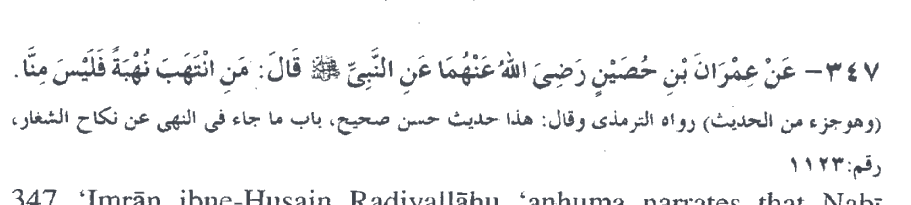
٣٤٧- عَنْ عِمْرَانَ بْنِ حُصَيْنٍ رَضِىَ اللّهُ عَنْهُمَا عَنِ النَّبِيّ قَالَ: مَنِ انْتَهَبَ نُهْبَةً فَلَيْسَ مِنّا
و هوجزء من الحديث! واه الترمذى وقال: هذا حديث حسن صحيح، باب ما جاء فى النهى عن نكاح الشغار،
رقم: ١١٢٣
Translation: 116. Abu Sa'Td Al KhudrT Radiyallahu 'anhu narrates that Rasulullah ﷺ said: He who believes in Allah and the Last Day should be hospitable to his guest, Rasulullah ﷺ said this three times. Someone asked: What is hospitality? He replied: Serve him for three days. If the guest stays beyond that, then entertaining him is an act of Sadaqah. (Musnad Ahmad)
Translation: 117. Miqdam Abu KarTmah Radiyallahu 'anhu narrates that Rasulullah ﷺ said: If the guest of people remains without hospitality till the morning, then it is the duty of every Muslim to help him, in taking from the crops and property of the host to the extent of the entertainment of one night. (Abu Dawud)
Note: This is a situation where there is.no provision with the guest and he is thus constrained. Otherwise out of kindness and courtesy fulfilling a guest's needs is his right. (Mazahir Haque)
📜حَدِيثٌ شَرِيفٌ
٣٥٠- عَنْ أَبِى الدَّرْدَاءِ رَضِى اللهُ عَنْهُ قالَ: قالَ رَسُولُ اللهِ : أَلَا أُخْبِرُ كُمْ بِأَفْضَلَ مِن رَجَةِ
الصّيَامِ وَالصَّلْوةِ وَالصَّدَقَةِ؟ قَالُوا: بَلْى، قَالَ: صَلَاحُ ذَاتِ الْبَيْنِ، فَإِنَّ فَسَادَ ذَاتِ الْبَيْنِ هِ
الْحَالِقَةً. رواه الترمذى وقال: هذا حديث صحيح، باب فى فضل صلاح ذات البين، رقم: ٢٥٠٩
Translation: 118. 'Abdullah ibne-'Ubaid ibne-*Umair Rahimahullah said that Jabir Radiyallahu 'anhu came to me with a group of the Sahabah of Rasulullah ﷺ. Jabir Radiyallahu 'anhu placed before them bread and vinegar and said: Eat, I have heard from Rasulullah ﷺ saying: Vinegar is the best curry. Verily a man is ruined, when some brothers come to his house and he considers it low to place before them things that he has in his house; and ruined are those people who consider low that is being placed before them. In another narration it is stated that it is evil enough for a person that he may consider low what is presented to him. (Musnad Ahmad, Tabarani, Abu Yaia, Majma'uz-Zawa'id)
📜حَدِيثٌ شَرِيفٌ
٣٥١- عَنْ حُمَيْدِ بْنِ عَبْدِ الرَّحْمُنِ عَنْ أَمَّهِ رَضِىَ اللّٰهُ عَنْهَا أَنَّ التَّبِىَّ قَالَ: لَمْ يَكْذِبْ مَنْ
تَمْى بَيْنَ الْنَيْنِ لِيُصْلِحَ. رواه أبو داوُد، باب فى إصلاح ذات البين، رقم: ٤٩٢٠
Translation: 119. Abu Hurairah Radiyallahu 'anhu narrates that Nabi ﷺ said: Indeed, Allah likes sneezing and dislikes yawning. So, when one of you sneezes, he should say Alhamdulilldh (Praise be to Allah). It is a right on every Muslim who hears him to say Yarhamukallah (may Allah have mercy on you) in reply. Indeed, yawning comes from Shaitan. So when one of you yawns, he should restrain himself as much as possible, as Shaitan laughs at the person Who yawns. (Bukhari)
Translation: 120. Abu Hurairah Radiyallahu 'anhu narrates that Rasulullah ﷺ said: Whosoever visits a patient or visits his Muslim brother, an angel says: You are blessed and your steps are blessed and you have made an abode in Paradise. (Tirmidhi)
Translation: 121. Thauban Radiyallahu 'anhu, a freed slave of Rasulullah ﷺ, narrates that Rasulullah ﷺ said: He who visits a patient dwells in the Khurfah of Paradise. It was asked: O Rasulullah! What is the Khurfah of Paradise? He replied: The harvested fruits of Paradise. (Muslim)
Translation: 122. Anas ibne-Malik Radiyallahu 'anhu narrates that Rasulullah ﷺ said: He who performs Wudu and performs it well, then visits his sick Muslim brother, seeking reward from Allah, he will be moved away a distance of seventy Kharlf from Hell. Thabit BananT Rahimahullah said: I asked Anas Radiyallahu 'anhu: O Abu Hamzah! What is Kharlf? He replied: A year. (Abu Dawud)
Translation: 123. Anas ibne-Malik Radiyallahu 'anhu narrates: I heard Rasulullah ﷺ saying: Whosoever visits a sick person enters into the Mercy of Allah, and when he sits with the sick he is completely immersed in His Mercy. Anas Radiyallahu 'anhu asked: O Rasulullah! This excellence is for the healthy person visiting the Sick, so what does the sick person get? Rasulullah ﷺ replied: His sins are forgiven. (Musnad Ahmad)
📜حَدِيثٌ شَرِيفٌ
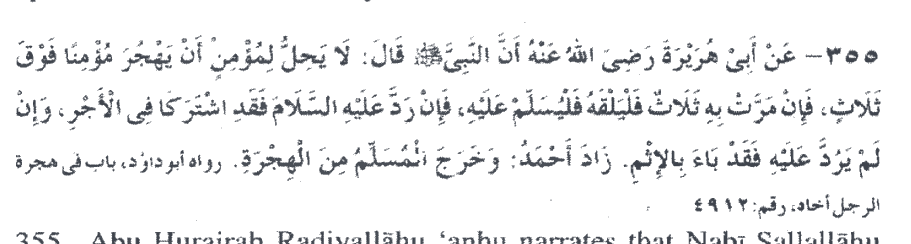
يَقُوْلُ : مَنْ هَجَرَ أَخَاهُ
٣٥٩- عَنْ أَبِىْ خِرَاشِ السُّلَمِيِّ رَضِىَ اللهُ عَنْهُ أَنَهُ سَمِعَ رَسُوْلَ اللهِ
سَنَةٌ، فَهُوَ كَسَفْكِ دَمِهِ. رواه أبو داوْد، باب فى هجرة الرجل أخاه، رقم: ٤٩١٥
Translation: 124. Ka'b ibne-Malik Radiyallahu 'anhu narrates that Rasulullah ﷺ said: He who visits a sick person enters into the Mercy of Allah; if he sits by his side, he is immersed in the Mercy. (Musnad Ahmad) 'Amr ibne-Hazm Radiyallahu 'anhu narrates: Even after leaving the sick, the visitor continues to be in the Mercy of Allah until he returns to the place from where he had come. (Tabarani, Majma'uz-Zawa'id)
Translation: 125. 'All Radiyallahu 'anhu narrates: I heard Rasulullah ﷺ saying: No Muslim who visits a sick Muslim in the morning except that seventy thousand angels invoke blessings on him till the evening; and if he visits him in the evening then seventy thousand angels invoke blessings on him till the morning and for him there is a garden of fruits in Paradise. (Tirmidhi)
📜حَدِيثٌ شَرِيفٌ
٣٦٢- عَنْ مُعَاذِ بْنِ جَبَلٍ رَضِىَ الله عَنْهُ عَن النَّبِىّ قَالَ: يَطّلِعُ اللّٰه إِلَى جَمِيْعِ خَلْقِهِ لَيْلَةَ
النَّصْفِ مِنْ شَعْبَانَ فَيَغْفِرُ لِجَمِيع خَلْقِهِ إِلَّا لِمُشْرِكِ أَوْ مُشَاحِنِ. رواه الطبرانى فى الكبير والأوسط
ورجالهما ثقات، مجمع الزوائد ١٢٦٨
Translation: 126. 'Umar ibnil Khattab Radiyallahu 'anhu narrates that Nabi ﷺ said: When you visit a sick person, ask him to supplicate for you, for verily his supplication is like that of the angels. (Ibne-Majah)
Translation: 127. 'Abdullah ibne-'Umar Radiyallahu 'anhuma narrates that while we were sitting with Rasulullah ﷺ, a man came and offered Sal am. When he was about to go back, Rasulullah ﷺ asked him: O Ansar brother! How is my brother Sa'd ibne-'Ubadah? The man replied: He is well. So Rasulullah ﷺ asked us: Who amongst you would like to visit him? Then, he stood up and we along with him. We were more than ten, who neither had shoes, nor stockings nor caps nor shirts. We walked through the stony plain till we came to him. The people of his tribe, who were with him withdrew and Rasulullah ﷺ along with those who accompanied him, came close to Sa'd. (Muslim)
Translation: 128. Abu Sa'Td Al KhudrT Radiyallahu 'anhu narrates that he heard Rasulullah ﷺ saying: The one who has done five deeds in a day, Allah Subhanahu wa Ta'ala, writes him amongst the dwellers of Paradise. One who visits a sick person, attends a funeral, fasts for a day, goes to offer Friday Salah and sets a slave free. (Ibn Hibban)
📜حَدِيثٌ شَرِيفٌ
٣٦٥- عَنْ أَبِىْ هُرَيْرَةَ رَضِىَ اللهُ عَنْهُ قال: قَالَ رَسُوْلُ اللهِ : لَيْسَ مِنَا مَنْ خَبَّبَ امرَأَةً عَلْى
زَوْجِهَا أَوْ عَبْدًا عَلَى سَيِّدِهِ . رواه أبو داوُد، باب فيمن خبب امراة على زوجها، رقم: ٢١٧٥
Translation: 129. Mu'adh ibne-Jabal Radiyallahu 'anhu narrates that Rasulullah ﷺ said: He who strives in the cause of Allah is under the security of Allah; he who visits a patient is under the security of Allah; he who goes to the masjid in the morning or evening is under the security of Allah; he who visits a ruler to help him is under the security of Allah; he who stays in his house and does not backbite anyone is under the security of Allah. (Ibn Hibban)
Translation: 130. Abu Hurairah Radiyallahu 'anhu narrates that Rasulullah ﷺ once asked us: Who is fasting today? Abu Bakr Radiyallahu 'anhu said: I am. Rasulullah ﷺ asked: Who followed a bier today? Abu Bakr Radiyallahu 'anhu said: I did. He asked: Who fed a poor person today? Abu Bakr Radiyallahu 'anhu replied: I did. He asked: Who visited a sick person today? Abu Bakr Radiyallahu 'anhu replied: I did. Rasulullah ﷺ then said: No one in whom these good deeds are combined except that he will enter Paradise. (Muslim)
📜حَدِيثٌ شَرِيفٌ
وقال تعالى
يطعِمُونَ الطّعًا
انّمَا نطعمُك
Translation: 131. Abdullah ibne 'Abbas Radiyallahu 'anhuma narrates that Nabi ﷺ said: Any Muslim slave of Allah visits a sick person, whose time of death has not come, and supplicates as under seven times, the sick person shall get cured. I ask Allah the Almighty, Rabb of the Mighty Throne, to cure you. (Tirmidhi)
Translation: 132. Abu Hurairah Radiyallahu 'anhu narrates that RasGIullah ﷺ said: He who follows the bier and offers the funeral Salat, will get a reward of a Qlrdt, and he who attends the funeral until its burial will get a reward of two Qirdt. It was asked: What are two Qirdt? He replied: Equivalent to two huge mountains. It is narrated at another place: Of the two mountains, the smaller one is like Mount Uhud. (Muslim)
Translation: 133. 'A'ishah Radiyallahu 'anha narrates that Nabi ﷺ said: If the company of Muslims reaches -hundred in number and they pray over a dead person, all of them interceding for him, their intercession for him will be accepted. (Muslim)
📜حَدِيثٌ شَرِيفٌ
يُوْجِبُ الْجَنَة؟ قَالَ: عَلَيْكَ بِحُسْنِ الْكَلَامِ وَبَذْلِ الطَّعَامِ. رواه الحاكم وقال: هذا حديث مستقيم وليس
له علة ولم يخرجاه ووافقه الذهبى ٢٣١
Translation: 134. 'Abdullah Radiyallahu 'anhu narrates that Nabi ﷺ said: Anyone who consoles an afflicted person, will have a reward equivalent to his. (Tirmidhi)
Translation: 135. Muhammad ibne-'Amr ibne-Hazm Radiyallahu 'anhu narrates that Nabi ﷺ said: No believer comforts his brother in distress, except that Allah Subhanahu wa Ta'ala clothes him with a dress of nobility on the Day of Reckoning. (Ibne-Majah)
Translation: 136. Umme Salamah Radiyallahu 'anha narrates that Rasulullah ﷺ came after Abu Salamah' s death, whose eyes were open. Closing his eyes, he said: Verily, when the soul is taken up, the eyes follow it (and therefore remain open). Some of his family members wept and wailed (they may have said some unwanted words). He said: Do not supplicate for yourself anything but good; undoubtedly the angels say AmTn to what you say. Then he supplicated: O Allah! Forgive Abu Salamah, raise his rank amongst those who are rightly guided, and You be the Caretaker of his descendants after him. Forgive him and us; O Rabb of the universe, make his grave spacious for him and grant him light in it (Muslim)
Note: Whenever someone supplicates this for another Muslim, he may take the name of the demised in place of the name of Abu Salamah,
📜حَدِيثٌ شَرِيفٌ
كودوا
شعَرِىّ رَضِىَ اللهُ عَنْهُ عَنِ النّبِىِّ فَ قالَ: أَطْعِمُوا الْجَادِ
الْمَريْضَ، وَفُكّوا الْعَانِيَ. رواه البخارى، باب قول اللّٰه تعالى: كلوا من طيبات ما رزقنكم ٠٠٠٠، رقم: ٥٣٧٣
Translation: 137. Abu Darda' Radiyallahu 'anhu narrates that Nabi ﷺ said: A Muslim's supplication in the absence of his brother is accepted. An angel is stationed at his head; whenever he makes a supplication for the good of his brother, this angel says: AmTn and may you receive the same. (Muslim)
Translation: 138. Anas Radiyallahu 'anhu narrates that Nabi ﷺ said: None of you is a true believer, until he likes for his brother what he likes for himself. (Bukhari)
Translation: 139. Khalid ibne- 'Abdullah QasarT Rahimahullah narrates from his father and his grandfather Radiyallahu 'anhu that RasQlullah ﷺ asked them: Do you love Paradise? I replied: Yes. Rasulullah ﷺ said: Like for your brother what you like for yourself, (Musnad Ahmad)
📜حَدِيثٌ شَرِيفٌ
٣٨٠- عَنِ ابْنِ عَبَّاسٍ رَضِىَ اللهُ عَنْهُمَا قَالَ: سَمِعْتُ رَسُوْلَ اللهِ يَقُوْلُ: مَا مِنْ مُسْلِمٍ كَسَا
مُسْلِمًا ثَوْبًا إِلَّا كَانَ فِيْ حِفْظِ اللهِ مَا دَامَ مِنْهُ عَلَيْهِ خِرْقَةٌ. رواه الترمذى وقال: هذا حديث حسن غريب،
باب ما جاء فى ثواب من كسا مسلما، رقم: ٢٤٨٤
Translation: 140. Abu Hurairah Radiyallahu 'anhu narrates that Rasulullah ﷺ said: Verily, Deen (religion) is NasThah (sincere wellwishing) verily Deen is NasThah, verily Deen is NasThah. The Sahabah asked: To whom O Rasulullah? He replied: To Allah, and His Book, and His Messenger, and to the rulers of the Muslims and their common folk. (Nasa'i)
Note: Sincere well-wishing for Allah stands for belief in Allah, fervent love for Him, to fear Him, to obey and worship Him and to ascribe no partners to Him. Sincere well-wishing for the Book of Allah means belief on it, giving it the respect it deserves, acquiring and spreading its knowledge and acting upon it. Sincere well-wishing for the Prophet means testifying to his prophethood, honouring him, loving and practicing his Sunnah, spreading his message and believing with heart and soul that our salvation lies in his obedience. Sincere well-wishing to the rulers of the Muslims means that they be assisted in the discharge of their responsibilities and to have a good opinion about them. They should be obeyed in right things. However if they make mistakes, attempts should be made to rectify them and they be given good counselling. Sincere well-wishing to the common folk is to look after their good and welfare. This includes bringing them towards Deen with sincerity and kindness. To teach them Deen and to inspire them towards righteousness. To consider their benefit ones own benefit and their loss ones own loss. To help them as far as possible and to fulfil their rights. (Nawawi)
📜حَدِيثٌ شَرِيفٌ
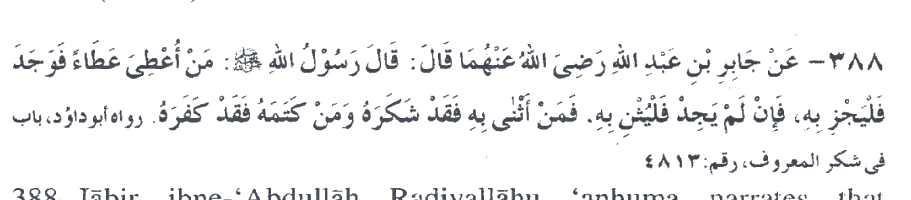
٣٨٨- عَنْ حَارِقَةَ بْنِ التُّعْمَانِ رَضِىَ اللهُ عَنْهُ قَالَ: قَالَ رَسُوْلُ اللهِ : مُنَاوَلَةُ الْمِسْكِينِ فَقِىْ
مِيْتَةَ السَّوْءِ. رواه الطبرانى فى الكبير والبيهقى فى شعب الإيمان والضياء وهو حديث صحيح، الجامع
الصغير ٦٥٧
Translation: 141. Thawban Radiyallahu 'anhu narrates that Rasulullah ﷺ said: My pond extends from Aden to Amman. Its bowls are equivalent to the stars in the sky. Its water is whiter than snow and sweeter than honey. The first to come on the pond will be the poor emigrants. We asked: O Rasulullah! Describe them to us? Rasulullah ﷺ replied: Those with dishevelled hair, and dirty clothes, who cannot marry women living in luxury. For whom doors are not opened. They fulfil the rights of others, while their own rights are not given to them. (Tabarani, Majma'uz-Zawaid)
Note: Aden is a famous city in Yemen and Amman is a well known city of Jordan. The words Aden and Amman are used only for the purpose of signs in this hadith. This, however, does not imply that the area of the pool is exactly the distance as referred to, but it is only to facilitate understanding, that the length and width of the pond spreads over hundreds of miles. (Ma'ariful HadTth)
Translation: 142. Hudhaifah Radiyallahu 'anhu narrates that Rasulullah ﷺ said: Do not immitate others and start saying if others treat us well, we will treat them well, and if they do wrong to us, we will do wrong to them; but accustom yourself to do good if people do good, and not to do wrong if they do wrong, (Tirmidhi)
Translation: 143. 'A'ishah Radiyallahu 'anna narrates that Rasulullah ﷺ never revenged in his personal affairs, however, when Allah's lawful bindings were violated, he would punish for the sake of Allah. (Bukhari)
📜حَدِيثٌ شَرِيفٌ
٣٨٤- عَنْ جَابِرِ رَضِىَ اللهُ عَنْهُ أَنّ رَسُوْلَ اللهِ ي قَالَ: مَنْ أَحْيِي أَرْضًا مَيْنَةً، فَلَهُ فِيْهَا أَجْرٌ
لحديث رواه ابن حبان، قال المحقق: إسناده على شرط مسلم ٦١٥١١
Translation: 144. 'Abdullah ibne-'Umar Radiyallahu 'anhuma narrates that Rasulullah ﷺ said: Indeed when a slave is faithful to his master and worships Allah well, then he gets a double reward. (Muslim)
Translation: 145. Tmran ibne-Husain Radiyallahu 'anhuma narrates that Rasulullah ﷺ said: When anyone has something due to him from another, he will be credited with (reward of) Sadaqah for every day allowed to postpone payment. (Musnad Ahmad)
Translation: 146. Abu Musa Al Ash 'an Radiyallahu 'anhu narrates that Rasulullah ﷺ said: Undoubtedly reverence to Allah includes honouring a grey haired Muslim; and also the one who has memorised the Qur'an and he neither exceeds the proper bounds and nor does he turn away from it; and honouring a just ruler. (Abu Dawud)
Note: The man who has memorised the Qur'an ought to be regular in recitation, and makes no excesses in pronouncing its verses for name and fame. (Badhl-ul-Majhud)
Translation: 147. Abu Bakr Radiyallahu 'anhu narrates: I heard Rasulullah ﷺ saying: He who honours a king appointed by Allah Tabaraka wa Ta'ala in the world, Allah will honour him on the Day of Resurrection. He who dishonours a king appointed by Allah 'Azza wa Jail in the world, Allah will dishonour him on the Day of Resurrection. (Musnad Ahmad, Tabarani, Majma'uz-Zawaid)
📜حَدِيثٌ شَرِيفٌ
لَا يَجْتَمِعُ الشِّحُّ وَالإِيْمَانُ فِ
٣٨٩- عَنْ أَبِىْ هُرَيْرَةَ رَضِىَ اللهُ عَنْهُ قَالَ: قَالَ رَسُوْلُ اللهِ
قَلْبِ عَبْدٍ أَبَدًا . !و هو جزء من الحديث واه النسانى، باب فضل من عمل فى سبيل الله ٠ ٠ ٠ ٠، رقم: ٣١١٢
Translation: 148. Abdullah ibne 'Abbas Radiyallahu 'anhuma narrates that Rasulullah ﷺ said: Blessings are with your elders. (Mustadrak Hakim)
Note: This means that those of old age have done more virtues and as such, they are more blessed. (Hashiyatut TarghTb)
📜حَدِيثٌ شَرِيفٌ
٣٩٠ - عَنْ أَبِىْ بَكْرِ الصَّدّيْقِ رَضِىَ اللهُ عَنْهُ عَنِ النَّبِيِّ
قَالَ: لَا يَدْخُلُ الْجَنَّةَ خَبٌّ وَلَا بَخِيْلٌ
وَلَا مَنَّانٌ . رواه الترمذى وقال: هذا حديث حسن غريب، باب ما جاء فى البخل، رقم: ١٩٦٣
Translation: 149. 'Ubada ibne-Samit Radiyaliahu 'anhu narrates that Rasulullah ﷺ said: He is not amongst my followers who neither shows respect to our elders, nor mercy to our youngsters and does not recognise the rights of our Alim (scholar). (Musnad Ahmad, Tabarani, Majma'uz-Zawa'id)
📜حَدِيثٌ شَرِيفٌ
قال اللهُ تعالى
بَلَىٰ مَنْ أَسْلَمَ وَجْهَهُ لِلَّهِ وَهُوَ مُحْسِنٌ
فَلَهُ أَجْرُهُ عِندَ رَبِّهِ وَلَا خَوْفُ عَلَيْهِمْ
وَلَا هُمْ يَحْزَنُونَ
البقرة: ١١٢
وقال تعالى
وَمَا تُنْفِقُونَ إِلَّا ابْتِفَآءَ وَجْهِ اللَّهِ
البقرة: ٤(٢٧٢
وقال تعالى
وَمَن يُرِدْ ثُوابَ
Translation: 150. Abu Umamah Radiyaliahu 'anhu narrates that Rasulullah ﷺ said: I advise my Caliph to follow after me to fear Allah, and I advise him with regard to the Jama 'at of Muslims to be respectful to their elders, and merciful to their youngsters, and to honour their 'Mama (scholars). He should not beat them so much that they are humiliated; he should not frighten them so as to make them infidels; he should not castrate them so as to finish their race; he should not shut the doors for their complaints, otherwise the strong will overpower the weak. (Baihaqi)
📜حَدِيثٌ شَرِيفٌ
الْأَخِرَةِ نُؤْتِهِ، مِنْهَا
وَسَنَجْزِى الشَّكِرِينَ
آل عمران: ١٤٥
وقال تعالى
وَمَا أَسْتَلْكُمْ عَلَيْهِ مِنْ أَجْرِ إِنْ أَجْرِىَ إِلَّا
عَلَى رَبِّ ٱلْعَلَمِينَ ٥٤ الشعراء: ١٤٥)
وقال تعالى
وَمَا انَيْتُم مِن زَكَومٍ تُرِيدُونَ وَجْهَ اللَّهِ
فَأُوْلَاتيِكَ هُمُ ٱلْمُضْعِقُونَ (٠) الروم: ٣٩)
وقال تعالى
وَأَدْعُوهُ مُخْلِصِينَ لَهُ ٱلدِّينَ االاعراف: ٢٩
Translation: 151. 'A'ishah Radiyaliahu 'anha narrates that Rasulullah ﷺ said: Forgive people of good qualities on their lapses, but not those faults to which prescribed penalties apply. (Abu Dawud)
📜حَدِيثٌ شَرِيفٌ
وقال تعالى
لَن يَنَالَ اللَّهَ لُحُومُهَا وَلَا بِمَاؤُهَا وَلَٰكِن
يَنَالُهُ التَّقْوَىٰ مِنكُمْ لمح: ٣٧
Translation: 152. 'Abdullah ibne-'Amr Radiyallahu 'anhuma narrates that Nabi ﷺ prohibited plucking of grey hair and said: Undoubtedly, the old age is the Nur (light) of a Muslim. (Tirmidhi)
📜حَدِيثٌ شَرِيفٌ
إِنَّ اللهَ لَا يَنْظُرُ إِلَى صُوَرِكُمْ
١- عن أبِي هريرة رضى الله عَنْهُ قال: قال رسول اللّهِ
وَأَمْوَ الِكُمْ، وَلْكِنْ يَنْظُرُ إِلَى قُلُوْبِكُمْ وَأَعْمَالِكُمْ. رواه مسلم، باب تحريم ظلم المسلم٠ ، رقم: ٦٥٤٣
Translation: 153. Abu Hurairah Radiyallahu 'anhu narrates that Rasulullah ﷺ said: Do not pluck out grey hair. Indeed, they will be a Nur (light) on the Day of Resurrection. He who ages with grey hair in Islam, then for each grey hair a good deed will be written, a sin will be wiped out and he will be elevated in rank for it. (Ibn Hibban) 154. 'Abdullah ibne-4Umar Radiyallahu 'anhuma narrates that Rasulullah ﷺ said: Indeed, Allah blesses certain people with special bounties for the benefit of other people. As long as they benefit others, Allah continues His bounties upon them but when they stop benefitting others, Allah takes these bounties back from them and transfers to others. (Tabarani, Hulyat-ul-
Translation: 155. Abu Dhar Radiyallahu 'anhu narrates that Rasulullah ﷺ said: Smiling at your brother is Sadaqah (charity); enjoining good and forbidding from evil is Sadaqah; directing someone who has lost his way is Sadaqah; guiding a man with poor eyesight is Sadaqah; removing stones, thorns and bones from the path is Sadaqah; and pouring water from your bucket into your brother's bucket is Sadaqah. (Tirmidhi)
📜حَدِيثٌ شَرِيفٌ
وَآخِرِهِمْ وَفِيْهِمْ أَسْوَاقِهُمْ وَمَنْ ليْسَ مِنْهُمْ؟ قالَ: يُخْسَفُ بِأوَّلِهِمْ وَآخِرِهِمْ، ثُمَّ يُبْعَثُوْنَ عَلَى
نِيَّاتِهِمْ. رواه البخارى، باب ما ذكر فى الأسواق، رقم: ٢١١٨
قَالَ: لَقَدْ تَرَكْتُمْ بِالْمَدِيْنَةِ أَقْوَامًا ما
٥- عَنْ أَنَسِ بْنِ مَالِكِ رَضِىَ اللهُ عَنْهُ أَنَ رَسُوْلَ اللهِ
سِرْتُمْ مَسِيْرًا، وَلَا أَنْفَقْتُمْ مِنْ نَفَقَةٍ، وَلَا قَطَعْتُمْ مِنْ وَادِ إِلَّا وَهُمْ مَعَكُمْ فِيْهِ، قَالُوا: يَا رَسُوْلَ اللهِ
وَكَيْفَ يَكُوْنُونَ مَعَنَا وَهُمْ بِالْمَدِيْنَةِ؟ قَالَ: حَبَسَهُمُ الْعُذرُ. رواه أبوداوُد، باب الرخصة فى القعود من
العذر ، رقم : ٢٥٠٨
Translation: 156. Ibne- 'Abbas Radiyallahu 'anhuma narrates that Nabi ﷺ said: Going out for a brother's need is better than ten years Vtikaf (confining oneself to a masjid exclusively for the worship of Allah). He who observes Vtikaf of one day for Allah's sake, three trenches are placed between him and Hell; each trench is wider than the distance between the earth and the sky. (Tabarani, Majma'uz-Zawa'id)
Translation: 157. Jabir ibne- 'Abdullah and Abu Talhah ibne-Sahl Al Ansari Radiyallahu 'anhum narrate that Rasulullah ﷺ said: No Muslim will desert a man who is confronted with a situation where his respect and honour is being violated but Allah Subhanahu wa Ta'ala will desert him in a situation when he will be in need of His help. And no Muslim will help a Muslim in a situation when his respect and honour is being violated, but Allah will help him in a situation when he will be in need of His help. (Abu Dawud)
Translation: 158. Hudhaifah ibnil-Yaman Radiyallahu 'anhu narrates that Rasulullah ﷺ said: He who is not concerned about the affairs of Muslims is not amongst them. He, who does not pass the morning and evening in a state of sincerity and faithfulness to Allah, His Prophet, His Book, and to the rulers of the Muslims and their common folk, is not amongst them. (Tabarani, TarghTb)
Translation: 159. 'Abdullah ibne-'Umar Radiyallahu 'anhuma narrates that Nabi Sallallahu"alaihi wasallam said: He who is engaged in fulfilling his brother's need, Allah will fulfil his needs. (Abu Dawud)
Translation: 160. Anas Radiyallahu 'anhu narrates that Nabi Sallallahu * alaihi wasallam said: He who guides towards good, gets the same reward as the one doing a good deed; and Allah likes helping a man in distress. (Bazzar, TarghTb)
Translation: 161. Jabir Radiyallahu 'anhu narrates that Rasulullah ﷺ said: A believer loves and is loved. There is no good in the one who neither loves nor is loved. The best amongst people is the one who benefits people the most. (Dar Qutni, Jami 'usSaghTr)
Translation: 162. Abu MQsa Al Ash'arT Radiyallahu 'anhu narrates that Nabi ﷺ said: Every Muslim is enjoined to give Sadaqah. He was asked: If one has nothing? He replied: Then he should labour with his own hands to benefit himself and give Sadaqah (as well): The Sahabah asked: If he cannot or does not work? He said: Then he should help the needy and the distressed person. The Sahabah asked further: If he does not do it? He said: Then he should enjoin others what is good. It was said: If he does not do it? He said: Then he should refrain from harming someone; this is (also) a Sadaqah for him. (Bukhari)
📜حَدِيثٌ شَرِيفٌ
١٥- عَنْ زَيْدِ بْنِ ثَابِتٍ رَضِىَ اللهُ عَنْهُ عَنِ النَّبِى قالَ: ثَلَاثُ خِصَالٍ لَا يَغِلّ عَلَيْهِنّ قَلْبُ
مُسْلِمِ: إِخْلَاصُ الْعَمَلِ لِلهِ، وَمُنَاصَحَةُ أَلَاةِ الْأَمْرِ، وَلُزُوْمُ الْجَمَاعَةِ فَإِنَّ دَعْوَتَهُمْ تُحِيْطُ مِنْ
وَرَاءِهِمْ. و هو بعض الحديث واه ابن حبان، قال المحقق: إسناده صحيح ٢٧٠١
Translation: 163. Abu Hurairah Radiyallahu 'anhu narrates that Rasulullah ﷺ said: A believer is a believer's mirror; and a believer is a believer's brother, who guards him against loss and protects him in all aspects in his absence. (Abu Dawud)
📜حَدِيثٌ شَرِيفٌ
مَصَائِيْحُ الدَّ جى، تَتَجَلَّى عَنْهُمْ كُلُّ فِئْنَةٍ ظَلْمَاءَ. رواه اليهقى فى شعب الإيمان ٣٤٣٥
Translation: 164. Anas Radiyallahu 'anhu narrates that Rasulullah ﷺ said: Help your Muslim brother whether he is an oppressor or is oppressed. A man asked: O Rasulullah! I will help him when he is oppressed, but how can I help him when he is an oppressor? He replied: You stop or prevent him from oppression for indeed that is your help to him. (Bukhari)
📜حَدِيثٌ شَرِيفٌ
١٧- عَنْ أَبِىْ فِرَاسِ رَحِمَهُ اللّهُ رَجُلِ مِنْ أَسْلَمَ قَالَ: نَادُى رَجُلٌ فَقَالَ: يَارَسُوْلَ اللهِ! مَا
الْإِيْمَانُ؟ قَالَ: الْإِخْلَاصُ. )وهو جزء من الحديث! !واه البيهقى فى شعب الإيمان ٣٤٢٥
Translation: 165. 'Abdullah ibne-'Amr Radiyallahu 'anhuma narrates that Nabi ﷺ said: Allah the Compassionate bestows mercy upon the merciful people. So, have mercy upon the inhabitants of the earth, the One in the Heaven will be merciful to you. (Abu Dawud)
📜حَدِيثٌ شَرِيفٌ
١٨ - عَنْ أَبِيْ أُمَامَةَ رَضِىَ اللهُ عَنْهُ قَالَ: قَالَ رَسُوْلُ اللهِ : صَدَقَةُ السَّرَّ تُطْفِيُ غَضَبَ الرَّبِّ
(وهو طرف من الحديث رواه الطبرانى فى الكبير وإسناده حسن، مجمع الزوائد ٢٩٣٣
Translation: 166. Jabir ibne- 'Abdullah Radiyallahu 'anhuma narrates that Rasulullah ﷺ said: All meetings are (confidential) trusts except three: Those for the purpose of shedding blood unlawfully or committing fornication or grabbing other's property unjustly. (Abu Dawud)
Note: It is not permissible to leak the secrets of a meeting. The three things that are mentioned in the hadfth are for the purpose of illustration only. The objective is that, if in a meeting there is conspiracy for wrong or evil and you happen to participate in it, then never keep such matters secret. (Ma'ariful Hadith)
📜حَدِيثٌ شَرِيفٌ
١٩- عَنْ أَبِىْ ذَرِّ رَضِىَ اللهُ عَنْهُ قَالَ: قِيْلَ لِرَسُوْلِ اللهِ : أَرَأَيْتَ الرَّجُلَ يَعْمَلُ الْعَمَلَ مِنَ
الْخَيْر وَيَحْمَدُهُ النَّاسُ عَلَيْهِ؟ قَالَ: تِلْكَ عَاجِلُ بُشْرَى الْمُؤْمِنِ. رواه مسلم، باب إذا أثنى على
الصالح ٠٠٠٠ ، رقم: ٦٧٢١
Translation: 167. Abu Hurairah Radiyallahu '6anhu narrates that Rasulullah ﷺ said: The believer is one from whom people are safe in respect to their lives and wealth. (Nasar)
Translation: 168. 'Abdullah ibne-'Amr Radiyallahu 'anhuma narrates that Nabi ﷺ said: A Muslim is the one from whose tounge and hands, other Muslims are safe, and a Muhajir (emigrant) is the one who abandons all that Allah has forbidden. (Bukhari) - VH
Translation: 169. Abu MQsa Radiyallahu 'anhu narrates that the Sahabah asked: O Rasulullah! Whose Islam is the best? He replied: From whose tongue and hands, other Muslims are safe. (Bukhari)
Note: Causing trouble with the tongue includes jesting, accusing, rebuking, while causing trouble with hands includes beating unjustly, grabbing other's wealth and property wrongfully and the like. (Fath-uI-BarT)
📜حَدِيثٌ شَرِيفٌ
٢٣- عَنْ مَعْنِ بْنِ يَزِيْدَ رَضِىَ اللهُ عَنْهُمَا قَالَ: كَانَ أَبِىْ يَزِيْدُ أَخْرَجَ دَنَانِيْرَ يَتَصَدَّقُ بِهَا،
فَوَضَعَهَا عِنْدَ رَجُلٍ فِي الْمَسْجِدٍ، فَجِئْتُ فَأَخَذْتُهَا فَأَتَيْتُهُ بِهَا، فَقَالَ: وَاللهِ! مَا إِيَّاكَ أَرَدْتُ،
فخاصَمْتُهُ إِلى رَسُوْلِ اللهِ فَقَالَ: لَكَ مَا نَوَيْتَ يَا يَزِيْدُ! وَلَكَ مَا أَخَذْتَ يَا مَعْنُ! رواه البخارى،
باب إذا تصدق على ابنه وهو لا يشعر ، رقم: ١٤٢٢
Translation: 170. 'Abdullah ibne-Mas'ud Radiyallahu 'anhu narrates that Rasulullah 'alaihi wasallam said: He, who helps his people in an unrighteous cause, is like a camel that falls into a well and is being pulled out by us tail. (Abu Dawud)
Note: Pulling out a camel by its tail is an exercise in futility, because a camel cannot be pulled out from a well"like this. Similarly, helping people unjustly is equally futile, for people cannot be put on the right track like this. (Badhl-uI-Majhud)
Translation: 171. Jubair ibne-Mut'im Radiyallahu 'anhu narrates that Rasulullah ﷺ said: He is not from us who calls towards Asabiyyah. He is not from us who fights out of 'Asabiyyah and he who dies upholding Asabiyyah. (Abu Dawud)
Note: 'Asabiyyah means fanatical association on the basis of language, tribe, race or nation.
Translation: 172. Fusailah Rahimahallah narrates: I heard my father that he asked: O Rasulullah! Is it from Asabiyyah that a man loves his people? He said: No, but a man helps his people in their wrong doing is from 'Asabiyyah (partisanship). (Musnad Ahmad)
Translation: 173. 'Abdullah ibne-'Amr Radiyallahu 'anhuma narrates that Rasulullah ﷺ was asked: Who is the most excellent amongst people? He replied: Everyone whose heart is Makhmum and tongue is truthful. The Sahabah asked: We understand whose tongue is truthful, but what does a Makhmum heart mean? He replied: The one who is a Muttaqi (fearful of Allah) is pure of heart, free of sins and without injustice, hatred or jealousy for any one, (Ibne-Majah)
Note:"A pure heart,"means a heart without any attachment for anyone except Allah. (Mazahir Haque)
Translation: 174. 'Abdullah ibne-Mas'ud Radiyallahu 'anhu narrates that Rasulullah ﷺ said: None of my Sahabah should convey to me anything (wrong) about anyone for indeed I would like to come out to you with a pure heart (free of ill feelings). (Abu Dawud)
📜حَدِيثٌ شَرِيفٌ
٢٨- عَنْ أَبِىْ أَمَامَةَ رَضِىَ اللهُ عَنْهُ عَنِ النَّبِيَّ ه قَالَ: يَقَوْلُ اللهُ سُبْحَانَهُ: ابْنَ آدمَ إِنْ صَبَرْتَ
وَاحْتَسَبْتَ عِنْدَ الصَّدْمَةِ الْأُوْلُى، لَمْ أَرْضَ لَكَ ثَوَابًا دُوْنَ الْجَنَّةِ. رواه ابن ماجه، باب ما جاء فى الصير
على المصيبة، رقم: ١٥٩٧
Translation: 175. Anas ibne-Malik Radiyallahu lanhu narrates that while we were sitting with Rasulullah Sallallahu 4alaihi wasallam, he said: A dweller of Paradise will come to you now. Then a man from Ansar came, from whose beard drops of water of ablution were falling and he was holding his shoes in his left hand. The second day Nabi ﷺ repeated his words as the same AnsarT came in the same condition he had come the first day. The third day Nabi ﷺ repeated the same words as that SahabT came in the same condition. When Nabi ﷺ stood up, 'Abdullah ibne-'Amr Radiyallahu 'anhuma followed that AnsarT to his house and said to him: I had a quarrel with my father and have vowed that I will not go to him for three days. If you allow, let me stay at your house till my oath is fulfilled? He said: Very well. Anas Radiyallahu 'anhu narrates: 'Abdullah mentioned that he spent three nights with that AnsarT but did not see him worshipping at night, except that when he awoke and changed his side on the bed, he praised Allah 'Azza wa Jail and said: Allahuakbar (Allah is the Greatest), until he got up for Saldt-ul-Fajr from his bed. 'Abdullah said: I did not hear him say anything except good. When three nights had passed and I considered his deeds to be quite ordinary, I said to the AnsarT; O slave of Allah! There was no quarrel and separation between me and my father but I heard Rasulullah ﷺ saying that the dweller of Paradise is coming to us and you came out on all three occasions. So, I decided to stay with you and see what (special) deed you perform? However, I did not see you doing anything extraordinary. What is that deed which raised you to the rank mentioned by Rasulullah ﷺ? The AnsarT replied: I have no deeds except that which you saw. * Abdullah Radiyallahu 'anhu said: When T turned to go away, the AnsarT called me back and said: I do not have any (special) deeds except for the ones you have seen. However I have no ill feelings in my heart about any Muslim and I am not jealous of anyone to whom Allah has granted a bounty. 'Abdullah Radiyallahu 'anhu said: This is that which has raised you to that rank, and this is that which is beyond our ability. (Musnad Ahmad, Bazzar, Majma'uz-Zawaid)
📜حَدِيثٌ شَرِيفٌ
قَالَ: إِذَا أَنْفَقَ الرَّجُلُ عَلَى أَهْلِهِ يَحْتَسِبُهَ
، عَن النّبِيِّ ف
و مَسْعُوْدٍ رَضِىَ اللَّهُ
فَهُوَ لَهُ صَدَقَةٌ. رواه البخارى، باب ما جاء ان الأعمال بالنية والحسبة، رقم: ٥٥
Translation: 176. Abu Hurairah Radiyallahu 'anhu narrates that Rasulullah ﷺ said: If anyone removes one of the anxieties of a distressed person in this world, Allah will remove one of the anxieties of the Hereafter from him. If anyone conceals a fault of a Muslim, Allah will conceal his faults in the Hereafter. Allah keeps helping a man, so long he keeps helping his brother. (Musnad Ahmad)
📜حَدِيثٌ شَرِيفٌ
٣٠- عَنْ سَعْدِ بْنِ أَبِىْ وَقَاصٍ رَضِىَ اللهُ عَنْهُ أَنّ رَسُوْلَ اللهِ
قَالَ: إِنَّكَ لَنْ تُنْفِقَ نَفَقَةَ تَبْتَغِىْ بِهَا
وَجْهَ اللهِ إِلَّا أَجِرْتَ عَلَيْهَا حَتّى مَا تَجْعَلُ فِيْ فَمِ امْرَأَتِكَ. رواه البخارى، باب ما جاء أن الأعمال بالنية
والحسبة، رقم : ٥٦
Translation: 177. Abu Hurairah Radiyallahu 'anhu narrates: I heard Rasulullah ﷺ saying: There were two friends in Bani IsraTl; one of them was sinful and the other was devout. Whenever the devout saw his friend committing a sin, he would ask him: Refrain from it. One day, when he saw him committing a sin, he asked him to desist from it; the sinful said: Leave me to my Rabb. Have you been sent as my supervisor? The devout-one said; I swear by Allah! Allah will not forgive you or you will not be sent to Paradise. When both of them died, they were raised before Rabb-al- ' AlamTn. Allah asked the devout: Did you know about Me or did you acquire My authority and stop Me from forgiving the sinful? So, Allah said to the sinful: Go and enter into Paradise by grace of My Mercy, and commanded (the angels) about the devout: Take him to the Fire. (Abu Dawud)
Note: The hadlth does not imply that one should dare to commit sins. The sinful was forgiven by the Mercy of Allah, but it is not necessary that every sinful person be treated in the same way. As a principle, there is a punishment for every sin. Nor does it mean that people should not be stopped from doing evils and wrongs. In Qur'an and hadith, there are hundreds of places, where there are commands to stop people from doing evil; and warnings against not forbidding evil. However, the message to be conveyed is that a pious person should neither rely on his own good deeds nor pass judgements on the sinful nor consider himself to be superior to them.
Translation: 178. Abu Hurairah Radiyallahu 'anhu narrates that Rasulullah Sallallahu"alaihi wasallam said: A person sees a straw in the eye of his brother, but neglects to see a log in his own eye. (Ibne-Hibhan)
Note: This refers to the fact that » people notice the small faults of others, but remain ignorant of their own big mistakes. 179, Abu Rafi* Radiyallahu 'anhu narrates that Rasulullah ﷺ said: He who bathes a deceased and conceals his faults, Allah forgives his forty major sins. He who digs a grave for his deceased brother and buries him, it is as if he has arranged for his residence until he is resurrected (this man is rewarded as much as he would get for providing a residence for a man till the Day of Resurrection). (Tabarani, Majma'uz-Zawa'id)
📜حَدِيثٌ شَرِيفٌ
لِإِحْدَاكُنَّ ثَلَاثَةٌ مِنَ الْوَلَدِ فَتَحْتَسِبَهُ، إِلَّا دَخَلَتِ الْجَنَّةَ، فَقَالَتِ امْرَأَة مِنْهُنَّ: أَوِ الْنَانِ؟ يَا رَسُوْلَ
اللهِ! قَالَ: أَوِ اثْنَانِ. رواه مسلم، باب فضل من يموت له ولد فيحتسبه، رقم: ٦٦٩٨
Translation: 180. Abu Rafi' Radiyallahu 'anhu narrates that Rasulullah ﷺ said: He who bathes a deceased and hides his faults is forgiven forty times. He who enshrouds the deceased, Allah will dress him in garments made of the fine and thick silk of Paradise. (Mustadrak Hakim)
📜حَدِيثٌ شَرِيفٌ
قال اللهُ تعالى
وَإِذَا قَامُواْ إِلَى الصَّلَوةِ قَامُوا كُسَالَىٰ
يُرَآءُونَ النَّاسَ وَلَا يَذْكُرُونَ اللَّهَ إِلَّا
قَلِيلًا
النساء: ١١٤٢
وقال تعالى
فَوَيْلٌ لِلْمُصَلِّينَ
الَّذِينَ هُمْ عَن صَلَاتِهِمْ سَاهُونَ
الَّذِينَ هُمْ يُرَاءُونَ
لالماعون
Translation: 181. Abu Hurairah Radiyallahu 'anhu narrates that Nabi ﷺ said: A person set out to visit his (Muslim) brother in another village, Allah sent an angel to wait for him on his way. When this man reached the angel he asked: Where are you heading? He replied: I am heading for a brother of mine in this village. The angel asked: Does he owe you something, which you want to get back? The man replied: No. I just love him for the sake of Allah 'Azza wa Jail. The angel said: I am Allah's messenger to you, indeed Allah loves you just as you love him for His sake. (Muslim)
Translation: 182. Abu Hurairah Radiyallahu 'anhu narrates that Nabi ﷺ said: He who wishes to acquire the taste of Iman, should love another Muslim, only for the pleasure of Allah 'Azza wa Jail. (Musnad Ahmad, Bazzar, Maj ma- 4uz-Zawaid)
Translation: 183. 'Abdullah ibne-Mas'ud Radiyallahu 'anhu narrates that Rasulullah ﷺ said: Verily, it is among the signs of Iman that a person loves another person purely for the pleasure of Allah, even though the other one may not have given him any wealth; This is undoubtedly Iman. (Tabarani, Majma'uz-Zawa'id)
Translation: 184. Anas Radiyallahu 'anhu narrates that Rasulullah ﷺ said: No two persons who love each other for the sake of Allah except that the one who loves his brother rriore is better, (Mustadrak Hakim)
Translation: 185. 'Abdullah ibne-'Amr Radiyallahu 'anhuma narrates that Rasulullah ﷺ said: He who loves someone for the sake of Allah and says: Indeed I love you for the sake of Allah, then both of them will enter Paradise. The one who loves will have a higher rank than the other, and will deserve that position because of his love for the sake of Allah. (Bazzar, TarghTb)
📜حَدِيثٌ شَرِيفٌ
عَنْهُ، وَأَرْضى عَنْهُ مَنْ أَسْخَطَهُ فِيْ رِضَاهُ حَتْى يَزِيْنَهُ وَيَزِيْنَ قَوْلَهُ وَعَمَلَهُ فِيْ عَيْنِهِ. رواه الطبرانى
ورجاله رجال الصحيح غير يحيى بن سليمان الجعفى، وقد وثقه الذهبى في آخر ترجمة يحيى بن سليمان الجعفى، مجمع
الزوائد ٣٨٦ ١٠
Translation: 186. Abu Darda' Radiyallahu 'anhu narrates that Rasulullah ﷺ said: No two men, in absence, love each other for the pleasure of Allah, except that the one who loves his friend more would be dearer to Allah. (Tabarani, Majma'uz-Zawa'id)
Translation: 187. Nu'man ibne-Bashlr Radiyallahu 'anhuma narrates that Rasulullah ﷺ said: The example of Muslims in their mutual love, mercy and sympathy is like that of a body; if one of the organs is afflicted, the whole body responds to during sleeplessness and fever. (Muslim)
📜حَدِيثٌ شَرِيفٌ
مَنْ تَعَلّمَ عِلْمًا مِمَّا يُبْتَغى بِهِ وَجْهُ
بِىْ هُرَيْرَةَ رَضِىَ اللهُ عَنْهُ قَالَ: قَالَ رَسُوْلُ اللهِ
٤٢ - ع
اللهِ، لَا يَتَعَلّمُهُ إِلَّا لِيُصِيْبَ بِهِ عَرَضًا مِنَ الدّنْيَا، لَمْ يَجِدْ عَرْفَ الْجَنَّةِ يَوْمَ الْقِيَامَةِ يَعْنِىْ رِيْحَهَا. رواه
ابوداود، باب فى طلب العلم لغير الله ، رقم: ٣٦٦٤
Translation: 188. Mu'adh Radiyallahu 'anhu narrates: I heard Rasulullah ﷺ saying: Those who love one another for the sake of Allah will be under the shade of 'Arsh (Allah's Throne), when there will be no shade on the Day of Resurrection, except the shade of the 4 Arsh. Prophets and martyrs will envy them for their Status. (Ibn Hibban)
Translation: 189. 'Ubadah ibne-Samit Radiyallahu 'anhu reported: I heard Rasulullah ﷺ narrating a HadTth QudsT from his Rabb (Allah), Tabaraka wa Ta'ala: My love is incumbent for those who love one another for My sake; My love is incumbent for those who sympathize with one another for My sake; My love is incumbent for those who meet one another for My sake; My love is incumbent for those who spend on one another for My sake. They would be seated on pulpits of Nur (light); Prophets and Siddiqin (truthful followers) will envy them for their high ranks. (Ibn Hibban) In another narration of 'Ubada ibne-Samit Radiyallahu 'anhu it is stated: My love is incumbent for those who maintain relations for My sake. (Musnad Ahmad) In a narration of Mu'adh ibne-Jabal Radiyallahu 'anhu it is stated: My love is incumbent for those who sit together for My sake. (Muatta Imam Malik) In a narration of 'Amr ibne-'Abasah Radiyallahu 'anhu it is said: My love is incumbent for those who are friends for My sake. (Tabarani, Majma'uz-Zawa'id) 190. Mu4adh ibne-Jabal Radiyallahu 'anhu narrates: I heard Rasulullah ﷺ narrating a HadTth QudsT that Allah the Almighty and Majestic has said: Those who love one another for My Glory, for them are seats on pulpits of Nur (light). The Prophets and martyrs shall envy them. (Tirmidhi)
Translation: 191. Ibne-'Abbas Radiyallahu 'anhuma narrates that Rasulullah ﷺ said: Verily, some slaves of Allah will be seated to the right of His Throne on the Day of Resurrection and Allah's both hands are the right hands. They will be on pulpits of Nur (lights): their faces will be of Nur. They would neither be Prophets, nor martyrs, nor Siddiqin (truthful followers). It was asked: O Rasulullah! Who will be those? He replied: These are the people who would have loved one another for the Majesty of Allah the Blessed and Exalted.(Tabarani Majma'uz-Zawa'id)
📜حَدِيثٌ شَرِيفٌ
٤٦- عَنْ أَبِىْ هُرَيْرَةَ رَضِىَ اللهُ عَنْهُ قَالَ: قَالَ رَسُوْلُ اللهِ (
تَعَوَّذُوا بِاللهِ مِنْ جُبِّ الْحَزَنِ
قَالُوا: يَا رَسُوْلَ اللهِ! وَمَا جُبُّ الْحَزَنِ؟ قَالَ: وَادٍ فِيْ جَهَنَّمَ يَتَعَوَّذُ مِنْهُ جَهَنَّمُ كُلَّ يَوْمٍ مِائَةَ مَرَّةٍ،
قِيْلَ: يَا رَسُوْلَ اللهِ! وَمَنْ يَدْخُلُهُ؟ قَالَ: الْقُرَّاءُ الْمُرَاؤُونَ بِأَعْمَالِهِمْ. رواه الترمذى وقال: هذا حديث
حسن غريب، باب ما جاء فى الرياء والسمعة، رقم: ٢٣٨٣
Translation: 192. Abu Malik Al- Radiyallahu 'anhu narrates that Rasulullah ﷺ said: O people! Listen and pay heed; know verily there are certain slaves of Allah the Almighty and Majestic who are neither prophets nor martyrs; prophets and martyrs will envy them for their high ranks and closeness to Allah. A villager from a distant place pointed to Nabi ﷺ by his hands and said: O NabTallah! There will be certain people, who would neither be prophets nor martyrs; yet prophets and martyrs will envy them for their high rank and closeness to Allah; please tell us about them i.e. describe their qualities to us. This question from the villager brought signs of happiness on the face of Rasulullah ﷺ and he said: These would be unknown individuals from various tribes, with no close kinships amongst them; they would have loved one another, sincerely for the pleasure of Allah. Allah will have for them pulpits of Nur, on which they would be seated on the Day of Resurrection. Allah will make their faces and clothes shine with Nur. When people will be terrified on the Day of Resurrection, they will not be terrified. They are the friends of Allah for whom there is no fear and no grief. (Musnad Ahmad)
Translation: 193. 'Abdullah ibne-Mas'ud Radiyallahu 'anhu narrates that a man came to Rasulullah ﷺ and said: O Rasulullah! What do you say of a man who loves a group of people but is unable to reach them (his actions do not match with theirs). Rasulullah ﷺ said: A man will be with those whom he loves. (Bukhari)
Translation: 194. Abu Umamah Raciiyallahu 'anhu narrates that Rasulullah ﷺ said: A slave of Allah does not love another slave for the sake of Allah 'Azza wa Jail except that he honours his Rabb 'Azza wa Jail. (Musnad Ahmad)
Translation: 195. Abu Dhar Radiyallahu 'anhu narrates that RasQluliah ﷺ said: The most excellent deed is love for the sake of Allah and hatred for the sake of Allah. (Abu Dawud)
Translation: 196. Anas Radiyallahu 'anhu narrates that Nabi ﷺ said: No one visits his (Muslim) brother for Allah's sake except that an angel announces from the heaven: You are blessed and you will be blessed with Paradise; and Allah Subhanahu wa Ta'ala says to the angels of the Throne: My slave visited for My sake, hence My hospitality for him is due on Me. Allah is not satisfied with any reward for him less than Paradise. (Bazzar, Abu Ya'la, TarghTb)
Translation: 197. Zaid ibne-Arqam Radiyallahu 'anhu narrates that Nabi ﷺ said: When a man makes a promise to his brother with the intention of fulfilling it, but could not do so, and could not come at the appointed time, he is guilty of no sin. (Abu Dawud)
Translation: 199. Jabir ibne- 'Abdullah Radiyallahu 'anhuma narrates that Rasulullah ﷺ said: When a man says something, and looks around, then it is a trust. (Abu Dawud)
Note: This means that if a man talks to you and he does not tell you to keep it secret, but from his actions you feel that he does not want the matter to be disclosed to anyone, then this a trust. For example, while talking to you, he looks around in a concerned manner, and then this matter is a trust and should not be disclosed. (Ma'ariful HadTth)
📜حَدِيثٌ شَرِيفٌ
٥٤- عَنْ أَبِىْ بَرْزَةَ رَضِىَ اللهُ عَنْهُ عَنِ النَّبِيِّ قَالَ: إِنَّمَا أَخْشَى عَلَيْكُمْ شَهَوَاتِ الْغَيِّ فِيْ
يُطُوْنِكُمْ وَفُرُوْحِكُمْ وَمُضِلَّاتِ الْهَوْى. رواه أحمد والبزار والطبرانى فى الثلاثة ورجاله رجال الصحيح لأن أبا
الحكم البنانى الراوى عن أبى برزة بيّنه الطبرانى، فقال: عن أبى الحكم، هو على بن الحكم، وقد روى له البخارى
وأصحاب السنن، مجمع الزوائد ٤٤٦١
Translation: 200. Abu Musa Al-Ash'arT Radiyallahu 'anhu narrates that Rasulullah ﷺ said: Undoubtedly amongst the greatest sins in Allah's sight which a man commits, after the major sins which Allah has prohibited, is that a man should die in debt, without making any arrangement for it to be paid off. (Abu Da wud)
Translation: 201. Abu Hurairah Radiyallahu 'anhu narrates that Nabi ﷺ said: A believer's soul is attached (preventing his entry to Paradise) to his debt till it is paid. (Tirmtdhi)
Translation: 202. 'Abdullah ibne-'Amr ibnil 'As Radiyallahu 'anhuma narrates that Rasulullah ﷺ said: Every sin of a martyr is forgiven except (his) debt. (Muslim)
📜حَدِيثٌ شَرِيفٌ
٥٨ - عَنْ أَنَسٍ رَضِىَ اللهُ عَنْهُ عَنِ النّبِيّ
أَنَّهُ قَالَ: وَأَمَا الْمُهْلِكَاتُ: فَشُحِّ مُطَاعٌ، وَهَوَى
مُتَّبَعٌ، وَإِعْجَابُ الْمَرْءِ بِنَفْسِهِ. !و هو طرف من الحديث واه البزار واللفظ له والبيهقى وغيرهما وهو مروى
عن جماعة من الصحابة، وأسانيده وإن كان لا يسلم شئ منها من مقال فهو بمجموعها حسن إن شاء اللّٰه تعالى،
الترغيب ٢٨٦١
Translation: 203. Muhammad ibne- 'Abdullah ibne-Jahsh Radiyallahu 'anhuma narrates that when we were sitting in the courtyard of the Masj id, where biers used to be put, and Rasulullah ﷺ was also sitting in the midst of us; he raised his eyes to the sky and looked, and then lowering his eyes and putting his hand to his forehead said: Subhanalldh (Glory be to Allah who is above all faults), Subhanallah What a severe threat has descended! Muhammad ibne- 'Abdullah Radiyallahu 'anhuma said: We remained quiet that day and night, but we were not at ease to remain quiet. In the morning, I asked Rasulullah ﷺ: What severe threat had descended? Rasulullah ﷺ said: It is about debts; I swear by Him, Who is holding Muhammad's life in His Hand; if a man owing a debt were to be martyred in Allah's path, then become alive; be martyred again in Allah's path, then become alive, he would not enter Paradise till his debt was paid. (Musnad Ahmad)
Translation: 204. Salmah ibnul Akwa' Radiyallahu 'anha narrates: A bier was brought and Rasulullah ﷺ was requested to offer the funeral Salat. He asked: Did the deceased owe anything? It was replied: He did not. So he led the funeral Salat. Then another bier was brought, and when Rasulullah ﷺ asked: Did the deceased owe anything? It was replied: He did. Rasulullah ﷺ said: Offer the funeral Salat
📜حَدِيثٌ شَرِيفٌ
٦١- عَنْ عَبْدِ اللهِ بْنِ قَيْسِ الْخُزَاعِىّ رَضِىَ الله عَنْهُ أَنَّ رَسُوْلَ اللهِ عَةَ قَالَ: مَنْ قَامَ رِيَاءَ وَسُمْعَةً
لَمْ يَزَلْ فِيْ مَقْتِ اللهِ حَتَّى يَجْلِسَ. نفسير ابن كثير ١١٦٣
Translation: 205. Abu Hurairah Radiyallahu 'anhu narrates that NabI ﷺ said: If anyone borrows from others with an intention to pay it back, Allah will pay it back for him. If someone borrows, with no intention to return it, Allah, will destroy his property. (Bukhari)
Note:"Allah will pay it back for him,"implies that Allah will help the debtor to pay back his debt. If he could not pay back in his lifetime, Allah will pay on his behalf in the Hereafter."Allah will destroy his property,"implies that the squanderer will sustain a loss pertaining to his life and property, because of his evil intention. (Fath-ul-BarT)
Translation: 206. 'Abdullah ibne-Ja'far Radiyallahu 'anhuma narrates that Rasulullah ﷺ said: Allah is with the debtor, till he pays back his debt, except that the debt was incurred for something disliked by Allah, (ibne-Majah)
Translation: 207. Abu Hurairah Radiyallahu 'anhu narrates that Rasulullah ﷺ borrowed a young camel and in return gave a better camel, and said: The best amongst you are those who discharge their debt in a better manner. (Muslim)
Translation: 208. 'Abdullah ibne-Abl Rabi a Radiyallahu 'anhu narrates that Nabi ﷺ borrowed forty thousand from me, and when revenue came in, he paid me back, saying: May Allah bless your family and your property. Veriiy the reward for a loan is commendation and repayment. (Nasa'i)
📜حَدِيثٌ شَرِيفٌ
وقال تعالى
قُلْ هَذِهِ، سَبِيلِى أَدْعُواْ إِلَى اللهِ عَلَى
بَصِيرَةِ أَنَاْ وَمَنِ ٱتَّبَعَنِى برسف: ١٠٨)
وقال تعالى
وَالْمُؤْمِنُونَ وَالْمُؤْمِنَاتُ بَعْضُهُمْ أَوْلِيَاءُ
بَعْضٍ يَأْمُرُونَ بِٱلْمَعْرُوفِ وَيَنْهَوْنَ
عَنِ ٱلْمُنكَرِ وَيُقِيمُونَ ٱلصَّلَوٰةَ
وَيُؤْتُونَ الزَّكَوٰةَ وَيُطِيعُونَ اللَّ
وَرَسُولَهُ أُوْلَتِيِكَ سَيَرْحَمُهُمُ ٱللَّهُ إِنَّ اللَّهَ
عَزِيزٌ حَكِيهٌ
١ التوبة: ٧١
وقال تعالى
وَتَعَاوَنُواْ عَلَى الْبِرِّ وَالنَّقْوَى وَلَا تَعَاوَنُواْ
عَلَى الْإِنْمِ وَالْعُدْوَنِ الدائدة
وقال تعالى
وَمَنْ أَحْسَنُ قَوْلًا يِمَّن دَعَا إِلَى اللَّهِ
وَعَمِلَ صَلِحًا
وَقَالَ إِنَّنِي مِنَ الْمُسْلِمِينَ
Translation: 209. Abu Hurairah Radiyallahu eanhu narrates that Rasulullah ﷺ said: If I had gold to the extent of Mount Uhud; I would not like to keep any of it more than three days, except what I put aside to re-pay a debt. (Bukhari)
📜حَدِيثٌ شَرِيفٌ
وقال تعالى
ٱلَّذِينَ إِن مَكَّنَّٰهُمْ فِي ٱلْأَرْضِ أَقَامُواْ
الصَّلَوةَ وَءَاتَوُا الزَّكَوٰةَ وَأَمَرُواْ
بِٱلْمَعْرُوفِ وَنَهَوْاْ عَنِ ٱلْمُنكَرِ وَلِلَّهِ
يَٰقِبَةُ الأمُورِ (
ينا لحج: ١٤١
وقال تعالى
وَجَهِدُواْ فِي اللَّهِ حَقَّ
Translation: 210. Abu Hurairah Radiyallahu 'anhu narrates that Rasulullah ﷺ said: He who does not thank people, does not thank Allah. (Tirmidhi)
Note: Some of the narrators elaborate this hadlth by saying that one who does not thank those who were kind to him, is not thankful to Allah, being habitually ungrateful. (Ma'ariful Hadlth)
📜حَدِيثٌ شَرِيفٌ
١- عَنْ مُعَاوِيَةَ رَضِىَ اللّهُ عَنْهُ قَالَ: قَالَ رَسُوْلُ اللهِ : إِنَّمَا أَنَا مُبَلّغٌ واللهُ يَهْدِىْ، وَإِنَّمَا أَنَا
قاسِمٌ وَ اللهُ يُعْطِىْ. رواه الطبرانى فى الكبير وهو حديث حسن، الجامع الصغير ٣٩٥١
Translation: 211. Usama ibne-Zaid Radiyallahu 'anhuma narrates that Rasulullah ﷺ said: If the recipient of a kindness says to his benefactor Jazakallahu Khair (May Allah give you a better reward), indeed he has fully praised and been thankful. (Tirmidhi)
Note: To pray in these words expresses that I am unable to recompense, so I invoke Allah Subhanahu wa Ta'ala that He may give you a better reward for this. Thus, these words carry praise for the benefactor. (Ma'ariful Hadlth)
Translation: 212. Anas Radiyallahu 'anhu narrates that when Nabi ﷺ came to MadTnah, the emigrants came to him and said: O Rasulullah! We have never seen people more liberal out of abundance or better in giving help when they have little than a people among whom we have settled. Undoubtedly they have taken over full responsibility and shared with us their pleasant things so that we are afraid that they will get the whole reward. Rasulullah ﷺ said: No as long as you make supplication to Allah for them and express praise for them this will not happen. (Tirmidhi)
Translation: 213. Abu Hurairah Radiyallahu 'anhu narrates that Rasulullah ﷺ said: If anyone is offered a gift of fragrant flowers, he must not refuse it because it is light in weight and has a pleasant fragrance. (Muslim)
Note: If flowers, which are of little value, are refused it is feared that the presenter will think that it was not worthy of acceptance, because of its low value and so he will be offended. (Ma'ariful Hadith)
Translation: 214. 'Abdullah ibne-'Umar Radiyallahu 'anhuma narrates that Rasulullah ﷺ said: Three things should not be refused: Pillow, perfume and milk. (Tirmidhi)
Translation: 215. Abu Umamah Radiyallahu anhu narrates that Nabi ﷺ said: If anyone intercedes for his Muslim brother and that person gives him a gift for it which he accepts, then undoubtedly he reaches a great door of the doors of usury. (Abu Dawud)
Note: This has been termed as usury because the intercessor gets a present in return for nothing. (Mazahir Haque)
Translation: 216. Ibne-' Abbas Radiyallahu 'anhuma narrates that Rasulullah ﷺ said: No Muslim who has two daughters and he treats them well as long as they live with him, or he lives with them, except that these two daughters will cause him to enter into Paradise. (Ibn Hibban)
Translation: 217. Anas Radiyallahu 'anhu narrates that Rasulullah ﷺ said: If anyone brings up two girls; he and I will be, together in Paradise like these two fingers; pointing with his two fingers. (Tirmidhi)
Translation: 218. 'A'ishah Radiyallahu 'anha narrates that Rasulullah ﷺ said: Whosoever assumed the responsibility of (managing) the affair of his daughters and treated them well, then these daughters will become shield for him from the Fire. (Bukhari)
Translation: 219. Abu Sa'Td Al-KhudrT Radiyallahu 'anhu narrates that Rasulullah ﷺ said: He who had three daughters or three sisters, or two daughters or two sisters, and he treated them well, and feared Allah towards them, for him is Paradise. (Tirmidhr)
📜حَدِيثٌ شَرِيفٌ
١٢ - عَنْ حُذَيْفَةَ بْنِ الْيَمَانِ رَضِىَ اللهُ عَنْهُ عَن النَّبِىِّ قَالَ: وَالَّذِيْ نَفْسِى بِيَدِهِ لَتَأْمُرُنَ
بِالْمَعْرُوْفِ وَلَتَنْهَوُنَ عَنِ الْمُنْكَرِ، أَوْ لَيُوْشِكَنَّ اللّهُ أَنْ يَبْعَثَ عَلَيْكُمْ عِقَابًا مِنْهُ ثُمَّ تَدْعُونَهُ فَلَا
يسْتَجِيْبُ لَكُمّ. رواه الترمذى وقال: هذا حديث حسن، باب ما جاء في الأمر بالمعروف والنهي عن المتكر،
رقم: ٢١٦
Translation: 220. Ayyub Rahimahullah on the authority of his father, who from his grandfather, narrates that Rasulullah ﷺ said: No father gives his son any gift better than good education. (Tirmidhi)
Translation: 221. Abdullah ibne-'Abbas Radiyallahu 'anhuma narrates that Rasulullah ﷺ said: If anyone has a baby girl and he neither buries her alive, nor slights her, nor prefers his son over her; then Allah because of her will send him to Paradise. (Mustadrak Hakim)
Translation: 222. Nu'man ibne-Bashir Radiyallahu 'anhuma narrates that my father brought me to Rasulullah and said; Verily, I have gifted this son of mine a slave. He asked: Have you given all your sons the same? My father replied: No. He said: Then take the slave back. (Bukhari)
Note: This hadith implies that all the children should be treated equally in giving a gift,
Translation: 223. Abu Sa'id and Abdullah Ibne-'Abbas Radiyallahu 'anhuma narrates that Rasulullah ﷺ said: He, who has a son born to him, should give him a good name and a good upbringing and when he reaches puberty, marry him. If he does not marry him when he reaches puberty, and if the son commits a sin, then indeed its guilt rests upon his father. (Baihaqi)
📜حَدِيثٌ شَرِيفٌ
١٦ - عَنْ جَرِيْرٍ رَضِىَ الله عنهُ قال: ولَقَدْ شكوت إِلَى النَّبِى أَنَّى لا أَتَبْتُ علَى الخَيْلِ،
فَضَرَبَ بِيَدِهِ فِىْ صَدْرِىْ وَقَالَ: اللّهُمَّ ثَبَتْهُ وَاجْعَلْهُ هَادِيًا مَهْدِيًّا. رواه البخارى، باب من لا يثبت على
الخيل ١١٠٤٣ : دار ابن كثير ، دمشق
Translation: 224. 'A'ishah Radiyallahu 'anha narrates that a villager came to Nabi ﷺ and said: Do you kiss your children? Whereas we do not kiss them. Then, Nabi ﷺ said: I can not put mercy in your heart when Allah has taken it away from you, (Bukhari)
Translation: 225. Abu Hurairah Radiyallahu"anhu narrates that Nabi ﷺ said: Give presents to one another, for a present removes hatred from the breast and a woman should not despise a gift from her neighbour, even if it be a portion of a goat's hoof. (Tirmidhi)
Translation: 226. Abu Dhar Radiyallahu 'anhu narrates that Rasulullah ﷺ said: None of you should consider any good deed insignificant; if you are unable to perform any good deed then atleast meet your brother cheerfully (this is also a good deed). If you buy meat or cook in a pot then increase its gravy and give some of it to your neighbour. (Tirmidhi)
Translation: 227. Abu Hurairah Radiyallahu 'anhu narrates that Rasulullah ﷺ said: He will not enter Paradise whose neighbour feels unsafe from his injurious conduct. (Muslim)
Translation: 228. Abu Hurairah Radiyallahu 'anhu narrates that Rasulullah ﷺ said: He who believes in Allah and the Day of Resurrection, should honour his neighbour. Sahabah asked: O Rasulullah! What are the rights of a neighbour? He replied: If he asks you for something, give it to him; if he needs your help, help him; if he ask for a loan, lend it to him; if he invites you, accept his invitation; if he is sick, visit him; if he dies, follow his bier; if some problem befalls him, comfort him. Do not trouble him with the smell of cooking, unless you send some of it to him; do not raise your house above his, which may obstruct his ventilation, except by his permission. (Targhib) 229. Abdullah ibne 'Abbas R:adiyailahu 'anhuma narrates that Rasulullah ﷺ said: He is not a believer who eats to his fill, while his neighbour is hungry. (Tabarani, Abu Ya'la, Majma- 'uz-Zawaid)
📜حَدِيثٌ شَرِيفٌ
فَأَعْطُوا الطَّرِيْقَ حَقَهُ، قَالُوا: وَمَا حَقُّ الطّرِيْقِ يَارَسُوْلَ اللهِ؟ قَالَ: غَضُّ الْبَصَرِ، وَكَفُّ الْأَذَى،
وَرَدُّ السَّلَامِ، وَالْأَمْرُ بِالْمَعْرُوْ فيِ، وَالنَّهْىُ عَنِ الْمُنْكَرِ. رواه البخارى، باب قول اللّه تعالى ياأيها الذين امنوا
الا تدخلوا بيوتا ٠٠٠ ٠ ، رقم: ٦٢٢٩
Translation: 230. Abu Hurairah Radiyallahu 'anhu narrates that a man said: O Rasulullah! Indeed such and such a woman has a reputation for engaging in Salat, Saum, and Sadaqah to a great extent but she is sharp-tongued with her neighbours. He replied: She is in the Fire! Then that person said: O Rasulullah! Such and such a woman has a reputation for engaging in Saum, Sadaqah and Salat to a small extent. Indeed her Sadaqah is just a few pieces of cheese, but she does hurt her neighbours with her tongue. He said: She is in Paradise. (Musnad Ahmad)
📜حَدِيثٌ شَرِيفٌ
٢٣- عَنِ ابْنِ عَبَّاسٍ رَضِىَ اللهُ عَنْهُمَا قَالَ: قَالَ رَسُوْلُ اللهِ
لَيْسَ مِنَّا مَنْ لَمْ يَرْحَمْ صَغِيْرَنَا
وَيُوَقَّرْ كَبِيْرَنَا وَيَأَمُرْ بِالْمَعْرُوْ في وَيَنْهَ عَنِ الْمُنْكَرِ. رواه الترمذى وقال: هذا حديث حبسن غريب، باب ما
جاء فى رحمة الصبيان، رقم: ١٩٣١
Translation: 231. Abu Hurairah Radiyallahu 'anhu narrates that Rasulullah ﷺ said: Who will learn these words from me, act upon them, or teach these to others who will act upon them? Abu Hurairah Radiyallahu 'anhu said: O Rasulullah! I will. He held my hand and counting five characteristics said: (1) Avoid the forbidden, you will become the greatest worshipper; (2) be satisfied with what Allah has granted yon, and you will be the richest of men; (3) be kind to your neighbour, you will be a true believer; (4) choose for others what you like for yourself, and you will be a Muslim; (5) and do not laugh excessively, for excessive laughter deadens the heart. (Tirmidhi)
Translation: 232. 'Abdullah ibne-Mas'ud Radiyallahu 'anhu narrates that a man asked: O Rasulullah! How can I know when I do good and when do bad? Nabi ﷺ replied: When you hear your neighbours say verily you have done good, then indeed you have done good; and when you hear them say verily you have done bad,indeed you have done bad. (Tabarani, Majma'uz-Zawa'id)
Translation: 233. 'Abdur Rahman ibne-AbT Qurad Radiyallahu 'anhu narrates that one day, Nabi ﷺ performed Wudu, the Sahabah began to wipe themselves with the water he had used. Nabi ﷺ asked them: What induces you to do this? They replied: For the love of Allah and His Messenger. Nabi ﷺ said: If anyone likes to love Allah and His Messenger; and also likes that Allah and His Messenger love him; then he should speak the truth whenever he speaks; and when he is entrusted with something, he must return it; and should treat his neighbours well. (BaihaqI, Mishkat)
📜حَدِيثٌ شَرِيفٌ
٢٦- عَنْ دُرَّةَ ابْنَةِ أَبِى لَهَبٍ قَالَتْ: قَامَ رَجُلٌ إِلَى النَّبِىَ وَهُوَ عَلَى الْمِنْبَرِ فَقَالَ: يَا رَسُوْلَ
اللهِ! أَىّ النَّاسِ خَيْرٌ؟ قَالَ: خَيْرُ النَّاسِ أَقْرَؤُهُمْ وَأَثْقَاهُمْ وَآمُرُهُمْ بِالْمَعْرُوْفِ وَأَنْهَاهُمْ عَنِ
الْمُنْكَرِ وَأَوْ صَلِّهُمْ لِلرَّجِمِ. رواه أحمد وهذا لفظه. والطبرانى ورجالهما ثقات وفى بعضهم كلام لا يضر، مجمع
الزوائد ٥٢٠
٨ ٢٦٢
Translation: 234. 'A' ishah Radiyallahu 'anha narrates that Rasulullah ﷺ said: JibraTl 'Alaihis Salam continously kept advising me about (the rights of) a neighbour until I thought that undoubtedly he would make him an heir. (Bukhari)
📜حَدِيثٌ شَرِيفٌ
وَإِلَى كُلَّ جَبَّارٍ، يَدْعُوُهُمْ إِلَى اللهِ تَعَالى، وَلَيْسَ بِالنَّجَاشِىِّ الَّذِىْ صَلَّى عَلَيْهِ النَّبِيُّ . رواه مسلم،
باب كتب النبى ا إلى ملوك الكفار ٠٠٠٠، رقم: ٤٦٠٩
Translation: 235. 'Uqbah ibne-'Amir Radiyallahu 'anhu narrates that Rasulullah ﷺ said: The first pair of adversaries on the Day of Resurrection will be two neighbours. (Musnad Ahmad, Majma-
Translation: 236. Sa'd Radiyallahu 'anhu narrates that Rasulullah ﷺ said: No one who intends evil for the people of MadTnah except that Allah will melt him in the fire, like the melting of lead or the dissolving of salt in water. (Muslim)
Translation: 237. Jabir ibne-'Abdullah Radiyallahu fcanhuma narrates: I heard Rasulullah ﷺ saying: He, who frightens the residents of MadTnah, frightens me. (Musnad Ahmad, Majma'uz-Zawa'id)
📜حَدِيثٌ شَرِيفٌ
٣٢- عَنْ جَابِرٍ رَضِىَ اللهُ عَنْهُ قَالَ: قَالُوا: يَا رَسُوْلَ اللهِ! أَحْرَقَتْنَا نِبَالُ تَقِيْفٍ فَادْعُ الله عَلَيْهِمْ
فَقَالَ: اللَّهُمَّ اهْدِ تَقِيْفًا . رواه الترمذى وقال: هذا حديث حسن صحيح غريب ، باب فى ثقيف وبنى حنيفة،
رقم : ٣٩٤٢
Translation: 238. 'Abdullah ibne-'Umar Radiyallahu 'anhuma narrates that Rasulullah ﷺ said: He who can die in MadTnah let him die there; verily I shall intercede for those who die there (and are buried there). (Ibn Hibban)
Note: The Scholars of Islam have explained that this is a special intercession, as Rasulullah' s intercession will generally be for all Muslims."Who can die in Madinah let him die there"means that he should reside there till his last.
Translation: 239. Abu Hurairah Radiyallahu 'anhu narrates that Rasulullah ﷺ said: No one amongst my Ummah who will endure the hardship and rigour of MadTnah, without my being an intercessor or witness on his behalf on the Day of Resurrection. (Muslim)
📜حَدِيثٌ شَرِيفٌ
٤ طِيْبَ نَفْسٍ قُلْتُ: يَا رَسُوْلَ
٣٤- عَنْ عَائِشَةَ رَضِىَ اللهُ عَنْهَا قَالَتْ: لَمَّا رَأَيْتُ مِنَ النَّبِيِّ
اللهِ! ادْعُ اللّهَ لِىْ، قَالَ: اللَّهُمَّ اغْفِرْ لِعَائِشَةَ مَا تَقَدَّمَ مِنْ ذَنْبِهَا وَمَا تَأَخَّرَ، وَمَا أَسَرَّتْ وَمَاأَعْلَنَتْ
تَضَحِكَتْ عَائِشَةُ رَضِىَ اللّهُ عَنْهَا حَتَى سَقَطَ رَأْسُهَا فِيْ حِجْرِهَا مِنَ الضِّحْكِ، فَقَالَ رَسُوْلُ
اللهِ : أَيَسُرُكِ دُعَانِيْ؟ فَقَالَتْ: وَمَا لِيْ لَا يَسُرُّنِيْ دُعَاؤُكَ؟ فَقَالَ: وَاللّهِ إِنَّهَا لَدَعْوَتِيْ لِأُمَّتِيْ
فِيْ كُلَّ صَلَاةٍ. رواه البزار ورجاله رجال الصحيح غير أحمد بن منصور الرمادى وهو ثقة، مجمع الزوائد ٣٩٠٩
قَالَ: إِنَّ الدَّيْنَ بَدَأْ غَرِيْبًا وَيَرْجِعُ
٣٥- عَنْ عَمْرِو بْنِ عَوْفِ رَضِىَ اللهُ عَنْهُ أَنَّ رَسُوْلَ اللهِ
غَرِيْبًا فَطُوْبِى لِلْغُرَبَاءِ الَّذِيْنَ يُصْلِحُونَ مَا أَفْسَدَ النَّاسُ مِنْ بَعْدِىْ مِنْ سُنَّتِيْ. وو بعض الحديث !واه
الترمذى وقال: هذا حديث حسن صحيح، باب ما جاء أن الإسلام بدأ غريبا ٠٠٠٠، رقم: ٢٦٣٠
٣٦- عَنْ أَبِىْ هُرَيْرَةَ رَضِىَ اللّهُ عَنْهُ قَالَ: قِيْلَ: يَا رَسُوْلَ اللهِ! ادْعُ عَلَى الْمُشْرِكِنْيْنَ، قَالَ: إِنَّىْ
لَمْ أَبْعَثْ لَعَّانًا وَإِنّمَا بُعِثْتُ رَحْمَةً. رواه مسلم. باب النهى عن لعن الدواب وغيرها، رقم:٦٦١٣
Translation: 240. Sahl Radiyallahu 'anhu narrates that Rasulullah ﷺ said: I, and the one who brings up an orphan, will be like this in Paradise, and he pointed his forefinger and middle finger with a slight gap between them. (Bukhari)
📜حَدِيثٌ شَرِيفٌ
وَلَا تُنَفَرُوا . رواه مسلم، باب فى الأمر بالتيسير ٠٠٠٠، رقم: ٤٥٢٨
Translation: 241. 'Amr ibne-Malik Al-QushairT Radiyallahu 'anhu narrates: I heard Rasulullah ﷺ saying: He who takes an orphan under his care, whose parents were Muslims; and let him share his meals, until Allah freed this child from his care. Paradise will be due for him. (Musnad Ahmad, Tabarani, Majma'uz-Zawa'id) 'Awf ibne-Malik Al-Ashja'T Radiyallahu 'anhu narrates that Rasulullah Sallallahu"alaihi wasallam said: I and that woman whose cheeks have darkened (from the hardships of upbringing her children) will be like these two on the Day of Ressurrection. The narrator of the hadith Yazid Rabimahullah pointed with the middle and the forefinger. Rasulullah ﷺ explaining her circumstances said: A woman, of rank and beauty, who became a widow and then patiently devoted herself to her orphan children (for upbringing them), till they reached the age of puberty or died. (Abu Dawud)
Translation: 243. Abu Musa Al-Ash'an Radiyallahu 'anhu narrates that Nabi 'alaihi wasallam said: Not an orphan sits for eating in the utensils of a people, except that Shaitan cannot come near their Utensils. (Tabarani)
📜حَدِيثٌ شَرِيفٌ
٣٩- عَنْ أَبِىْ مَسْعُوْدِ الْبَدْرِىّ رَضِىَ اللهُ عَنْهُ قَالَ: قَالَ رَسُوْلُ اللهِ : مَنْ دَلّ عَلْى خَيْرٍ فَلَهُ
مِثّلُ أجْرِ فاعِلِهِ. و هو جزء من الحديث واه أبو داود، باب فى الدال على الخير ، رقم: ٥١٢٩
Translation: 244. Abu Hurairah Racjiyallahu 'anhu narrates that a man complained to Rasulullah of his hard-heartedness. He said: Pass an affectionate hand over the orphan's head and feed the poor. (Musnad Ahmad, Majma'uz-Zawa'id)
Translation: 245. Safwan ibne-Sulaim Radiyallahu 'anhu narrates that Nabi Sallallahu 4alaihi wasallam said: He who strives to serve a widow and the poor is like one who struggles in the path of Allah, or like the one who fasts by day and stands in Salat by night. (Bukhari)
Translation: 246. 'A'ishah Radiyallahu 'anha narrates that Rasulullah ﷺ said: The best amongst you is he who is the most kind to his family; and I am the kindest amongst you to my family. (Ibn Hibban)
Translation: 247. 'A'ishah Radiyallahu"anha narrates that an old woman came to Nabi ﷺ when he was with me. He asked her: Who are you? She said: I am Juthamah Madaniyah. He asked: How are you? How have you been after our (coming to MadTnah)? She replied: May my parents be sacrificed for you! Everything is well. When she went away I asked: O Rasulullah! You have given so much attention to this old woman. He replied: This woman used to come to us in the lifetime of KhadTjah. Verily, (paying) regard for an old acquaintance is a sign of Iman. (Mustadrak Hakim, Isabah)
📜حَدِيثٌ شَرِيفٌ
وقال تعالى
وَٱلَّذِينَ جَهَدُواْ فِينَا
لَنَهْدِيَنَّهُمْ سُبُلَنَا وَإِنَّ ٱللَّهَ
لَمَعَ ٱلْمُحْسِنِينَ
١ العتكبوت: ٦٩
وقال تعالى
وَمَن جَهَدَ فَإِنَّمَا يُجَاهِدُ
لِنَفْسِهِ: إِنَّ اللَّهَ لَغَنِىٌّ عَنِ
الْعَالَمِين ل
٤العنكيوت
وقال تعالى
إِنَّمَا ٱلْمُؤْمِنُونَ ٱلَّذِينَ ءَامَنُواْ بِٱللَّهِ
وَرَسُولِهِ، ثُمَّ لَمْ يَرْتَابُواْ وَجَهَدُوا
بِأَمْوَاَلِهِمْ وَأَنْفُسِهِمْ فِي سَبِيلِ اللَّهِ
أَوْلَيئِكَ هُمُ ٱلصَّدِقُونَ
الحجرات : ١٥
وقال تعالى
يَتَأَيُّهَا الَّذِينَ ءَامَنُواْ هَلْ أَدُلُّكُمْ عَلَىٰ تِجَرَقٍ
تُجِيكُمْ مِنْ عَذَابٍ أَلِيمٍ ل
نُؤْمِنُونَ بِٱللَّهِ وَرَسُولِهِ. وَتُجَهِدُونَ فِي سَبِيلِ
ٱللَّهِ بِأَمْوَٰلِكُمْ وَأَنْفُسِكُمْ ذَٰلِكُمْ خَيْرٌ لَكُمْ
إِن كُنْتُمْ تَعْلَمُونَ
Translation: 248. Abu Hurairah Radiyallahu 'anhu narrates that Rasulullah ﷺ said: A believer must not hate his believing wife. If he dislikes one of her habits, he would indeed like her other habit. (Muslim)
Note: Rasulullah ﷺ gave a brief principle of good living. If people have some faults, then for sure, they also have virtues in them. Humans are a combination of faults and virtues; so one should ignore the faults and focus on the virtues. (Turjuman-us-Sunnah)
Translation: 249. Qais ibne-Sa'd Radiyallahu 'anhu narrates that Rasulullah ﷺ said: If I were tq order anyone to prostrate to another, I would order a woman to prostrate before her husband for the right that Allah has entrusted upon women to their husbands. (AbuDawud)
Translation: 250. Umme Salamah Radiyallahu 'anha narrates that RasOlullah ﷺ said: Any woman, who died while her husband was pleased with her, will enter Paradise. (Tirmidhi)
📜حَدِيثٌ شَرِيفٌ
٤٥- عَنِ ابْنِ عَبَّاسٍ رَضِىَ اللهُ عَنْهُمَا قَالَ: كَانَ رَسُوْلُ اللهِ فَ يَبيْتُ اللّيَالِىَ الْمُتَتَابِعَةَ طَاوِيًا
وَأَهْلُهُ لَا يَجِدُونَ عَشَاءً، وَكَانَ أَكْثَرُ خُيْزِهِمْ خُبْزَ الشّعِيْرِ. رواه الترمذى وقال: هذا حديث حسن
صحيح، باب ما جاء فى معيشة النبى ة وأهله، رقم: ٢٣٦٠
Translation: 251. Ahwas Radiyallahu 'anhu narrates: I heard Nabi ﷺ saying: Listen carefully! Treat women kindly. Indeed they are like captives in your hands (you do not have any rights over them other than being good to them except that when they are guilty of open indecency). If they do so, abandon their beds (give up sleeping with them, bu< live in the house), and give them a mild punishment. If they are obedient to you, do not try to find excuse against them. Listen carefully! Verily you have rights over your wives, as they have rights over you. Your right is that they should not permit anyone you dislike to come to your beds or enter your house. Listen carefully! Women's rights over you are that you should treat them well in the matter of food and clothing. (Tirmidhi)
Translation: 252. 'Abdullah ibne-'Umar Radiyallahu 'anhuma narrates that Rasulullah ﷺ said: Pay the labourer his wages before his sweat dries. (Ibne-Majah)
Strengthening the Bonds of Kinship
STRENGTHENING THE BONDS OF KINSHIP VERSES OF QUR'AN Allah Subhanahu wa Ta'ala says::Juj *& JiS Note: A"close neighbour"is he who resides in the immediate neighbourhood and is also a relative. The distant neighbour is one who is not relative. Another interpretation is that a"close neighbour"is one whose door is just near to yours and a distant neighbour is one whose door is away. A"traveller includes a person accompanying you in a journey, a traveller who is presently your guest or any traveller who is in need. Allah Subhanahu wa Ta'ala says:: Juj Ji5j
Translation: 253. Abu Darda' Radiyallahu 'anhu narrates: I heard Rasulullah ﷺ saying: A father is the best gate of the gates of Paradise; so it is up to you, either you lose that gate (by disobeying him), or protect it (by obeying him). (Tirmidhi) 254, 'Abdullah ibne-'Amr Radiyallahu 'anhuma narrates that Nabi ﷺ said: Allah's pleasure lies in a father's pleasure and Allah's displeasure lies in a father's displeasure. (Tirmidhi) 255. 4 Abdullah ibne-'Umar Radiyallahu 'anhuma narrates: I heard Rasulullah ﷺ saying: The finest act of righteousness for a son is to treat his late father's friends kindly. (Muslim)
📜حَدِيثٌ شَرِيفٌ
٤- عَنْ عَبْدِ اللهِ بْنِ عُمَرَ رَضِىَ اللهُ عَنْهُمَا قَالَ: أَخَذَ رَسُوْلُ اللهِ بِمَنْكِبِىْ فَقَالَ: كُنْ فِي
الدَّنْيَا كَأَنّكَ غَرِيْبٌ أَوْ عَابِرُ سَبِيْلٍ. رواه البخارى، باب قول النبي لكن في الدنيا كأنك غريب٠٠٠٠،
رقم: ٦٤١٦
Translation: 256. 'Abdullah ibne-'Urnar Radiyallahu 'anhuma narrates: I heard Rasulullah ﷺ saying: He, who likes to maintain bonds of kinship with his father when he is in his grave, should treat his father's brothers kindly after him. (Ibn Hibban)
📜حَدِيثٌ شَرِيفٌ
لَوْ كَانَتِ الدَّنْيَا تَعْدِلُ عِنْدَ اللهِ
٥١- عَنْ سَهْلِ بْنِ سَعْدٍ رَضِىَ اللهُ عَنْهُ قَالَ: قَالَ رَسُوْلُ اللهِ
، ما جاءفي
جَنَاحَ بَعُوْضَةٍ مَا سَقْى كَافِرًا مِنْهَا شَرْبَة مَاءٍ. رواه الترمذى وقال: هذا حديث صحيح غريب،
هوان الدنيا على اللّٰه عزوجل، رقم: ٢٣٢٠
Translation: 257. Anas ibne-Malik Radiyallahu 'anhu narrates that Rasulullah ﷺ said: He who wishes that his life span be prolonged and his provisions increased should treat his parents well and maintain his bonds of kinship. (Musnad Ahmad)
Translation: 258. Mu'adh Radiyallahu 'anhu narrates: Rasulullah ﷺ said: He who treats his parents well, for him are the good tidings of a prolonged lifespan. (Musmdrak Hakim)
📜حَدِيثٌ شَرِيفٌ
٥٥- عَنْ أَبِىْ هُرَيْرَةَ رَضِىَ اللهُ عَنْهُ قَالَ: قَالَ رَسُوْلُ اللهِ فَة: لَا يَجْتَمِعُ غُبَارٌ فِيْ سَبِيْلِ اللهِ
وَدُخَانُ جَهَنَّمَ فِيْ جَوْفِ عَبْدٍ أَبَدًا وَلَا يَجْتَمِعُ الشّحُّ وَالإِيْمَانُ فِيْ قَلْبٍ عَبْدٍ أَبَدًا. رواه النسانى، باب
فضل من عمل فى سبيل اللّٰه على قدمه، رقم: ٣١١٢
Translation: 259. Abu Usaid Malik ibne-RabT'ah As-Sa'idI Radiyallahu 'anhu narrates that while we were with Rasulullah ﷺ, a man from Ban i Salamah came and said: O Rasulullah! Is there any kindness left that I can do for my parents, after their death? He said: Yes! By supplicating for them, asking for forgiveness for them, carrying out their final instructions after their death, joining ties of relationship which are dependant on them and honouring their friends. (Abu Dawiid)
📜حَدِيثٌ شَرِيفٌ
٥٦- عَنْ أَبِىْ هَرَيْرَةَ رَضِىَ اللهُ عَنْهُ عَنِ النَبِىّ قالَ: لا يَجْتَمِعُ غَبَارٌ فِيْ سَبِيلِ اللهِ عَزّوَجَلّ
وَدُخَانُ جَهَنَّمَ فِيْ مَنْخَرَىْ مُسْلِمٍ أَبَدًا . رواه النسانى، باب فضل من عمل فى سيل اللّٰه على قدمه، رقم: ٣١١٥
Translation: 260. Malik or Ibne-Maiik Radiyallahu 'anhuma narrates: I heard Nabi ﷺ saying: He who has his parents or one of them alive and did not treat them well will enter Fire, and Allah will remove His Mercy from him. And any Muslim who sets free a Muslim slave is liberated from the Fire. (Abu Ya'ia. Musnad Ahmad, Tabarani. TarghTb)
📜حَدِيثٌ شَرِيفٌ
اللهِ إِلَّا أَمَّنَ اللّهُ وَجْهَهُ يَوْمَ الْقِيَامَةِ، وَمَا مِنْ رَجُلٍ يَغْبَارُ قَدَمَاهُ فِيْ سَبِيْلِ اللهِ إِلَّا أَمَّنَ الله قَدَمَيْهِ مِنَ
التَّارِ يَوْمَ الْقِيَامَةِ. رواه البيهقى فى شعب الإيمان ٤٣٤
Translation: 261. Abu Hurairah Radiyallahu 'anhu narrates that RasGluIlah ﷺ said: May he be humiliated. May he be humiliated. May he be humiliated. It was said: Who, O Rasulullah? He replied: The one, who having one or both parents live to old age, does not enter Paradise (by serving them and pleasing their hearts). (Muslim)
📜حَدِيثٌ شَرِيفٌ
٥٩- عَنْ أَنَسٍ رَضِىَ اللهُ عَنْهُ قَالَ: قَالَ رَسُوْلُ اللّهِ : غَدْوَةٌ فِيْ سَبِيْلِ اللهِ أَوْ رَوْحَةٌ خَيْرٌ مِنَ
الدّنْيَا وَمَا فِيْها. وهو بعض الحديث واه البخارى، باب صفة الجنة والنار، رقم: ٦٥٦٨
Translation: 262. Abu Hurairah Radiyallahu 'anhu narrates that a man came to Rasuluilah ﷺ and asked: O Rasulullah! Who is the most deserving of my excellent conduct and service? He replied: Your mother. The man asked: Who is next? He replied: Then your mother. The man asked: Who is next? He replied: Then your mother. The man asked: Who is next? He replied: Then your father. (Bukhari)
📜حَدِيثٌ شَرِيفٌ
٦٠- عَنْ أَنَسِ بْنِ مَالِكِ رَضِىَ الله عَنْهُ قَالَ: قَالَ رَسُوْلُ اللهِ : مَنْ رَاحَ رَوْحَةً فِىْ سَبِيْلِ اللهِ،
كَانَ لَهُ بِمِثْل مَا أَصَابَهُ مِنَ الْغُبَارِ مِسْكًا يَوْمَ الْقِيَامَةِ. رواه ابن ماجه، باب الخروج فى النفير، رقم: ٢٧٧٥
Translation: 263. 'A'ishah Radiyallahu 'anha narrates that Rasulullah Sallallahu 'alaihi wasallarm said: While asleep I found myself in Paradise and heard someone reciting the Qur'an. I asked: Who is this? The angels replied: Harithah ibne-Nu'man. Then Rasulullah ﷺ said to 'A'ishah: (indeed) Great deeds are like this, great deeds are like this! (it's the result of a great deed that) Harithah ibne-Nu'man was very dutiful to his mother. (Musnad Ahmad) (
📜حَدِيثٌ شَرِيفٌ
أَسْتَأْذِنَ رَسُوْلَ اللهِ ، فَذَكَرَ ذَلِكَ لِرَسُوْلِ اللهِ فَقَالَ: لَا تَفْعَلْ، فَإِنَّ مَقَامَ أَحَدِكُمْ فِيْ سَبِيْلِ
اللهِ أَفْضَلُ مِنْ صَلَاتِهِ فِيْ بَيْتِهِ سَبْعِيْنَ عَامًا، أَلَا تُحِبُّونَ أَنْ يَغْفِرَ اللهُ لَكُمْ وَيُدْخِلَكُمُ الْجَنَّةَ؟ اغْزُوا
فِيْ سَبِيْلِ اللهِ، مَنْ قاتَلَ فِيْ سَبِيْلِ اللهِ فُوَاقَ نَاقَةٍ وَجَبَتْ لَهُ الْجَنَّةُ. رواه الترمذى وقال: هذا حديث حسن،
باب ما جاء فى الغدو ٠٠٠٠، رقم: ١٦٥٠
Translation: 264. Asma binte Abu Bakr Radiyallahu 'anha says: My mother who was an idolater visited me during the time of Rasulullah ﷺ. So T inquired from Rasulullah ﷺ: My mother has come and would like to meet me, shall I meet her? He replied: Yes and be affectionate to your mother. (Bukhari)
Translation: 265. 'A'ishah Radiyallahu 'anha narrates: I asked: O Rasulullah! Amongst people who has the greatest right over a woman? He replied: Her husband. I asked: Amongst people who has the greatest right over a man? He replied: His mother. (Mustadrak Hakim)
📜حَدِيثٌ شَرِيفٌ
٦٠- عَنْ أَبِىْ هُرَيْرَةَ رَضِىَ اللهُ عَنْهُ قَالَ: قَالَ رَسُوْلُ اللهِ : مَنْ لَقِىَ اللهَ بِغَيْرِ أَثَرٍ مِنْ جِهَادٍ،
لَقِىَ الله وَفِيْهِ تُلْمَةٌ. رواه الترمذى وقال: هذا حديث غريب، باب ما جاء فى فضل المرابط، رقم: ١٦٦٦
Translation: 266. 'Abdullah ibne-'Umar Radiyallahu 'anhuma naiTates that verily a man came to Nabi ﷺ and asked: O Rasulullah! I have committed a major sin; can my turning in repentance be accepted? He asked: Do you have a mother? He replied: No. Rasululiah asked again: Do you have a maternal aunt? He replied: Yes. Rasululiah said: Then serve her with kindness. (Tirmidhi)
Translation: 267. Abu Umamah Radiyallahu 'anhu narrates that Rasululiah ﷺ said: The doing of good deeds saves a person from a bad death; secret charity subsides Rabb's anger; and strengthening bonds of kinship prolongs life. (Tabararu, Majma-kuzZawaid)
Note: 1. Strengthening kinship may include helping relatives financially from one's earnings or devoting time for their affairs. (Ma'ari.ful HadTth) 2. Prolonging life means that when a person strengthens bonds of kinship Allah blesses him. He is inspired to do good deeds and it becomes easy for him to do actions which will be useful to him in the Hereafter. (Nawawi)
📜حَدِيثٌ شَرِيفٌ
٦٨- عَنِ ابْنِ عَبَّاسٍ رَضِىَ اللهُ عَنْهُمَا قَالَ: بَعَثَ النَّبِيُّ عَبْدَ اللهِ بْنَ رَوَاحَةَ فِيْ سَرِيَّةٍ فَوَافَقَ
ذُلِكَ يَوْمَ الْجُمُعَةِ، فَعَدَا أَصْحَابُهُ، فَقَالَ: أَنَخَلَّفُ فَأُصَلِّى مَعَ رَسُوْلِ اللهِ فُ ثُمَّ أَلْحَقُهُمْ، فَلَمَّا
صَلَّى مَعَ النَّبِيَّ رَآهُ، فَقَالَ لَه: مَا مَنَعَكَ أَنْ تَغْدُوَ مَعَ أَصْحَابِكَ؟ فَقَالَ: أَرَدْتُ أَنْ أُصَلَّىَ
مَعَكَ ثُمَّ أَلْحَقَهُمْ، فَقَالَ: لَوْ أَنْفَقْتَ مَا فِى الْأَرْضِ جَمِيْعًا مَا أَدْرَكُتَ فَضْلَ غَدْوَتِهِمْ. رواه الترمدى
وقال: هذا حديث غريب، باب ما جاء فى السفر يوم الجمعة، رقم: ٥٢٧
١٦-٦٠-٦٠
Translation: 268. Abu Hurairah Radiyallahu 'anhu narrates that Nabi ﷺ said: Whosoever believes in Allah and the Last Day should extend hospitality to his guests. And whosoever believes in Allah and the Last Day should be kind to his relations. And whosoever believes in Allah and the Last Day should either speak well or keep silent. (B u khan)
Translation: 269. Anas ibne-Malik Radiyallahu 'anhu narrates that Rasululiah ﷺ said: He who likes his livelihood to be increased, and his life prolonged, should kindly fulfil the rights of his relatives. (Bukhari)
Translation: 270. Sa'Td ibne-Zaid Radiyallahu 'anhu narrates that indeed Nabi ﷺ said: Verily, this Raham (bond of kinship) is a branch of Ar-Rahman ('Azza wa Jail). He who breaks it, Allah will prohibit Paradise on him. (Musnad Ahmad, Bazzar, 111. ' Abdullah ibne-'Amr Radiyallahu 'anhuma narrates that Nabi ﷺ said: He is not strengthening bonds of kinship who just reciprocates the conduct of his relatives; but the one, who joins his ties of relationship when they are severed, is strengthening the bond. (Bukhari)
Translation: 272. 'Ala' ibne-Kharijah Radiyallahu 'anhu narrates that Rasulullah ﷺ said: Learn enough of your lineage by means of which you are able to bind ties with your relatives.
Translation: 273. Abu Dhar Radiyallahu 'anhu narrates that my close friend billah. 'There is no might to resist evil, and no power to do good, except through Allah", for these words are undoubtedly from the treasure under the Throne. (Musnad Ahmad)
Note: Anyone who regularly recites La haula wala quwata ilia billah undoubtedly is entitled to a very big reward. (Mazahir Haque)
📜حَدِيثٌ شَرِيفٌ
٧٣- عَنْ عُبَادَةَ بْنِ الصَّامِتِ رَضِىَ اللّٰهُ عَنْهُ قَالَ: قَالَ رَسُوْلُ اللهِ ة: عَلَيْكُمْ بِالْجِهَادِ فِيْ سَبِيْلِ
اللهِ فَإِنَّهُ بَابٌ مِنْ أَبْوَابِ الْجَنَّةِ، يُذْهِبُ اللهُ بِهِ الْهَمَّ وَالْغَمَّ (وَزَادَفِيْهِ غَيْرُهُ) وَجَاهِدُوا فِيْ سَبِيْلِ اللهِ
الْقَريْبَ وَالْبَعِيْدَ، وَأَقِيْمُوا حُدُوْدَ اللهِ فِي الْقَرِيْبِ وَالْبَعِيْدِ، وَلَا تَأْخُذْكُمْ فِي اللهِ لَوْمَةُ لَائِمِ. رواه
الحاكم وقال: هذا حديث صحيح الإسناد ولم يخرجاه ووافقه الذهبى ٧٤٢
٧٤- عَنْ أَبِىْ أُمَامَةَ رَضِىَ اللهُ عَنْهُ أَنَّ رَجُلًا قَالَ: يَا رَسُوْلَ اللهِ! انْذَنْ لِيْ بِالسِّيَاحَةِ، قَالَ
إِنّ سِيَاحَةَ أَمَّتِىَ الْجِهَادُ فِيْ سَبِيْلِ اللّهِ عَزّوَجَلَّ. رواه أبو داوُد، باب فى النهى عن السياحة،
رقم : ٢٤٨٦
Translation: 274. Jubair ibne-Mut'im Radiyaliahu 'anhu narrates that verily Nabi ﷺ said: He will not enter Paradise who breaks ties of kinship. (Bukhari)
Note: Severing ties of kinship is such a grievous sin that none stained with it will be able to enter Paradise. However, when one is cleansed after undergoing punishment, or is pardoned by Allah Subhanahu wa Ta'ala for some reason or without any reason, then he will be able to enter Paradise. (Ma'ariful Hadrth)
📜حَدِيثٌ شَرِيفٌ
٧٥- عَنْ فَضَالَةَ بْنِ عُبَيْدٍ رَضِىَ اللهُ عَنْهُ قَالَ: قَالَ رَسُولُ اللهِ
٥: أَقْرَبُ الْعَمَلِ إِلَى اللهِ
عَزّوَجَلَ الْجِهَادُ فِيْ سَبِيْلِ اللهِ، وَلَا يُقارِبُهُ شَءٌ. رواه البخارى فى التاريخ وهو حديث حسن ، الجامع
الصغير ٢٠١
Translation: 275. Abu Hurairah Radiyaliahu 'anhu narrates that a man said: O Rasulullah! I have relatives with whom I try to unite ties, but they severe relations with me. I treat them kindly, but they treat me badly. I forbear their excesses and they are rude to me. Rasulullah Sallallahu *alaihi wasallam said: If you are as you say, it is as if you are casting hot ashes on their faces; and so long as you maintain this behaviour, you will have support against them from Allah. (Muslim)
Warning against Harming Muslims
WARNING AGAINST HARMING VERSES OF QUR'AN Allah Subhanahu wa Ta'ala says:: Jw 'in Ji
📜حَدِيثٌ شَرِيفٌ
Translation: 276. Mu'awiyah Radiyallahu fcanhu narrates: I heard Rasulullah ﷺ saying: Indeed when you pursue the secret faults of people, you will corrupt them. (Abu Dawud)
Note: Pursuing the faults of people creates hatred, jealousy and many other evil promptings in them. By seeking and denouncing the faults of others, one may create obstinacy in them to continue their sins thus worsening their deeds (and relation to Allah). (Badhl-ulMajhud)
Translation: 277. 'Abdullah ibne-'Umar Radiyallahu 'anhuma narrates that Rasulullah ﷺ said: Do not harm Muslims; do not condemn them; and do not look for their faults. (Ibn Hibban)
Translation: 278. Abu Barzah Al-AslamT Radiyallahu 'anhu narrates that Rasulullah ﷺ said: O the community of people! who have accepted Islam by their tongues; and Iman has not entered their hearts, do not backbite Muslims nor seek out their faults. Undoubtedly he who seeks out the faults of his Muslim brother, will have his faults sought by Allah; and whose faults are sought by Allah, He will disgrace him even at his home. (Abu DawGd)
Note: This hadlth is a warning to those who backbite Muslims, as this can only be the work of hypocrites and not of Muslims. (Badhl-ulMajhud)
Translation: 279. The father of Anas Juhani Radiyallahu 'anhu narrates that we went on an expedition with Nabi ﷺ. People stayed there in a manner occupying so much space, that they encroached the road. Nabi ﷺ sent a man to announce among the people: Those who occupy much space or encroach the road, for them there is no (reward of) Jihad. (Abu Dawud)
📜حَدِيثٌ شَرِيفٌ
٨٠- عَنْ أَبِيْ هُرَيْرَةَ رَضِىَ اللهُ عَنْهُ قَالَ: سَمِعْتُ رَسُوْلَ اللهِ
يَقُوْلُ: مَثَلُ الْمُجَاهِدِ فِىْ سَبِيْلِ
اللهِ، وَاللهُ أَعْلَمُ بِمَنْ يُجَاهِدُ فِيْ سَبِيْلِهِ كَمَثَلِ الصَّائِمِ الْقَائِمِ الْخَاشِعِ الرَّاكِعِ السَّاجِدٍ. رواه النسانى،
باب مثل المجاهد فى سبيل اللّٰه عزوجل، رقم: ٣٩٢٩
Translation: 280. Umamah Radiyallahu 'anhu narrates that Nabi ﷺ said: He who beats upon the bare back of a Muslim
Translation: 281. Abu Hurairah Radiyallahu 'anhu narrates that Rasulullah ﷺ once asked his Saliabah: Do you know who is poor? replied: The poor amongst us is he who has no money or property. Rasulullah ﷺ explained: The poor amongst my Ummah is one, who will come on the Day of Resurrection with Salat, Saum and Zakat, but who had abused somebody, slandered someone, usurped the goods of another person, had shed blood or beaten another person. So this one and that one will be given a part of the aggressor's good deeds; should his good deeds fall-short, before he clears what he owes then the aggrieved person's sins and faults will be transferred from them to him; and he will be thrown into Hell-Fire. (Muslim) 282. * Abdullah Radiyallahu 'anhu narrates that RasQlullah ﷺ said: To abuse a Muslim is disobedience, and his murder is infidelity. (Bukhari)
Note: A Muslim who murders another Muslim negates his perfection in Islam, and this could become a reason for his dying in infidelity. (Mazahir Haque)
📜حَدِيثٌ شَرِيفٌ
٨٢ - عَنِ ابْنِ عَبَّاسٍ رَضِىَ اللهُ عَنْهُمَا عَنِ النَّبِىِّ
قَالَ: إِذَا اسْتُنْفِرْتُمْ فَانْفِرُوا. رواه ابن ماجه،
باب الخروج فى النفير ، رقم: ٢٧٧٣
Translation: 283. 'Abdullah ibne-'Amr Radiyallahu 'anhuma narrates that Rasulullah 'alaihi wasallam said: He who abuses a Muslim is like one who is heading to his destruction. (Tabarani, Jami- 'us-SaghTr) 284. %ad ibne-Himar RadiyaHfhu 'anhu said: O Nabi Allah! One of my people abuses me, though he is inferior to me. Should revenge him? Nabi ﷺ replied: Those two who abuse each other are like two Shaitan who insult and call each Other a liar. (Ibn Hibban) 285, Abu Juraiy Jabir ibne-Sulaim Radiyallahu 'anhu said: I requested Rasulullah ﷺ for some advice. He said: Do not abuse anyone. After that, I have never abused a freeman or a slave, a camel or a goat. He said: And do not consider any act of kindness insignificant, speaking cheerfully with your brother is undoubtedly an act of kindness. Keep your lower garment up to the middle of the calf or if you so desire then up to the ankles; avoid its trailing, for that is a sign of pride and indeed Allah does not like pride. If anyone abuses you or makes you ashamed for something he knows about you, do not make him ashamed for something you know about him; for the burden of that will be on him. (Abu Dawud)
Translation: 286. Abu Hurairah Radiyallahu 'anhu narrates that a man abused Abu Bakr while Nabi ﷺ was sitting. Appreciating (the forbearance and patience of Abu Bakr Radiyallahu 'anhu), he kept smiling, but when the man went on at length and Abu Bakr Radiyallahu 'anhu replied to some of what he said; Rasulullah ﷺ became angry and left. Abu Bakr Radiyallahu fianhu went after him and said: O Rasulullah! He was abusing me in your presence but when I replied to some of what he said, you became angry, and left. He replied: There was an angel with you, replying to him on your behalf but when you replied to him, Shaitan got in, and I am not supposed to sit with Shaitan. He then added: O Abu Bakr! There are three things, all of which are true: 1. Anyone who is wronged and he ignores it for the sake of Allah Azza wa Jail, Allah will help him out and strengthen him. 2. Anyone who begins to give intending thereby to unite ties of relationship, Allah provides him with much more because of it. 3. Anyone who opens a door of begging, desiring to increase his wealth, Allah Azza wa Jail increases his scantiness because of it (Musnad Ahmad)
Translation: 287. 'Abdullah ibne-'Amr ibnil 'As Radiyallahu 'anhuma narrates that Rasulullah ﷺ said: It is a major sin that a man slanders his parents. The Sahabah asked: O Rasulullah! Could a person slander his own parents? Rasulullah ﷺ answered: Yes, if he slanders another person's father, the latter would slander his father and if he slanders his mother, the latter in turn, would slander his mother. (Muslim)
📜حَدِيثٌ شَرِيفٌ
الْمَغْرِب، فإِذَا طَلَعَتْ طُبعَ على كُلِّ قَلْب بِمَا فِيْهِ، وكُفِيَ الناسُ العَمَلَ. رواه أحمد والطبرانى في
الأوسط والصغير ورجال أحمد ثقات، مجمع الزوائد ٤٥٦٥
Translation: 288. Abu Hurairah Radiyallahu 'anhu narrates that Nabi ﷺ supplicated with these words: O Allah! I make a covenant with You; kindly never go against it, for I am only a human being; if I annoy or scold or curse or beat any of the believers, make this a source of Your blessing, purification (from the sins), and - closeness to You on the Day of Resurrection. (Muslim)
📜حَدِيثٌ شَرِيفٌ
Translation: 289. MughTrah ibne-Shu'bah Radiyallahu 'anhu narrates that Rasulullah ﷺ said: Do not abuse the deceased, as you would thus cause distress to the living. (Tirmidhi)
Note: It means that by abusing the deceased, his relatives would be grieved, but the one who is abused will not be affected.
Translation: 290. 'Abdullah ibne-'Umar Radiyallahu 'anhuma narrates that Rasulullah ﷺ said: Mention the good qualities of your deceased and refrain from mentioning their faults. (Abu Dawud)
📜حَدِيثٌ شَرِيفٌ
٩٠- عَنْ أَبِىْ أُمَامَةَ رَضِىَ الله عَنْهُ قَالَ: قَالَ رَسُوْلُ اللهِ : أَفْضَلُ الصَّدَقَاتِ ظِلُّ فُسْطَاطٍ فِيْ
سَبِيْلِ اللهِ، وَمَنِيْحَةُ خَادِمٍ فِىْ سَبِيْلِ اللهِ، أَوْ طَرُوْقَةُ فَحْلٍ فِىْ سَبِيْلِ اللهِ. رواه الترمذى وقال: هذا حديث
حسن غريب صحيح، باب ما جاء فى فضل الخدمة فى سبيل الله، رقم: ١٦٢٧
٨٨ ٨١٠٠
Translation: 291. Abu Hurairah Radiyallahu 'anhu narrates that Rasulullah ﷺ said: Whosoever has done a wrong, affecting his brother's honour or something else, must ask him for forgiveness now, before that Day comes when he will have neither DTnar nor Dirham. If he has any good deeds, then these will be subtracted, equal to his wrong doings; and if he has no good deeds, then the evil deeds of the one wronged will be taken and laid upon him. (Bukhari)
📜حَدِيثٌ شَرِيفٌ
٩١- عَنْ أَبِىْ أُمَامَةَ رَضِىَ الله عَنْهُ عَنِ النَّبِىّ قَالَ: مَنْ لَمْ يَغْزُ أَوْ يُجَهَّزْ غَازِيًا أَوْ يَخْلُفْ غَازِيًا
فِيْ أَهْلِهِ بِخَيْرِ. أَصَابَهُ اللّه بقارِعَةِ. قَالَ يَزِيْدُ بْنُ عَبْدِ رَبَهِ فِىْ حَدِيْثِهِ: قَبْلَ يَوْمِ الْقِيَامَةِ. رواه أبوداوُد
باب كراهية ترك الغزو . رقم : ٢٥٠٣
Translation: 292. Bara' ibne-'Azib Radiyallahu 'anhuma narrates that Rasulullah ﷺ said: The worst usury is disgracing his brother. (Tabarani, Jami'us-SaghTr)
Note: Disgracing a Muslim is termed as the worst usury. In usury the wealth of others is taken away and exploited for personal gains, similarly, disgracing Muslim causes harm to his honour. And the honour of a Muslim is far more respectable than his belongings; thus, disgracing is termed as the worst form of usury. (Faid-ul-QadTr,Badhl-
📜حَدِيثٌ شَرِيفٌ
بَعَثَ إِلَى بَنِيْ لِحْيَانَ فَقَالَ
٩٢- عَنْ أَبِىْ سَعِيْدٍ الْخُدْرِىَ رَضِىَ اللهُ عَنْهُ أَنَّ رَسُوْلَ اللهِ
تَيَخْرُجْ مِنْ كُلّ رَجُلَيْن رَجُلّ ثُمّ قَالَ لِلْقَاعِدِ: أَيُكُمْ خَلَفَ الْخَارِجَ فِيْ أَهْلِهِ وَمَالِهِ بِخَيْرٍ، كَانَ لَهُ
جا مه
مِثْلُ نِصْفِ أَجْرِ الْخَارِجِ. رواه مسلم، باب فضل إعانة الغازى في سبيل الله، رقم:٤٩٠٧
Translation: 293. Abu Hurairah Radiyallahu 'anhu narrates that RasOlullah ﷺ said: Indeed the biggest amongst the major sins is to attack a Muslim1 s honour unjustly. (Abu Dawud)
Translation: 294. Abu Hurairah Radiyallahu 'anhu narrates that RasOlullah ﷺ said: Whosoever hoards grain to raise its price for Muslims is a sinner. (Musnacf Ahmad, Majma'uz-Zawa'id)
Translation: 295. 'Umar ibnil-Khattab Radiyallahu 'anhu narrates: I heard RasOlullah ﷺ saying: If anyone hoards food from Muslims, Allah will smite him with leprosy and stringency. (Xbne-Majah)
Note: The hoarder is one who at the time of people's need, (as grain is not freely available in the market) stores his grain secretly, waiting for the prices to rise. (Mazahir Haque)
Translation: 296. 'Uqbah ibne-'Amir Radiyallahu 'anhu narrates that RasOlullah ﷺ said: A believer is the brother of a believer. It is not lawful for a believer to outbid the concluded deal of his brother, or propose to the same woman whom his brother has proposed, until he abandons the intention of marrying this woman. (Muslim)
Note: Outbidding has several meanings; one of these is that when a deal between two men has been concluded, a third person asks the seller to cancel the deal and deal with him afresh. (Nawawi) Muslim Scholars must be consulted to learn the Masdil (Islam's way of conducting business and other affairs). Knowingly proposing for a woman, for whom a proposal has already been received and likely to be accepted, is against the teachings of Islam. (Fath-ui-Mulhim) 297. * Abdullah ibne-'Umar Radiyallahu 'anhuma narrates that Rasulullah ﷺ said: He who raises a weapon at us, is not from us. (Muslim)
Translation: 298. Abu Hurairah Radiyallahu 'anhu narrates that Nabi ﷺ said: None of you should point towards his Muslim brothers with a weapon, for he does not know when the Shaitan may interrupt causing its misuse with one's hand (injuring his Muslim brother and in its punishment), he falls into a pit of the Fire. (Bukhari)
Translation: 299. Abu Hurairah Radiyallahu 'anhu narrates that Abul Qasim ﷺ said: If anyone points with a piece of iron (weapon) at his brother, indeed angels curse him, till he stops pointing it, even if he is his brother who has the same father and mother. (Muslim)
Note: Pointing with a piece of iron or weapon towards his real brother does not necessarily mean that he wants to kill or hurt him; but he might just have done this playfully, despite which angels will curse him. The purpose is to firmly forbid such things, even playfully. (Mazahir Haque) 300* Abu Hurairah Radiyallahu 'anhu narrates that Rasulullah ﷺ passed by a heap of grain and inserted his hand into it; his fingers were moistened by the wet grain. He asked: O owner of the grain! What is this? The man replied: O Rasulullah! It is due to rain. Rasulullah ﷺ said: Why did you not put the damp grain on top of the heap, so people could see it? He who deceives people does not belong to me. (Muslim)
Translation: 301. Mu'adh ibne-Anas JuhanT Radiyallahu 'anhu narrates that Nabi ﷺ said: If anyone guards a believer's honour from a hypocrite, then Allah will appoint an angel who will guard his flesh from the Hell-Fire on the Day of Resurrection. If anyone accuses a Muslim by saying something to defame him, then Allah will restrain him on the bridge over Hell until he is cleansed from what he said. (Abu Dawud)
📜حَدِيثٌ شَرِيفٌ
فِيْهِ، فَوَاللهِ! لَأَنْ يَهْدِىَ اللّٰهُ بِكَ رَجُلًا وَاحِدًا خَيْرّ لَكَ مِنْ أَنْ يَكُوْنَ لَكَ حُمْرُ النَّعَمِ. دوموجزء من
الجديث) رواه مسلم، باب من فضائل على بن أبى طالب رضى اللّٰه عنه، رقم: ٦٢٢٣
Translation: 302. Asma binte-YazTd Radiyallahu 6anha narrates that Rasulullah ﷺ said: If anyone defends his brother's honour in his absence, then it is Allah's responsibility to set him free from the Fire. (Musnad Al?mad, Tabarani, Majma-uz-Zawaid)
📜حَدِيثٌ شَرِيفٌ
١٠٤- عَنِ ابْنِ عَبَّاسٍ رَضِىَ اللهُ عَنْهُمَا قَالَ: قَالَ رَسُوْلُ اللهِ
وَيُسْمَعُ مِمَّنْ يَسْمَعُ مِنْكُمْ. رواه أبو داوُد، باب فضل نشر العلم، رقم: ٣٦٥٩
تَسْمَعُونَ وَيُسْمَعُ مِنْكَمْ
Translation: 303. Abu Darda' Radiyallahu 'anhu narrates that Nabi ﷺ said: He who safeguards the honour of his Muslim brother, then Allah 'Azza wa JaJl will save him from the Hell-Fire on the Day of Resurrection. (Musnad Ahmad)
Translation: 304. 'Abdullah ibne-'Urnar Radiyallahu 'anhuma narrates: I heard Rasulullah ﷺ saying: If anyone's intercession becomes an obstacle to one of the punishments prescribed by Allah he has opposed Allah; if anyone disputes knowingly about something which is false he remains in the displeasure of Allah till he desists; and if anyone makes an untruthful accusation against a Muslim he will be made by Allah to dwell in the filthy fluid flowing from the inhabitants of Hell, till he retracts his statement. (Abu Dawud)
Translation: 305. Abu Hurairah Radiyallahu 'anhu narrates that Rasulullah ﷺ said: Do not be jealous of one another; do not outbid to deceive without intending to buy; do not hate one another; do not be indifferent to one another; do not enter into a transaction when others have completed it; and O slaves of Allah! Be like brothers amongst yourselves. A Muslim is a brother of a Muslim; he neither oppresses him nor deserts him, nor looks down upon him. Piety is here: Then pointing towards his chest, he said this thrice: It is evil enough for a man to consider his Muslim brother worthless. All things of a Muslim are inviolable for his brother in faith; his blood, his property and his honour. (Muslim)
Note: Piety denotes the fear of Allah and a state of awareness for the reckoning in the Hereafter. Thus,"piety is here"implies a feeling within the heart, and not something physical that can be seen so as to ascertain whether a person is pious or not. It is not appropriate for a Muslim to look doen upon his Muslim brother, as a person who appears lowly may have a high degree of piety and thus be honourable to Allah. (Ma'ariful Hadith)
Translation: 306. Abu Hurairah Radiyallahu 'anhu narrates that Nabi ﷺ said: Avoid jealousy, verily, jealousy consumes good deeds like fire consumes dry wood (or he said) grass. (Abu Dawud)
Translation: 307. Abu Humaid Sa'idT RadiyallShu 'anhu narrates that Nabi ﷺ said: It is not permissible for anyone to take his brother's stick without obtaining his consent. (Ibn Hibban)
📜حَدِيثٌ شَرِيفٌ
مَنْ أَنْفَقَ نَفَقَةَ فِىْ سَبِيْلِ اللهِ
١٠٩ - عَنْ خُرَيْم بْنِ فَاتِكٍ رَضِىَ اللهُ عَنْهُ قَالَ: قَالَ رَسُوْلُ الله
كُتِبَتْ لَهُ سَبْعُسانَةِ ضِعْفٍ. رواه الترمذى وقال: هذا حديث حسن، باب ما جاء فى فضل النفقة فى سبيل الله،
رقم: ١٦٢٥
Translation: 308. YazTd Radiyallahu 'anhu narrates that Nabi ﷺ said: Undoubtedly none of you should take the belongings of his brother, neither in amusement nor seriously. (Abu Dawud)
📜حَدِيثٌ شَرِيفٌ
١١٠- عَنْ مُعَاذِ رَضِيَ اللهُ عَنْهُ قَالَ: قَالَ رَسُوْلُ اللهِ فَ: إِنّ الصَّلَاةَ وَالصِّيَامَ وَالذِّكْرَ
يُضَاعَفُ عَلَى النّفقَةِ فِىْ سَبِيْلِ اللهِ عَزَّوَ جَلَّ بِسَبْعٍ مائَةِ ضِعْفٍ. رواه أبوداوُد، باب فى تضعيف الذكر فى
سبيل اللّه عزّ وجلّ، رقم : ٢٤٩٨
Translation: 309. 'Abdur Rahman ibne-Abu Laila Rahimahullah narrates that Sahabah of Muhammad ﷺ told a incident: Once during a journey with NabI ﷺ; while one of them fell asleep, some of the others went and took his rope (in jest). The sleeper (on awakening not finding his rope) got startled. NabI ﷺ said: It is not lawful for a Muslim to frighten another Muslim. (Abu Dawud)
📜حَدِيثٌ شَرِيفٌ
١١١ - عَنْ مُعَاذٍ رَضِىَ الله عَنْهُ عَنْ رَسُولِ اللهِ
ي قَالَ: إِنَّ الذِّكرَ فى سَبِيلِ اللهِ يُضَغَّفُ فَرْقَ
النَّفَقَةِ بِسَبْعِ مِائَةِ ضِعْفٍ. قال يحى فى حدينه: بِسَبْعِمانَةِ أَلْفِ ضِعْفٍ. رواه أحمد ٤٣٨٣
Translation: 310. Abu Buraidah Radiyallahu 'anhu narrates that Rasulullah ﷺ said: The murder of a believer is worse, in the sight of Allah than the destruction of the whole world. (Nasa'i)
Note: It means that, just as the destruction of the whole world would be a great calamity for mankind, so also the murder of a single Mu'min is an even greater tragedy in the Court of Allah.
📜حَدِيثٌ شَرِيفٌ
١١٢- عَنْ مُعَاذِ الْجُهَنِىّ رَضِىَ الله عَنْهُ أَنَ رَسُوْلَ اللهِ ك قَالَ: مَن قَرَأَ أَلْفَ آيةٍ فِىْ سَبِيلِ اللهِ،
تكَتَبَهُ اللّٰه مَعَ النَّبِّيْنَ وَالصَّدَّيْقِيْنَ وَالشَّهَدَاءِ وَالصَّالِحِيْنَ. رواه الحاكم وقال: هذا حديث صحيح الإسناد
ولم يخرجاه ووافقه الذهبى ٨٧
Translation: 311. Abu Sa'Id Al-KhudrT and Abu Hurairah Radiyallahu 'anhuma narrate that Rasulullah ﷺ said: If all the inhabitants of the skies and the earth were to share in shedding the blood of a believer, Allah would overturn them all, in the Fire. (Tirmidhi)
📜حَدِيثٌ شَرِيفٌ
١١٣- عَنْ عَلِىّ رَضِىَ اللّهُ عَنْهُ قَالَ: مَا كَانَ فِيْنَا فَارِسٌ يَوْمَ بَدْرٍ غَيْرَ الْمِقْدَادِ، وَلَقَدْ رَأَيْتُنَا وَمَا
فِيْنَا إِلَّا نَائِمٌ إِلَّا رَسُوْلُ اللهِ ا تَحْتَ شَجَرَةٍ يُصَلِّى وَيَبْكِىْ حَتَى أَصْبَحَ. رواه أحمد ١٢٥١
١١٤- عَنْ أَبِيْ سَعِيْدٍ الْخُدْرِىِّ رَضِىَ اللّهُ عَنْهُ قَالَ: قَالَ رَسُوْلُ اللهِ : مَنْ صَامَ يَوْمًا فِيْ سَبِيْلِ
اللهِ بَاعَدَ اللهُ بَيْنَهُ وَبَيْنَ النّارِ بِذلِكَ اليَوْمِ سَبْعِيْنَ خَرِيْفًا. رواه النسانى، باب ثواب من صام٠٠٠٠،
رقم: ٢٢٤٧
١١٥- عَنْ عَمْرِو بْنِ عَبَسَةَ رَضِىَ اللّهُ عَنْهُ قَالَ: قَالَ رَسُوْلُ اللهِ ا: مَنْ صَامَ يَوْمًا فِىْ سَبِيْلِ اللهِ
بَعُدَتْ مِنْهُ النَّارُ مَسِيْرَةَ مِاتَةِ عَامٍ. رواه الطبرانى فى الكبير والأوسط ورجاله موثقون، مجمع الزوائد٤٤٤٣
١١٦- عَنْ أَبِيْ أَمَامَة الْبَاهِلِيّ رَضِىَ اللهُ عَنْهُ عَنِ النّبِيِّ قَالَ: مَنْ صَامَ يَوْمًا فِيْ سَبِيْلِ اللهِ
جَعَلَ اللهُ بَيْنَهُ وَبَيْنَ النَّارِ خَنْدَقًا كَمَا بَيْنَ السّمَاءِ وَالْأَرْضِ. رواه الترمذى وقال: هذا حديث غريب، باب
ما جاء فى فضل الصوم فى سبيل الله، رقم: ١٦٢٤
Translation: 312. Abu Darda' Radiyallahu 'anhu narrates: I heard Rasulullah ﷺ saying: Hopefully Allah may forgive every sin except the one who dies a polytheist, or a believer who sheds the blood of a Mu'min (believer) deliberately. (Abu Dawud) 313. 'Ubadah ibne-$amit Radiyallahu 'anhu narrates that Rasulullah ﷺ said: He who kills a believer and rejoices at it, Allah will not accept his actions, be they obligatory or optional. (Abu Dawud)
Translation: 314. Abu Bakrah Radiyallahu 'anhu narrates: I heard Rasulullah ﷺ saying: When two Muslims draw their swords on each other, the killer and the victim both will be in the Fire. Abu Bakrah said: I or someone else asked: O Rasulullah! The killer (about him we can understand), but why the victim? He replied: Indeed he too intended to kill his companion. (Muslim)
Translation: 315. Anas Radiyallahu 'anhu narrates that NabI ﷺ was asked about the major sins. He replied: To associate a partner with Allah, to disobey parents, to murder someone, and to give false testimony. (Bukhari)
Translation: 316. Abu Hurairah Radiyallahu 'anhu narrates that Nabi ﷺ said: Avoid seven disastrous things. It was asked: O Rasulullah! What are they? He replied: Associating a partner with Allah, sorcery (magic), killing unjustly one whose killing Allah has forbidden, eating usury, consuming the wealth of an orphan, fleeing from the battle field, and accusing innocent chaste believing women of fornication. (Bukhari)
Translation: 317. Wathilah ibnil-Asqa' Radiyallahu 'anhu narrates that Rasulullah ﷺ said: Do not rejoice at your brother's misfortune; lest Allah may show Mercy on him and afflict you. (Tirmidhi)
Translation: 318. Mu'adh ibne-Jabal Radiyallahu 'anhu narrates that RasulullahSallallahu 'alaihi wasallam said: He who reproaches his brother for a sin (from which he had repented) will not die until he himself indulges in that sin. (Tirmidhi)
Translation: 319. 'Abdullah ibne-'Umar Radiyallahu 'anhuma narrates that Rasulullah ﷺ said: Anyone who calls his Muslim brother: O infidel! Then surely infidelity returns to one of them. Either he is (infidel) as it is said, o infidelity returns to the one who accused. (Muslim)
Translation: 320. Abu Dhar Radiyallahu 'anhu narrates: I heard Rasulullah ﷺ saying: He who calls someone an infidel or enemy of Allah, but that person is not guilty, then tl ese words return to the one who blamed. (Muslim)
📜حَدِيثٌ شَرِيفٌ
١٢٧ - وَيُرْوَى عَنْ أَبِي هُرَيْرَةَ رَضِىَ اللهُ عَنْهُ قَالَ: مَا رَأَيْتُ أَحَدًا أَكْثَرَ مَشُوْرَةً لِأَصْحَابِهِ مِنْ
رَسُوْل اللهِ . رواه الترمذى، باب ما جاء في المشورة، رقم: ١٧١٤
Translation: 321. 'Imran ibne-Husain Radiyallahu 'anhu narrates that Rasulullah ﷺ said: When a man calls his brother: O infidel! It is as if, he has killed him. (Bazzar, Majma'uz-Zawa'id)
Translation: 323. Abu Darda* Radiyallahu 'anhu narrates that Rasulullah ﷺ said: The invokers of curses would neither be intercessors nor witnesses on the Day of Resurrection. (Muslim)
Translation: 325. 'Abdur Rahman ibne-Ghanam Radiyallahu 'anhu narrates thai Nabr ﷺ said: The best slaves of Allah an those who, when seen, remind one of Allah; and the worst slaves o Allah are those, who backbite, who cause separation among the friends and who seek to distress the upright. (Musnad Ahmad, Majma-
Translation: 326. Ibne- 'Abbas Radiyallahu 'anhuma narrates that Rasulullah 'alaihi wasallam came upon two graves and said: Indeed both occupants are being punished, but not for something big (not difficult to save oneself from); one did not save himself from (drops of) his urine, and the other went about as a tell-tale. (Bukhari) 327. Anas ibne-Malik Ra4iyal'ahu 'anhu.narrates that Rasulullah 'alaihi wasallam said: When I was taken $ (on the ascendance), I passed by people who had nails of copper and they were scratching their faces and chests. I asked: O JibraTl! Who are these people? He replied: They used to eat (backbite) human flesh and dishonour people. (Abu Dawiid)
Translation: 328. Jabir ibne- 'Abdullah Radiyallahu 'anhuma. narrates that we were with Nabi ﷺ, when a foul odour arose. He said: Do you know what this odour is? This odour is of those who backbite believers. (Musnad Ahmad, Majma'uz-Zawa'id)
📜حَدِيثٌ شَرِيفٌ
الْجَمَاعَةُ رَحْمَةً
١٣٧- عَنِ التُّعْمَانِ بْنِ بَشِيْرٍ رَضِىَ اللهُ عَنْهُمَا قَالَ: قَالَ رَسُوْلُ اللهِ
وَالْفُرْقَةُ عَذَابٌ. )وهو بعض الحديث واه عبد اللّٰه بن أحمد والبزار والطبرانى ورجالهم ثقات، مجمع
الزوائد ٩٢
Translation: 329. Abu Sa'd and Jabir ibne-' Abdullah Radiyallahu 'anhum narrate that Rasulullah ﷺ said: Backbiting is worse than fornication. The Sahabah asked: O Rasulullah! How is backbiting worse than fornication? He replied: A man commits fornication then seeks forgiveness; Allah forgives him; but a man who backbites is not forgiven, until the one whom he has backbitten forgives him. (Bayhaqi)
📜حَدِيثٌ شَرِيفٌ
١٣٩- عَنْ أَنَسٍ رَضِى اللهُ عَنْهُ قَالَ: قَالَ رَسُوْلُ الله : عَلَيْكُمْ بِالدُّلْجَةِ، فَإِنَّ الْأَرْضَ تُطْوَى
بِاللّيْل . رواه ابوداود، باب فى الدلجة، رقم: ٣٥٧٩
Translation: 330. 'A'ishah Radiyallahu 'anha narrates: I said to Nabi ﷺ: It is enough for you that SafTyah is such and such i.e. short. He said: Indeed you uttered such a word that if mixed in the sea, its bitterness would prevail the saltiness of the sea, 'A'ishah Radiyallahu 'anha says: I imitated someone in front of him. He said: I do not like to imitate one even if I were to get so much and so much (that is a large amount of wealth). (Abu Dawud)
📜حَدِيثٌ شَرِيفٌ
الشَّيْطَانُ يَهُمُّ بِالْوَاحِدِ
هُ قَالَ: قَالَ رَسُوْلُ اللهِ
١٤١ - عَنْ أبِي هُرَيْرَةَ رَضِىَ اللَّه
وَالإِثْنَيْن، فإِذا كَانُوا ثَلاثة لمْ يَهُمَّ بِهِمْ. رواه البزار وفيه عبد الرحمن بن أبى الزناد وهو ضعيف وقد وثق،
بجمع الزوائد ٤٩١٣
Translation: 331. Abu Hurairah Radiyallahu 'anhu narrates that Rasulullah ﷺ said: Do you know what is backbiting? Sahabah said: Allah and His Messenger know better. He said: Saying something about your brother he dislikes. It was asked: Does the matter stand if what is said really exists in my brother? He replied: If what you say is true, then verily you have backbitten; but if it is not present in him, then you have slandered him. (Muslim)
Translation: 332. Abu Darda' Radiyallahu 'anhu narrates that Rasulullah ﷺ said: He who mentions a fault in a person, which is not present in him so as to defame him, Allah will detain him in Hell-fire till he proves what he said. (Tabarani, Majma'uz-Zawaid)
📜حَدِيثٌ شَرِيفٌ
فَيَزْجِى الضَّعِيْفَ وَيُرْدِفُ وَيَدْعُوْ لَهُمْ. رواه أبو داود، باب لزوم الساقة، رقم: ٢٦٣٩
Translation: 333. 'Uqbah ibne-'Amir Radiyallahu 'anhu narrates that Rasulullah ﷺ said: Undoubtedly lineage is some thing not to be used for slandering or reproaching anyone; all of you are the children of Adam; your example is like a Sa' (a measure of volume), which you have not filled (that is none of you is perfect and each of you has some defect or the other). None has superiority over another, except in Deen and good deeds. It is enough reproach for a man to be foul-mouthed, obscene, miserly, and coward. (Musnad Ahmad)
📜حَدِيثٌ شَرِيفٌ
١٤٥- عَنْ أَبِى سَعِيْدِ الْخُدْرِىِّ رَضِىَ اللّهُ عَنْهُ أَنَّ رَسُوْلَ اللهِ قَةَ قَالَ: إِذَا خَرَجَ قَلَانَةٌ فِيْ سَفَرٍ
فَلْيُؤَمّرُوا أَحَدَهُمْ. رواه أبو دارُد، باب فى القوم يسافرون ٠٠٠٠، رقم: ٢٦٠٨
Translation: 334. 'A'ishah Radiyallahu 'anna narrates that a man sought permission to see Nabi ﷺ. He said: He is a bad son of his tribe, (or he is a bad man of his tribe) and then said: Let him come in. When he came in Rasulullah ﷺ talked to him politely. 'A'ishah Radiyallahu 'anha asked: O Rasulullah! You talked to the man politely, though verily you said about him what you said. He said: The worst man in the eyes of Allah, on the Day of Resurrection, will be he whom people avoid meeting, because of his wickedness. (Abu Dawud)
Note: Rasulullah ﷺ said these words to record the truth so as to save people from his evil, and as such cannot be considered as backbiting. However he spoke with this man politely to educate us, how to behave with such people and perhaps to rectify this person. (Mazahir Haque)
Translation: 335. Abu Hurairah Radiyallahu 'anhu narrates that Rasulullah ﷺ said; The Mu'min is straight forward and generous; the Fajir (sinner) is deceitful and mean. (Abu Dawud)
Note: This hadith means that a Mu'min by nature is free of treachery and cunning; he always refrains from troubling and forming ill opinion about people, because his temperamental goodness is against this. As opposed to this a Fajir is cunning and deceitful. Temperamentally he is inclined to spread evil and create disharmony. (Tarjumanus-Sunnah)
Translation: 336. Anas Radiyallahu 'anhu narrates that Rasulullah ﷺ said: He who harms a Muslim, verily harms me; and he who harms me, verily annoys Allah. (Tabarani, Faidul-QadTr)
📜حَدِيثٌ شَرِيفٌ
Translation: 337. 'A'ishah Radiyallahu 'anha narrates that Rasulullah ﷺ said: The man who is most hateful to Allah is the one who quarrels and argues the most. (Bukhari, Muslim)
📜حَدِيثٌ شَرِيفٌ
١٥١- عَنْ أَبِى ذَرّ رَضِى الله عنهُ أنَّ رَسُول الله قال: يا أَبَا ذَرّ! إِنَّى أراك ضعِيفًا، وَإِنِّى
أُحِبُّ لَكَ مَا أُحِبُّ لِنَفْسِى، لَا تَأَمَّرَنَّ عَلَى اثْنَينِ وَلَا تَوَلّينَّ مَالَ يَتْيمٍ. رواه مسلم، باب كراهة الإمارة
بغير ضرورة، رقم: ٤٧٢٠
Translation: 338. Abu Bakr SiddTq Radiyallahu 'anhu narrates that Rasulullah ﷺ said: Accursed is he who harms a Mu'min, or acts deceitfully towards him. (Tirmidhi)
Translation: 339. Abu Hurairah Radiyallahu 'anhu narrates that Rasulullah ﷺ stood beside some people, who were seated, and said: Would you like me to distinguish between the best of you and the worst of you? They remained silent. So Rasulullah ﷺ asked this thrice. A man then said: Do inform us, O Rasulullah! Distinguish for us between the best of us and the worst of us, Rasulullah Sallallahu *alaihi wasallam said: The best of you is he in whom good hopes are placed, and from whose evil people are safe, but the worst of you is he in whom good hopes are not placed, and from whose evil people are not safe. (Tirmidhi)
📜حَدِيثٌ شَرِيفٌ
١٥٤- عَنْ أَبِىْ هُرَيْرَةَ رَضِىَ اللهُ عَنْهُ عَنِ النَّبِيِّ قَالَ: إِنَّكُمْ سَتَحْرِصُونَ عَلَى الإِمَارَةِ،
وَسَتَكُوْنُ نَدَامَةً يَوْمَ الْقِيَامَةِ، فَنِعْمَ الْمُرْضِعَةُ وَبِئْسَتِ الْفَاطِمَةُ. رواه البخارى، باب ما يكره من الحرص
على الإمارة، رقم: ٧١٤٨
Translation: 340. Abu Hurairah Radiyallahu 'anhu narrates that Rasulullah ﷺ said: People possess two characteristics of infidelity: Sarcastic criticism of lineage and loud weeping and wailing on the dead. (Muslim)
📜حَدِيثٌ شَرِيفٌ
١٥٦- عَنِ ابْنِ عَبَّاس رَضِىَ اللهُ عَنْهُمَا قالَ: قالَ رَسُوْلَ اللهِ : مَنِ اسْتَعْمَلَ رَجُلا مِنْ عِصَابَةٍ
وَفِي تِلْكَ الْعِصَابَةِ مَنْ هُوْ أَرْضَى لِلهِ مِنْهُ فَقَدْ خَانَ اللّهَ وَخَانَ رَسُوْلَهُ وَخَانَ الْمُؤْمِنِيْنَ. رواه الحاكم
فى المستدرك وقال: هذا حديث صحيح الإسناد ولم يخرجاه ٩٢٤
Translation: 341. Abdullah ibne- 'Abbas Radiyallahu 'anhuma narrates that Nabi ﷺ said: Do not quarrel with your brother, nor joke with him (in a manner which will hurt him), and do not make a promise to him which you do not honour. (Tirmidhi)
Translation: 342. Abu Hurairah Radiyallahu 'anhu narrates that Rasulullah ﷺ said: There are three signs of a hypocrite: When he speaks, he lies; when he promises, he breaks it; when he is entrusted, he violates the trust. (Muslim)
Translation: 343. Hudhaifah Radiyallahu 'anhu narrates: I heard RasGlullah ﷺ saying: A tell-tale will not enter Paradise. (Bukhari)
Note: This means that the habit of tell-tale is amongst those serious sins which prevents admission into Paradise. No one with this evil habit will be able to enter Paradise. If Allah forgives someone with His Mercy or cleanses someone through punishment, only then he will be qualified to enter Paradise. (Ma'ariful HadTth)
📜حَدِيثٌ شَرِيفٌ
عَزَّوَجَلَّ شَيْئًا مِنْ أَمْرِ الْمُسْلِمِيْنَ، فَاحْتَجَبَ دُوْنَ حَاجَتِهِمْ وَخَلَّتِهِمْ وَفَفْرِهِمْ، احْتَجَبَ اللّهُ عَنْهُ
دُوْنَ حَاجَتِهِ وَخَلّتِهِ وَفَقّرهِ. رواه أبو داوُد، باب فيما يلزم الإمام من أمر الرعية ٠٠٠٠ ، رقم: ٢٩٤٨
Translation: 344. Khuraim ibne-Fatik Radiyallahu 'anhu naiTates that RasQlullah ﷺ offered Salatul-Fajr, after which he stood up and said: False witness has been equated to associating a partner to Allah. He said this thrice and then recited a verse of the Qur'an:"So, avoid the filth of idols and avoid speaking falsehood, as people pure of faith to Allah, not associating anything with Him."(Abu Dawud)
Note: False witness is a grievous sin, like shirk (polytheism) or idolatry, so believers must refrain from this, as they refrain from shirk and idolatry. (Ma'ariful HadTth)
📜حَدِيثٌ شَرِيفٌ
١٦٠- عَنْ أَبِىْ هُرَيْرَةَ رَضِىَ اللهُ عَنْهُ قَالَ: قَالَ رَسُوْلُ اللهِ : مَا مِنْ أَحَدٍ يُؤَمَرُ عَلَى عَشَرَةٍ
فَصَاعِدًا لَا يُقْسِطُ فِيْهِمْ إِلَّا جَاءَ يَوْمَ الْقِيَامَةِ فِى الْأَصْفَادِ وَالْأَغْلَالِ. رواه الحاكم وقال: هذا حديث
صحيح الإسناد ولم يخرجاه ووافقه الذهبى ٨٩٤
Translation: 345. Abu Umamah Radiyallahu 'anhu narrates that Rasulullah ﷺ said: If anyone acquired what rightly belongs to another Muslim, by his (false) oath Allah has made Hell obligatory for him and prohibited his admission to Paradise. A man asked: Even, if it is a small thing, O Rasulullah! He replied: Even if it is a branch of the Arak tree. (Muslim)
Translation: 346. 'Abdullah ibne-'Umar Radiyallahu 'anhuma narrates that Nabi ﷺ said: Whoever unjustly occupies a piece of land, on the Day of Resurrection, he will be made to sink down the distance of seven earths. (Bukhari)
📜حَدِيثٌ شَرِيفٌ
Translation: 347. Tmran ibne-Husain Radiyallahu 'anhuma nanates that Nabi ﷺ said; Whosoever plunders is not from us. (Tirmidhi)
Translation: 348. Abu Dhar Radiyallahu 'anhu narrates that Nabr ﷺ said: Three men to whom Allah would neither speak on the Day of Resurrection, nor look at them, nor purify them; for them is a painful punishment. RasQlullah ﷺ repeated this thrice. Abu Dhar Radiyallahu 'anhu said: They are unsuccessful and losers. Who are they O Rasulullah!? He said: The one who wears a trailing lower garment, the one who keeps recounting people of his generosity to them and the one who sells the commodity by false swearing. (Muslim)
Translation: 349. 'Ammar ibne-Yasir Radiyallahu 'anhuma narrates that Rasulullah ﷺ said: Whoever beats his slave unjustly, will be retaliated against on the Day of Resurrection. (Tabarani, -Zawaid)
Note: Beating of employees is also included in this warning
Translation: 350. Abu Darda' Radiyallahu 'anhu narrates that Rasulullah ﷺ said: Shall I not inform you of something more excellent in degree than fasting, Sadaqah and Salah? The Sahabah replied: Certainly, do tell us! He answered: It is putting things right between people; for undoubtedly discord between people is destructive. (Tirmidhi)
📜حَدِيثٌ شَرِيفٌ
١٦٨- عَنْ وَائِلٍ الْحَضْرَمِىِّ رَضِىَ الله عَنْهُ قَالَ: قالَ رَسُوْلُ اللهِ
٤: اسْمَعُوا وَأَطِيْعُوا، فَإِنّمَا
عَلَيْهِمْ مَا حُمَّلُوا وَعَلَيْكُمْ مَا حُمَّلْتُمْ. رواه مسلم، باب فى طاعة الأمراء وإن منعوا الحقوق، رقم: ٤٧٨٣
Translation: 351. Humaid ibne-'Abdur Rahman narrates from his mother Radiyallahu %anha that Nabi ﷺ said: He who has spoken untruthfully to strike a reconciliation between two persons has not lied. (Abu Dawud) 352, * Abdullah ibne-'Umar Radiyallahu 'anhuma narrates that Nabi Sallallahu 4aJaihi wasallam used to say; I swear by the One in Whose Hand is my soul, there can be no other reason for discord between two musiims loving each other except that one of them committed a si tl. (Musnad Ahmad, Majma-' uz-Zawaid) 353. Abu Ayyub Al-Ans5n Radiyallahu 'anhu narrates that indeed Rasulullah ﷺ said: It is not lawful for a Muslim to keep away from his brother for more than three -nights; when they meet, they torn their faces, The better one of them is he, who first offers Salam. ' (Muslim). 354, Abu Hurairah Radiyallahu 'anhu narrates that Rasulullah ﷺ said; It is not lawful for a Muslim to keep apart from his brother, for more than three days. Whoever stayed apart for more than three days and died, entered HelL (Aba Diwod)
📜حَدِيثٌ شَرِيفٌ
Translation: 355. Abu Hurairah Radiyallahu 'anhu narrates that Nabi ﷺ said: It is not allowed for a Mu'min to keep apart from a Mu'min, for more than three days, If three days pass he should meet his brother and offer him Salam; if the other replies, both of them share the reward, but if he does not reply, then he has sinned and the one who offered the Salam is absolved of the sin of keeping apart. (Abu Dawud)
Translation: 356. 'A'ishah Radiyallahu 'anha narrates that Rasulullah ﷺ said: It is not right for a Muslim to remain apart from his Muslim brother for more than three days. When he meets him, he should offer him Salam thrice and if, the other does not reply, the other takes the burden of the sin, (Abu Dawud)
📜حَدِيثٌ شَرِيفٌ
١٧١- عَنْ أَبِىْ هُرَيْرَةَ رَضِىَ اللهُ عَنْهُ قَالَ: قَالَ رَسُوْلُ اللهِ : مَنْ أَطَاعَنِى فَقَدْ أَطَاعَ الله وَمَنْ
عَصَانِى فَقَدْ عَصَى الله، وَمَنْ أَطَاعَ الإِمَامَ فَقَدْ أَطاعَنِى وَمَنْ عَصَى الإِمَامَ فَقَدْ عَصَانِي. رواه ابن
ماجه، باب طاعة الإمام، رقم: ٢٨٥٩
Translation: 357. Hi sham ibne-'Amir Radiyallahu 'anhu narrates: I heard Rasulullah ﷺ saying: It is not lawful for a Muslim to break relationships from his Muslim brother for more than three days. Indeed, they would continue to remain deviated from the truth, so long as they continue to remain apart. And any one of the two who initiates reconciliation (his initiation) will expiate the sin of staying apart. When he offers Salam, and the other does not reply, then the angels reply to his Salam while Shaitan replies to the other. If these two die in this state of separation, they will neither enter Paradise nor gather together in Paradise, (ibne-tfibban)
Translation: 358. Fadalah ibne-'Ubaid Radiyallahu 'anhu narrates that Rasulullah ﷺ said: Whoever severs relationship from his Muslim brother for more than three days, will enter Hell, except that Allah helps him by His mercy. (Tabarani, Majma'uz-Zawa'id)
Translation: 359. Abu Khirash SulamT Radiyallahu 'anhu narrates that he heard Rasulullah Sallallahu 'alaihi wasatlam saying: Whoever stays apart from his brother for a year is as if he has shed his blood;. (Abu Dawud)
Translation: 360. Jabir Radiyallahu 'anhu narrates: I heard Nabi ﷺ saying: Indeed, the Shaitan has despaired of being worshipped by those who engage in prayer in the Arabian-Peninsula, but he has hopes of setting them against one another. (Muslim) 36 L Abu Hurairah Radiyallahu 'anhu narrates that Rasulullah ﷺ said: Deeds are presented to Allah on every Thursday and Monday. Then Allah 4Azza wa Jail forgives every slave who did not associate anything with Allah except he who has an enmity against his Muslim brother, Allah then says: Hold both of them, until they reconcile! Hold both of them, until they reconcile. (Muslim)
Translation: 362. Mufcadh ibne-Jabal Radiyallahu 'anhu narrates that Nabi ﷺ said: Allah looks closely to His entire creation on the fifteenth night of the month of Sha 'ban, and forgives all His creation, except a polytheist and one who bears
Translation: 363. Jabir Radiyallahu 'anhu narrates that Rasulullah ﷺ said: The deeds are presented on each Monday and Thursday (before Allah Subhanahu wa Ta'ala). Those who seek forgiveness are forgiven; those who turn in repentance, it is accepted, but the case of those who have rancour and grudge in their hearts remains in abeyance (they are not forgiven) until they seek forgiveness (for their rancour and grudge) ()
📜حَدِيثٌ شَرِيفٌ
١٨٠- عَنْ صَخْرِ الْغَامِدِيّ رَضِىَ الله عَنْهُ عَنِ التَّبِيِّ : اللَّهُمَ بَارِكْ لِأُمَّنِىْ فِى بُكُوْرِهَا، وَكَانَ
إِذَا بَعَثَ سَرِيَّةً أَوْ جَيْشًا بَعَثَهَا مِنْ أَوَّلِ النَّهَارِ، وَكَانَ صَخْرٌ رَجُلًا تَاجِرًا وَكَانَ يَبْعَثُ تِجَارَتَهُ مِنْ
أَوَّلِ النَّهَارِ ، فَأَثْرَى وَكَثُرَ مَالُهُ. رواه أبو داود، باب فى الإبتكار فى السفر ، رقم: ٣٦٠
Translation: 364. Abu Musa Radiyallahu 'anhu narrates that Nabr ﷺ said: Mu'mins are to one and another like a building, whose parts reinforce each other. Then he interlaced his fingers (demonstrating how Muslims should be attached to one another and should strengthen one another). (Bukhari)
Translation: 365. Abu Hurairah Radiyallahu 'anhu narrates that Rasulullah ﷺ said: He is not from us who instigates a woman against her husband, or a slave against his master. (Abu Dawud)
Translation: 366. Zubair ibnil-'Awwam Radiyallahu 'anhu narrates that Nabi Sallaliahu 'alaihi wasallam said: The disease of the people who passed before you namely jealousy and hatred, has crept into you and
Translation: 367. 'Atr ibne-'AbduIlah Al-KhurasanT Rahimahullah narrates that Rasulullah Sallaliahu 'alaihi wasallam said: Shake hands with one and another, hatred will depart; give presents to one another, it will produce love and remove enmity, (Muatta Imam Malik)
Helping Muslims
VERSES OF QUR'AN Allah Subhanahu wa Ta'ala says: The likeness of those who spend their wealth in the path of Allah, is as the likeness of a grain of corn, it grows seven ears, (and) each ear has a hundred grains. Allah gives manifold increase (in wealth) to whom He wills. And A!;:h is AllSufficient (for His creature needs), All-Knowing. Al-Baqarah 2: Allah Subhanahu wa Ta'ala says: Those who spend their wealth (in Allah's Cause) by night and day, in secret and in public, verily their reward is with their Rabb, and there shall be no fear to come upon them neither shall they grieve. Allah Subhanahu wa Ta'ala says: By no means shall you attain the reality of true piety and righteousness, unless you spend (in Allah's cause) that which you love. Ale-'Imran 3:
Translation: Allah Subhanahu wa Ta'ala says: And who give food- however great may be their own need and desire for it- to the needy, and the orphan and the captive. (Saying) we feed you, only for the sake of Allah and we wish no reward, nor thanks from you. Al-Insan 76: 8-9
📜حَدِيثٌ شَرِيفٌ
١٨٥- عَنْ أَنَسِ رَضِىَ اللهُ عَنْهُ عَنِ النّبِىّ فَ قَالَ: يَسِّرُوا وَلَا تُعَسِّرُوا، وَبَشِرُوا وَلَا تُنَفِّرُوا
رواه البخارى، باب ما كان النبى فؤال يتخولهم بالموعظة ٠٠٠٠، رقم: ٦٩
Translation: 368. 'Abdullah ibne-'Amr ibnil-'As Radiyallahu 'anhuma narrates that Rasulullah ﷺ said: He who feeds bread to his brother to his fill and gives him water to drink until he is satisfied, Allah keeps him away from Hell by seven trenches. The distance between two trenches is a journey of five hundred years. (Mustadrak Hakim) 369, Jabir ibne- 'Abdullah Radiyallahu 'anhuma narrates that Rasulullah ﷺ said: Undoubtedly, among the actions which make forgiveness obligatory is the feeding of a hungry Muslim. (Baihaqi)
Translation: 370. Abu Sa'Td Radiyallahu 'anhu narrates that Nabi ﷺ said: If any Muslim clothes a Muslim when he is naked, Allah will clothe him with the green garments of Paradise; if any Muslim feeds a Muslim when he is hungry, Allah will feed him from the fruits of Paradise; if any Muslim gives a Muslim a drink when he is thirsty, Allah 'Azza wa Jail will give him drink from sealed pure wine (Abu Dawud) 37 L 'Abdullah ibne-'Amr Radiyallahu 'anhuma narrates that a man asked Nabi ﷺ: What is the best deed in Islam? He answered: You feed people and say: Assalamu* alaikum to those whom you know and those whom you do not know. (Bukhari)
Translation: 372. 'Abdullah ibne-'Amr Radiyallahu 'anhuma narrates that Rasulullah ﷺ said: Worship Ar-Rahman (the Compassionate), and feed people, and spread Salam, you will safely enter Paradise (by means of these actions). (Tirmidhr)
Translation: 373. Jabir Radiyallahu 'anhu narrates that Rasulullah ﷺ said: The reward of Hajj-ul-Mabrur (virtuous and accepted pilgrimage) is nothing except Paradise. Sahabah asked: O NabTallah! What is Hajj-ul-Mabriirl He replied: In which food is served with generosity and Salam is commonly spread.. (Musnad Ahmad)
📜حَدِيثٌ شَرِيفٌ
قَالَ: إِنّ أحْسَنَ مَا دَخَلَ الرَّجُلُ عَلَى أَهْلِهِ إِذَا
جَابِر رَضِىَ اللَهُ
قدِمَ مِنْ سَفر أوّل الليْل. رواه أبو داوُد، باب فى الطروق، رقم: ٢٧٧٧
Translation: 374. Hani Radiyallahu 'anhu narrates when he came to Rasulullah ﷺ and asked: O Rasulullah! Which thing makes Paradise incumbent? He replied: Make incumbent on yourself to speak graciously and to feed generously. (Musiadrak Hakim)
Translation: 375. Ma'rur Rahimahullah narrates: I met Abu Dhar Radiyallahu 'anhu at Rabadhah; who was wearing a cloak and, his slave was also wearing a similar one, I asked him the reason for this. He replied: I abused a person by calling his mother with bad names. Nabi ﷺ said to mp: O Abu Dhar! Did you abuse him by ■calling his mother with bad names? You still have some characteristics of ignorance of pre-Islamic times. Your slaves are your brothers and Allah has put them under your command. So whosoever has a brother under his command should feed him with what he eats and dress him with what he wears. Do not ask them (slaves) to do things beyond their capacity (power) and if you do so, then help them. (Bukhari)
📜حَدِيثٌ شَرِيفٌ
قال اللهُ تعالى
وَقُل لِعِبَادِي يَقُولُواْ الَّتِي هِيَ أَحْسَنُ إِنَّ
الشَّيْطَنَ يَنزَغُ بَيْنَهُمْ إِنَّ ٱلشَّيْطً
كَانَ لِلْإِنِسَٰنِ عَدُوًّا مُبِينًا
الإسراء: ٥٣
وقال تعالى
وَٱلَّذِينَ هُمْ عَنِ ٱللَّغْوِ مُعْرِضُونَ (٠)
المؤمنون
وقال تعالى
إِذْ تَلَقَوْنَهُ بِأَلْسِنَتِكُمْ وَتَقُولُونَ بِأَفْوَاهِكُمْ
مَا لَيْسَ لَكُم بِهِ، عِلْمٌ وَتَحْسَبُونَهُ هَيِّنَا
Translation: 376. Jabir ibne-'Abdullah Radiyallahu 'anhuma narrates: Whenever Rasulullah ﷺ was asked for anything, he never said 'No'. (Muslim)
Note: It means that Rasulullah ﷺ never used the plain word *no' before anyone who asked for something. If he had something with him, he would give it then and there; if not, he would either promise him, or remain quiet, or excuse himself with some suitable words, or say words of supplication. (Mazahir Haque)
📜حَدِيثٌ شَرِيفٌ
فَتَبَيَّنُواْ أَن تُصِيبُواْ قَوْمًا بِجَهَٰلَةٍ
فَنُصْبِحُواْ عَلَىٰ مَا فَعَلْتُمْ
نَدِ مينَ ١٦ االحجرات: ١٦
وقال تعالى
مَا يَلْفِظُ مِن قَوْلٍ إِلَّا لَدَيْهِ
رَقِيبٌ عَتِيدٌ
إق: ١١٨
١- عَنْ أَبِيْ هُرَيْرَةَ رَضِى اللهُ عَنْهُ قَالَ: قَالَ رَسُوْلَ اللهِ : مِنْ حُسْنِ إِسْلَامِ الْمَرْءِ تَرْكَهُ مَا لَا
يَعْنِيْهِ. رواه الترمذى وقال: هذا حديث غريب، باب حديث من حسن إسلام المرء ٠٠٠٠ ، رقم: ٢٣١٧
Translation: 377. Abu Musa Al-Ash'arT Radiyallahu 'anhu narrates that NabI ﷺ said: Feed the hungry, visit the sick and help free the captive. (Bukhari
Translation: 378. Abu Hurairah Radiyallahu 'anhu narrates in a in a HadTth QudsT that Rasulullah Sallallahu 4alaihi wasallam said: Indeed Allah ' Azza wa Jail will say on the Day of Resurrection: O son of Adam! I was sick and you did not visit Me; to which he will reply: O my Rabb! How could I visit You? You are the Rabb of the worlds. Allah will say: Did you not know that My such slave was sick, and you did not visit him? Did you not know that if you had visited him, you would have found Me with him? O son of Adam! I asked you for food, but you did not feed Me; to which he will say: O my Rabb! How could I feed You,You are the Rabb of the worlds? Allah will say: Did you not know My such slave asked you for food, and you did not feed him. Did you not know if you had fed him, you would have surely found near Me? O son of Adam! I asked you to give Me water, but you did not give Me water to drink; to which he will reply: O my Rabb! How could I give You the water to drink, You are the Rabb of the worlds? Allah will say: My such slave asked you for water, but you did not give him water to drink. If you had given him water to drink, you would have surely found him near Me? (Muslim)
Translation: 379. Abu Hurairah Radiyallahu 'anhu narrates that Rasuluilah ﷺ said: When anyone's servant prepares his food and brings it to him after being near its heat and smoke, he should make him sit down with him and eat; but if the food is small in quantity, he should put one or two mouthfuls of it in his hand. (Muslim)
Translation: 380. Ibne-'Abbas Radiyallahu 'anhuma narrates: I heard Rasuluilah ﷺ saying: Anyone amongst you, who gives clothes to wear to another Muslim,1 will be in the safe custody of Allah, so long as a shred of the cloth remains on him. (Tirmidhr)
📜حَدِيثٌ شَرِيفٌ
٥- عَنْ أَنَسِ بْنِ مَالِكِ رَضِىَ اللهُ عَنْهُ قَالَ: قَالَ رَسُوْلُ اللهِ
لَا يَبْلُغُ الْعَبْدُ حَقِيْقَةَ الإِيْمَانِ
حَتّى يَخْزُنَ مِنْ لِسَانِهِ. رواه الطبرانى فى الصغير والأوسط وفيه داوُد بن هلال، ذكره ابن أبى الحاتم ولم يذكر فيه
ضعفا، وبقية رجاله رجال الصحيح غير زهير بن عباد وقد وثقه جماعة، مجمع الزوائد ٥٤٣١٠
Translation: 381. Harithah ibne-Nu'man Radiyallahu 'anhu narrates that Rasuluilah ﷺ said: To give charity to a poor person with one's own hands, saves one from a bad death. (Tabarani,. Bayhaqi, Diya Jami-'us-SaghTr)
📜حَدِيثٌ شَرِيفٌ
٧- عَنْ أَبِى هُرَيْرَةَ رَضِىَ اللهُ عَنْهُ قَالَ: قَالَ رَسُوْلُ اللهِ : مَنْ وَقَاهُ اللهُ شَرَّ مَا بَيْنَ لَحْيَيْهِ وَشَرَّ
مَا بَينَ رِجْلَيْهِ دَخَلَ الْجَنَّةَ. رواه الترمذى وقال: هذا حديث حسن صحيح، باب ما جاء في حفظ اللسان،
رقم: ٢٤٠٩
Translation: 382. Abu Musa Radiyallahu 'anhu narrates that Nabi ﷺ said: A trustworthy Muslim treasurer who gives exactly as his owner has instructed him, in the most gracious and correct manner to whomsoever it was meant to be given, receives the same reward of Sadaqah (charity) as received by his owner. (Muslim)
📜حَدِيثٌ شَرِيفٌ
٨- عَنْ أَبِى سَعِيْدِ الْخُدْرِىَّ رَضِىَ اللهُ عَنْهُ قَالَ: جَاءَ رَجُلٌ إِلَى النَّبِيِّ فَقَالَ: يَا رَسُوْلَ اللهِ
أَوْصِنِى، فَقَالَ )فِ مَا أَوْصَى بِهِ :وَاخْزُنْ لِسَانَكَ إِلَّا مِنْ خَيْرٍ، فَإِنَّكَ بِذْلِكَ تَغْلِبُ الشَّيْطَانَ
وهو بعض الحديث! رواه أبويعلى وفى إسناده ليث بن أبى سليم وهو مدلس، قال المحقق: الحديث حسن، مجمع
الزوائد ٣٩٢
Translation: 383. Jabir Radiyallahu 'anhu narrates that Rasulullah ﷺ said: Any Muslim who plants a tree, then whatever is eaten from it, is Sadaqah for him; what is stolen from it is Sadaqah for him; what beasts eat is Sadaqah for him; what birds eat is Sadaqah for him; whosoever takes anything from the tree (fruits etc) is Sadaqah (for the planter). (Muslim)
📜حَدِيثٌ شَرِيفٌ
٩- عَنْ أَبِىْ سَعِيْدِ الْخُدْرِىّ رَضِىَ اللهُ عَنْهُ رَفَعَهُ قَالَ: إِذَا أَصْبَحَ ابْنُ آدَمَ فَإِنَّ الْأَعْضَاءَ كُلَّهَا
تَكَفِّرُ اللّسَانَ فَتَقُوْلُ: اتَّقِ اللّٰهَ فِيْنَا فَإِنَّمَا نَحْنُ بِكَ، فَإِنِ اسْتَقَمْتَ اسْتَقَمْنَا، وَإِنِ اعْوَجَجْتَ
اعْوَ جَجْنَا . رواه الترمذى، باب ما جاء فى حفظ اللسان، رقم: ٣٤٠٧
Translation: 384. Jabir Radiyallahu 'anhu narrates that Rasulullah ﷺ said: He who cultivates a barren land, has a reward thereby. (Ibn Hibban)
📜حَدِيثٌ شَرِيفٌ
١٠- عَنْ أبِىْ هُرَيْرَةَ رَضِىَ اللهُ عَنْهُ قَالَ: سُئِلَ رَسُوْلُ اللهِ عَنْ أَكْثَرِ مَا يُدْخِلُ النَّاسَ الْجَنَّةَ،
قَالَ: تَقْوَى اللهِ وَحُسْنُ الْخُلُقِ، وَسُئِلَ عَنْ أَكْثَرِ مَا يُدْخِلُ النَّاسَ التَّارَ، قَالَ: الْفَمُ وَالْفَرْجُ. رواه
الترمذى وقال: هذا حديث صحيح غريب، باب ما جاء فى حسن الخلق، رقم: ٢٠٠٤
Translation: 385. Qasim Rahimahullah 'narrates that a man passed by Abu Darda' Radiyallahu 'anhu when he was planting a tree in Damascus and said to Abu Darda' Radiyallahu 'anhu: Are you doing this work, though you are a Sahabi of Rasulullah ﷺ? He said: Do not hasten to blame me; I heard Rasulullah ﷺ saying: Anyone who plants a sapling, then a man or any of the creations of Allah kAzza wa Jail, eats from it, it becomes a Sadaqah for him. (Muslim)
Translation: 386. Abu Ayyub Al-AnsarT Radiyallahu lanbu narrates that Rasulullah ﷺ said: Any man who plants a tree Allah Subhanahu wa Ta'alii rewards him for the entire yield of this tree (i.e the reward of all the fruit that this tree will bear in its life time). (Musnad Ahmad)
Translation: 387. 'A'ishah Radiyallahu 'anha narrates that Rasulullah ﷺ would accept a present and give something in return for it. (Bukhari)
📜حَدِيثٌ شَرِيفٌ
Translation: 388. Jabir ibne- 'Abdullah Radiyallahu 'anhuma narrates that Rasulullah ﷺ said: If anyone is given a gift and has the means he should make a return for it, but if he has not the means he should praise him. For he who praises him for it; has given thanks. And he who conceals (this act of kindness and does not praise) has been ungrateful. (Abu Dawud)
Translation: 389. Abu Hurairah Radiyallahu"anhu narrates that Rasulullah ﷺ said: Miserliness and Iman (belief) can never be together in the heart of a slave of Allah. (Nasa'i)
Translation: 390. Abu Bakr SicldTque Radiyallahu 'anhu narrates that Nabi Sallallahu 'alaihi wasallarn said: The deceitful, the miser, and the one who keeps reminding people of his generosity to them, will not enter Paradise. (Tirmidhr)