Avoiding the Irrelevant (Tark‑e-Mala'yani)
Translation: Allah Subhanahu wa Ta'ala said to His Prophet ﷺ: And say to My slaves (believers) Chat they should (only) say those words that are the best (in which no one's heart is hurt). Because Shaitan, verily, provokes discord among them. Surely, Shaitan is to man an open enemy. Ai-Isra 17: While mentioning the qualities of believers Allah Subhanahu wa Ta'ala says: And those who turn away from un profitable and shameful talk and Allah Subhanahu wa Ta'ala says: (A great Punishment would have touched you for that which you had spoken): When you were spreading it with your tongues, and saying with you mouths that of which you had no
Note: These verses refer to an incident, when the hypocrites falsely propagated a slander against 'A'ishah Radiyallahu 'anha, at which some simple Muslims innocently began to spread the rumour. false witness, nor attend meetings - of wrong affairs and sins). And when they pass by playful meetings they pass honourably Note: They neither join others in sins, nor pay heed to playful meetings which go beyond the forbidden limits and nor get unnecessarily involved with them. Allah Subhanahu wa Ta'ala says: - ju; Juj And when they hear unprofitable 112 & and shameful talk, they withdraw Allah Subhanahu wa Ta'ala says:, JiSj
Translation: 1. Abu Hurairah Radiyallahu 'anhu narrates that Rasulullah ﷺ said: The excellence and good observance of Islam by a man is to leave aside what does not concern him. (TitmidhT)
Note: The meaning of this hadith is that the perfection and beauty of a man's belief is reflected in his giving up unprofitable talk and actions.
Translation: 2. Sahl ibne-Safcd Radiyallahu 'anhu narrates that Rasulullah ﷺ said: He who guarantees me of what is between his jaws and what is between his legs, I shall guarantee him Paradise. (Bukhari)
Translation: 3. Harith ibne-Hisham Radiyallahu 'anhu narrates: I inquired Rasulullah ﷺ: Tell me something which I may hold to firmly. Rasulullah ﷺ pointed towards his tongue and said: Control this, (Tabram, Majma'uz-Zawa'id)
Translation: 4. Abu Juhaifah Radiyallahu 'anhu narrates that Rasulullah ﷺ asked the Sahabah Radiallahu 'anhum: Which deed is the most pleasing to Almighty Allah? Everyone kept quiet and did not reply. Rasulullah ﷺ then said: It is to guard one's tongue. (Bayhaqi)
Translation: 5. Anas ibne-Malik Radiallahu 'anhu narrates that Rasulullah Sallallahu *alaihi wasallam said: A slave of Allah cannot attain the reality of Iman, until he guards his tongue. (Tabram, Majma-uz-Zawaid)
Translation: 6. 'Uqba ibne-'Amir Radiyallahu 'anhu narrates that I asked: O Rasulullah! What is the way to salvation? He said: Control your tongue, remain in your house, and weep over your sins. (Tirmidhr)
Note: Control your tongue means that it should not be used wrongly, e.g. backbiting, slandering, talking immodestly, speaking unnecessarily, talking carelessly, quarrelling, abusing, cursing men and animals, excessively indulging in poetry, mocking, disclosing secrets, making false promises, swearing falsely, duplicity, flattery and asking uncalled questions, (ittihaf)
Translation: 7. Abu Hurairah Radiyallahu 'anhu narrates that RasuluIJah ﷺ said: Whom Allah saves from the evil of that which is between his jaws and the evil of that which is between his legs, he will enter Paradise. (Tirmidhi)
Translation: 8. Abu Sa'Td KhudrT Radiyallahu 'anhu narrates that a man came to Nabi ﷺ and said: O Rasulullah! Advise me. He advised (amongst other things): Protect your tongue except for good. Undoubtedly, by this you will overcome Shaitan. (Majma-'uzZawaid)
Translation: 9. Abu Sa'Id Al KhudrT Radiallahu 'anhu narrates that Rasulullah ﷺ said: When a man gets up in the morning, all the limbs humble themselves before the tongue and say: Fear Allah concerning us, for we are dependent on you. If you are straight we are straight, if you are crooked we are crooked. (Tirmidhr)
Translation: 10. Abu Hurairah Radiallahu 'anhu narrates that Rasulullah ﷺ was asked: What will be greatest means of people entering into Paradise? He said: Fear of Allah and good conduct. Then he was asked; What will be the greatest means of people going into Hell? He said: The mouth and the private parts. (Tirmidhi)
Translation: 11. Bara ibne-'Azib Radiyallahu 'anhuma narrates that a villager came to Rasulullah ﷺ and said: O Rasulullah! Tell me such a deed which may take me to Paradise. He mentioned some deeds: To set slaves free, to relieve the neck from the burden of debt, and to gift an animal to benefit others from its milk and besides some other deeds. And then said: If you cannot do so then restrain your tongue to speak nothing but good. (Baihaqi)
Translation: 12. Aswad ibne-Asram Radiyallahu 'anhu narrates that he requested: O Rasulullah! Advise me. He said: Control your hands. I said: If
Translation: 13. Aslam Rahimahullah narrates that 'Umar ibnil-Khattab Radiyallahu 6anhu saw Abu Bakr pulling his tongue. 'Umar asked: O Khalifah of Rasulullah! What are you doing? He said: Indeed this tongue has brought me to the place of destruction. RasOlullah ﷺ said: There is no part of the body that does not complain to the tongue of its sharpness for its speaking evil. (Bayhaqi)
Translation: 14. Hudhaifah Radiyallahu 'anhu narrates that I was sharp tongued with my family; I said: O Rasulullah I fear that my tongue will take me to Hell. He said: Where has your seeking forgiveness gone? I undoubtedly seek forgiveness from my Rabb a hundred times every day. (Musnad Ahmad)
Translation: 15. 'AdTy ibne-Hatim Radiyallahu 'anhu narrates that Rasulullah ﷺ said: Good and evil for a man is between his two jaws. (Tabarani, Majma'uz-Zawa'id)
Translation: 16. Hasan Rahimahullah says that a hadith has been conveyed to us that Rasulullah ﷺ said: May Allah have Mercy on His slave who speaks good and avails the benefit of it, or remains silent and so remains safe. (Baihaqr)
Translation: 17. 'Abdullah ibn 'Amr Radiyallahu 'anhuma narrates that Rasulullah ﷺ said: He who keeps silent gets deliverance. (Tirmidhi)
Note: It means that he who restrains his tongue from useless talk is saved from many troubles, distress and harm of this world and that of the next. A man is caught up in troubles mostly on account of his tongue. (Mirqat)
Translation: 18. 'Imran ibne-Hattan Rahimahullah narrated that I went to Abu Dhar Radiallahu 'anhu and found him sitting alone in the masjid, with a black cloak wrapped around. I asked him: O Abu Dhar! Why this solitude? He replied: I had heard Rasulullah ﷺ saying: Solitude is better than an evil companion; and a good companion is better than solitude. Speaking what is good is better than silence, and silence is better than talking evil. (Baihaqr)
Translation: 19. Abu Dhar Radiallahu 'anhu narrates: I went to Rasulullah ﷺ and said: O Rasulullah! Advise me. He mentioned a long tradition till he said: You observe prolonged silence, for this drives away the Shaitan and helps you in your religious affairs. Abu Dhar said: Advise me more. He said: Avoid too much laughing, for indeed it brings death to the heart, and removes the Nur (light) of the face. (Bayhaqi)

Translation: 20. Anas Radiyallahu 'anhu narrates that Rasulullah ﷺ met Abu Dhar and said: O Abu Dhar! Shall I not tell you of two qualities which are light on the back, and are very heavy on the Scale as compared to others? Abu Dhar said: Yes verily, O Rasulullah! He said: Adopt good manners and observe prolonged silence. I swear by Him Who has control on the life of Muhammad, none of the deeds performed by any of the creation is as virtuous as these two. (Bayhaqi)
Translation: 21. Mu'adh ibne-Jabal Radiyallahu 'anhu narrates that I asked: O Rasulullah! Is all that we say recorded for us? (and will we be punished for it) He said: May your mother be bereaved of you (understand well) that there is nothing more that throws people over their noses into Hell-Fire than the harvest of their tongues. Indeed you remain safe as long as you are silent but when you speak it will either be recorded in your favour (a good deed) or against you (a sin). (Tabarani, Majma'uz-Zawa'id)
Note:"May your mother be bereaved of you"is, according to the Arab tradition, an address of affection and not of cursing.
Translation: 22. 'Abdullah Radiyallahu 'anhu narrates that he heard Rasulullah ﷺ saying: Most of the faults that the son of Adam commits are by his tongue. (Tabram, Majma'uz-Zawa'id)
Translation: 23. A maid-slave of the daughter of Abul Hakam Radiyallahu 'anha narrates that she heard RasGlullah Sallallahu 'alaihi wasailam saying: Indeed a person comes so close to Paradise that between him and Paradise there remains a distance of an arm's length; then he speaks such a word because of which he is removed from Paradise more than the distance from MadTnah to Sana'a. (Musnad Ahmad, Majma-'uzZawaid)
Translation: 24. Bilal ibne-Harith Al-Muzanf Radiyallahu 'anhu, a companion of Rasulullah Sallallahu 'alaihi wasailam narrates: I heard Rasulullah Sallallahu 'alaihi wasailam sayi'ng: Any of you says something that pleases to Allah, which he does not deem important, but by this saying, Allah destines His pleasure for him till the Day of Resurrection. And someone of you says something that displeases to Allah, which he does not deem important, but by this saying, Allah destines His displeasure for him till the Day of Resurrection. (Tirmidhi)
Translation: 25. Abu Sa'Td Al-KhudrT Radiyallahu 'anhu narrates that NabI Sallallahu 'alaihi wasailam said: A man says such a word not considering it to be significant and only to make people laugh, by which he plunges himself into the depth of Hell to a distance more than that between the earth and the sky. (Musnad Ahmad)
Translation: 26. Abu Hurairah Radiyallahu 'anhu narrates that Nabi ﷺ said: A man speaks a word pleasing to Allah, without considering it of any importance, yet Allah exalts him in ranks for it. And a man speaks a word displeasing to Allah, without considering it of any importance, due to which he falls into Hell. (Bukhari)
Translation: 27. Abu Hurairah Radiyallahu 'anhu narrates that Rasulullah ﷺ said: A man speaks something thoughtlessly because of which he falls deep into Hell to a distance more than that between the East and the West. (Muslim)
Translation: 28. Abu Hurairah Radiyallahu 'anhu narrates that Rasulullah ﷺ said: Indeed a man says something not thinking it to be harmful, and for it, he falls into Hell equal to a journey of seventy years. (Tirmidhi)
Translation: 29. 'Ami* ibnil"As Radiyallahu 'anhuma narrates: I heard Rasulullah ﷺ saying: I have been commanded to talk briefly, for brevity is better. (Abu Dawud)
Translation: 30. Abu Hurairah Radiyallahu 'anhu narrates that Rasulullah ﷺ said: He who believes in Allah and the Last Day, should speak what is good or be silent. (Bukhari)
Translation: 31. Umme Habiba Radiyallahu 'anha, wife of Nabi ﷺ, narrates that Nabi Sallallahu 'alaihi wasallarn said: The words of the son of Adam are against him except enjoining good, prohibiting evil or remembering Allah. (Tirmidhi)
Translation: 32. 'Abdullah ibne-'Umar Radiyallahu 'anhuma narrates that Rasulullah ﷺ said: Do not speak too much except in glorifying Allah, for talking too much without remembering Allah causes hardness of the heart. And amongst the people farthest away from Allah are those, whose hearts are hard. (Tirmidhi)
Translation: 33. MughTrah ibne-Shu'bah Radiyallahu 'anhu narrates that he heard Nabi ﷺ saying: Indeed Allah has disliked three habits for you. 1) Gossiping, 2) Squandering wealth, and 3) Asking too many questions. (Bukhari)
Translation: 34. 'Ammar Radiyallahu 'anhu narrates that Rasulullah ﷺ said: He who is two-faced in this world, will have two tongues of fire on the Day of Resurrection. (Abu Dawud)
Translation: 35. Mu'adh Radiyallahu 'anhu asked: O Rasulullah! Command me such a deed that may send me to Paradise. He replied: Believe in Allah and speak good words, reward will be written for you; and speak no evil words that will be written against you. (Tabarani, Majma- 'uz-Zawaid)
Translation: 36. Mu'awiyah ibne-HTdah Radiyallahu 'anhu narrates: I heard Nabi ﷺ saying: Woe to him who says something false just to make people laugh; voe to him, woe to him. (tirmidhr)
Translation: 37. 'Abdullah ibne-'Umar Radiyallahu 'anhuma narrates that Nabi ﷺ said: When a man -tells a lie, the angels move a mile away from him due to the bad odour of what he came with. (Tirmidhi)
Translation: 38. Sufyan ibne-AsTd Ai-HadramT Radiyallahu 'anhu narrates: I heard Rasulullah ﷺ saying: It is great unfaithfulness that you say something to your brother, and he believes you while you are lying. (Abu Dawud)
Note: This means that though lying is a serious sin, but in certain situations its seriousness is intensified. For instance, a man trusts you and you take undue advantage of this trust by lying and deceiving him.
Translation: 39. Abu Umamah Radiyallahu 'anhu narrates that Rasulullah ﷺ said: A believer may naturally have all qualities (good or bad) except deception and falsehood. (Musnad Ahmad)
Translation: 40. Safwan ibne-Sulaim Rahimahullah narrates that Rasulullah ﷺ was asked: Could a believer be coward? He replied: Yes. He was asked: Could a believer be a miser? He replied: Yes. He was asked: Could a believer be liar? He replied: No. (Muatta Imam Malik)
Translation: 41. Anas ibne-Malik Radiyallahu 'anhu narrates that Nabi ﷺ said: You people guarantee six things about yourselves, I guarantee Paradise for you: They asked: What are these? He said: When anyone of you speaks, he should not lie; when he makes a promise, he should not break it; when entrusted, he should not breach the trust; lower your eyes; and control your hands; and protect your private parts. (Abu Ya'Ia, Majma'uz-Zawa'id)
Translation: 42. 'Abdullah Radiyallahu 'anhu narrates that Rasillullah ﷺ said: Undoubtedly, truth leads to good deeds, and good deeds lead to Paradise; a man keeps speaking the truth till he is labelled SiddTq (standard bearer of truth) by Allah. Undoubtedly falsehood leads to evil and evil leads to Hell; a man keeps lying till he is labelled as a great liar by Allah. (Muslim)
Translation: 43. Hafs ibne-'Asim Radiyallahu 'anhu narrates that Rasulullah ﷺ said: It is enough for a man to be a liar if he relates everything he hears. (Muslim)
Note: It means to narrate whatever one hears, without checking its truthfulness, is also a degree of falsehood, due to which one loses the trust placed in one by people.
Translation: 44. Abu Hurairah Radiyallahu 'anhu narrates that Nabi ﷺ said: It is enough for a man to be a sinner that he relates whatever he hears. (Abu Dawud)
Translation: 45."Abdur Rahman ibne-Abi Bakr Radiyallahu 'anhuma narrates that a person praised another before Nabi ﷺ (and the one being praised was also present). Nabi ﷺ said: Woe unto you! You have cut the neck of your brother (he repeated it thrice); if one of you must praise, and consider it to be essential and despite knowing him to (be good), he should just say: I think so and so is a good man, Allah is going to account him (and Allah alone in reality knows whether he is good or bad). I cannot praise anyone before Allah with certainty. (Bukhari)
Translation: 46. Abu Hurairah Radiyallahu 'anhu narrates: I heard Rasulullah ﷺ saying: All of my followers will be forgiven, except those who sin openly. Sinning openly is that a man commits an evil deed at night; and Allah keeps it hidden then getting up at dawn he says: O so and so, I committed such and such sin last night. He spent the night in such a way that Allah veiled his sin, and at dawn he himself lifted the veil which Allah had put on him. (Bukhari)
Translation: 47. Abu Hurairah Radiyallahu 'anhu narrates that Rasulullah ﷺ said: When a man says: People are ruined; he is the one who has to suffer the most. (Muslim)
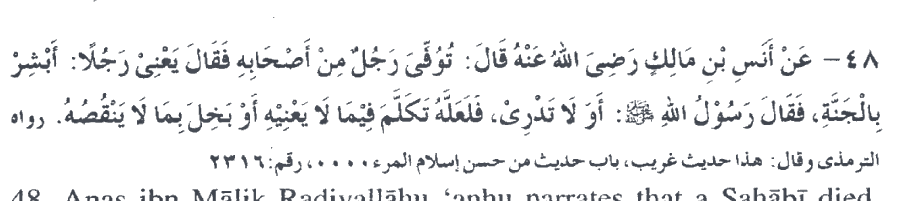
Translation: 48. Anas ibn Malik Radiyallahu 'anhu narrates that a SahabT died, and a man said (addressing the dead): Glad tidings of Paradise to you. Rasulullah Sallallahu 4alaihi wasallam told him: How do you know? Perhaps he spoke something irrelevant or was miserly about something which would cause him no loss. (Tirmidhi)
Note: The meaning of this hadith is that, one should not dare to declare someone to be a man of Paradise; however due to his good deeds, one can be hopeful.
Translation: 49. Hassan ibne-'Atiyyah Rahimahullah says: Shaddad ibne-Aws Radiyallahu 'anhu was on a journey. He camped at a location and said to his slave: Bring the Sufra (the cloth spread on the ground for placing food to eat), to have some leisure, (Hassan says) It was surprising for me, then he said: Since I became Muslim, I never said any thing without thinking except for these words, so do not remember these words, but remember what I say now: I heard Rasfllullah ﷺ saying: When people start collecting treasure of gold and sil ver, then you make your treasure by these words: O Allah! I seek guidance, dutifultiess and firmness in every work, and the ability to express thankfulness on Your bounties, and the ability to devotedly worship You, and ask You for a clean heart (from idolatry and infidelity), and seek of You a truthful tongue, and beg for all the good in Your knowledge, and ask forgiveness from all sins in Your knowledge, and seek refuge of You from all evil in Your knowledge. Verily You have the knowledge of all the Unseen. (Musnad Ahmad)